
Every which way you look, the curse of identity politics and victim-hood is becoming even more rampant and poisonous in 21st century India. Literacy keeps growing, as does intolerance and prejudice towards other identities. The more we are integrating with the world, the more insular we seem to be becoming. The more we see of social and economic mobility, the more we see regressive behaviour based on faith and identity rather than reason and common sense. Says Naved Hameed, General Secretary, Movement for Empowerment of Muslims, “To be honest, communalism never ended in this country, though there is no doubt that there has been a lot of talk to end communalism at various levels. The Indian society and system is totally biased against Muslims and Dalits in particular”. For all you know, there might be an organisation called Movement for Empowerment of Hindus and its General Secretary will be as candid as Hamid. The only difference will be that he will say that Hindus are discriminated against in their own country because of vote bank politics.
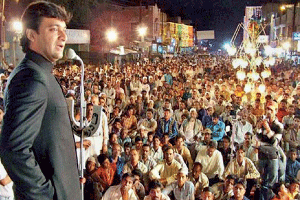
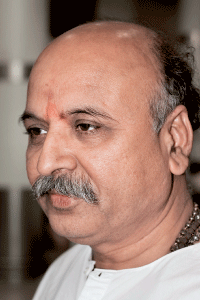
How did things come to such a sorry pass in India? How did secularism become an empty slogan and a term that everybody twists to score ideological points? Quite obviously, the principal blame lies with prejudiced Hindus and Muslims who seem to value faith more than national identity and pride. It is people like Akbaruddin Owaisi and Praveen Togadia who are responsible for spreading prejudice and hatred. But that is stating the obvious. The question to ask is: what caused people like Owaisi and Togadia to rise in prominence after India became an independent country?
 If you ignore pop analysis of the instant kind and do some serious historical soul searching, the past does provide some clues for the fragmented identity polity of contemporary times. You could even call it counter history since some icons appear in the firing line. In India, it is very hazardous now to point fingers at icons. Libraries are burnt down if there is even academic analysis of the great Shivaji. Dalits activists throw shoes and more at people who criticise BR Ambedkar.
People take to the streets and indulge in violence if someone targets the Dravidian icon Anna. Fawning Congressmen react angrily and aggressively if there is any criticism of the Nehru-Gandhi family. The list is now becoming longer and longer. And yet the behaviour of some icons do need to be examined and some deeply held beliefs must be reexamined if we are serious about the reasons behind the rise and rise of malevolent identity politics.
The headline of this feature talks about 1951 and 1986 to be the blunder years. It is events and decisions during these two years that have played a very large role in not only encouraging identity politics, but also creating communal divides. This historical blotch is sad enough. Even more sad is the fact that the blunders were committed by leaders who were enormously popular and virtually unchallenged in their sway over popular sentiments when they took the fateful decisions. We are talking about Jawaharlal Nehru in 1951 and his grandson Rajiv Gandhi in 1986.
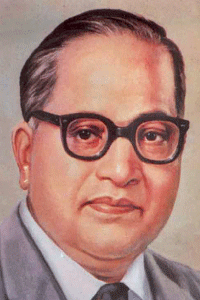
 Readers with even rudimentary knowledge of history will know that soon after independence, a Constituent Assembly was created to create a new Constitution of India. Even as the Assembly debated and argued over the future of India, Jawaharlal Nehru as prime minister coped as well as he could in leading a country ravaged by partition and communal bloodbath. History buffs will also know that Nehru, though immensely popular, was not unchallenged. Sardar Vallabhbhai Patel was an equally towering leader and not always in agreement with Nehru’s world view and ideology. In 1950, Patel died and Nehru was, in a manner of speaking, the undisputed king. Meanwhile, the Constitution had been drafted and one of the lofty promises made in that document was to have a Uniform Civil Code for all citizens. Dr BR Ambedkar was the Union Law Minister and was aggressively pushing for that. Apprehensive that Muslims might feel insecure and think that their religious identity was being threatened, Nehru and a reluctant Ambedkar decided to first pass a modern civil code for the Hindu community. Quite obviously, right wing Hindu groups were violently opposed to the idea. It was also an open secret that India’s first President Dr Rajendra Prasad was not very excited about the idea. He did write to Nehru expressing his unhappiness with the proposed civil code for Hindus.
Let’s quote a few lines from India After Gandhi written by Ramchandra Guha, believed by many to be a definitive history of post Independence India: “Nehru chose not to challenge the President. In any case, the progress of the bill in the Provisional Parliament had been painfully slow…In the end, the session ended, the bill was virtually talked out and it lapsed. The man who was most hurt by this was the Law Minister Dr Ambedkar who had staked his reputation on the bill, meeting criticism and calumny with equal resolution. That Nehru had finally chosen to give in to the opposition pained him deeply. In October, 1951, he resigned from the Union Cabinet”.
Do remember, India was yet to conduct its first Lok Sabha elections that happened in 1952. As mentioned earlier, Nehru had virtually unquestioned authority as well as popularity. There are many who feel that it was only Nehru who had the stature and hold over public opinion to pass not just a civil code for Hindus, but a uniform civil code for the entire country as committed by the Constitution. Many scholars and analysts think that this one decision taken by Nehru, though hardly ever talked about, had repercussions whose effects are still being felt.
 “The driving force behind Baba Saheb’s insistence on passing the Hindu Code Bill was emancipation of women. But the Caste Hindus, including women, who deemed this move as an endeavour to attack the sanctity of Hinduism opposed this radical bill. In his robust defense to this Bill, Dr Ambedkar maintained that the ideals enshrined in it were derived from the Constitution of India, which is founded on liberty, equality and fraternity. Dr Ambedkar was so fed up with the opposition that he left Nehru’s cabinet. He said, “It (the Hindu Code Bill) was killed and buried, unwept and unsung”. Dr Ambedkar’s influence on women is still overt particularly in the Maharashtrian Buddhist women, who are not only empowered but frequently take apart the mainstream Feminist movement as the Brahmin Women Movement. “The repercussions of that failure still resonates,” says Ratnesh Katulkar who is an Ambedkarite activist and scholar at Dr Babasaheb Ambedkar National Institute of Social Sciences.
Nobody is suggesting here that Nehru was not secular in the true sense of the term. In fact, this historical blunder is testimony to a fact that even great leaders can go wrong. In any case, there are some who think that India was prejudiced against minorities even when Dr Ambedkar was pursuing a modern civil code for the Hindu community. Says Hamid, “If we talk about 1951, then a year ago in 1950, the government of India had passed a presidential decree barring Muslims and Christian Dalits from reservations in employment, education and legislature and that was the worst example of communal politics of exclusion”.
To be fair to Nehru, his surrender to right wing Hindu groups was temporary and a civil code for the Hindu community was indeed passed in two installments 1955 and 1956. But well meaning and reformist as the move was, it worked perversely to create new communal divides. There were many in India who became convinced that Nehru was imposing his own Western ideas of secularism and was pampering to Muslims and minorities at the cost of Hindus. You may disagree with it, but that sense of grievance and betrayal is still widely prevalent, particularly among those inclined towards the RSS ideology and world view.
Says Rakesh Sinha, director of the India Policy Foundation, “ Nehru with his fancy Western ideas of secularism is responsible for this divide. Divided on lines of caste and community, Hindus are a majority only in name. Only Semitic religions have majorities. It is unfortunate that Muslims of India gave more importance to Sharia than the Constitution that calls for a uniform civil code. The moment you talk about this, you are branded a communal. Then Acharya JB Kripalini was the biggest communalist because he had strongly objected to laws made separately for separate religious identities.”
So who is right, people like Hamid or people like Sinha? It is easy to say both are wrong; it is much tougher to deny the deep divide that exists. In fact, only the naive and the mentally challenged will assume that the politics of grievance based on identities has not existed in India since 1947. Says well known political analyst Suvrokamal Dutta, “The history of independent India began with identity politics. So politics of identity is nothing new. During the 1950s, Dr Ambedkar, Nehru, Patel and Abul Kalam Azad were iconic figures. Then identity politics centered around issues and personalities. With the passage of time, identity politics has become nasty and virulent”.
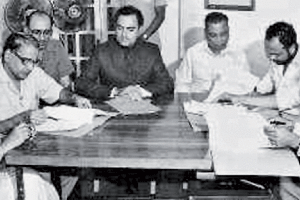
It was India’s good fortune that Nehru’s decision to first bow down to right wing Hindus and then conveniently ignore a commitment to a uniform civil code did not create divides that were so deep that they were divisive and destructive. By the early 1980s the issue of a Hindu – Muslim divide had been replaced by serious fears of a Hindu – Sikh divide. Political grievances of the Sikh community and some deeply cynical politics had degenerated into armed rebellion and terrorism. The assault on the Golden Temple in Amritsar, the assassination of Indira Gandhi and the subsequent genocide of innocent Sikhs – all in 1984 – had deeply scarred the psyche and soul of India. So when Rajiv Gandhi led the Congress party to an unprecedented majority in the Lok Sabha elections, a mandate that even his grandfather Nehru had not been given by the Indian voter. Rajiv Gandhi came as a whiff of fresh air in India’s decaying and hide bound polity. He talked of computes and technology, he talked of modernism and he talked of healing wounds. He even signed two historic peace accords with Sikh and Assamese groups. He represented new hope for a new India.
And then out of the blue fell yet another hammer blow of identity politics, the consequences of which are still being borne by India. This hammer blow has proven to be even more dangerous than the Nehru blunder of 1951. Says well known senior journalist SAH Rizvi, “1951 is not that significant but no doubt 1986 is very significant. 1986 was the turning point in the Indian politics. The then Prime Minister Rajiv Gandhi mishandled the Shah Bano case which resulted in the backlash of the Hindu community. Rajiv’s mishandling of Shah Bano case fueled the communalism and divided the whole of the cow belt on communal lines”.
What exactly did happen? In 1985, the Supreme Court ordered that an elderly Muslim woman named Shah Bano is entitled to maintenance after divorce. This was a historic judgement in many ways because it did what even Nehru had failed to do. It opened the doors for gender equality and empowerment in the Muslim community. Most well meaning Indians welcomed the verdict as a step in the right direction. But just as right wing Hindu groups had vehemently opposed empowerment of women in 1951, some right wing Muslim groups were vehement in their opposition to the Shah Bano verdict of the Supreme Court. In 1951, right wing Hindu groups had accused Ambedkar and Nehru of trying to destroy Hinduism. Right wing Muslim groups adopted the same posture in 1985 after the Shah Bano verdict.
 Quite predictably, there was a huge debate in and out of the Parliament. And sensible Indians from both Hindu and Muslim communities urged Rajiv Gandhi not to succumb to the pressure tactics applied by by some hide bound Muslims. There were arguments presented to show how even Islamic countries like Egypt and Indonesia had civil laws that empowered women and gave them more rights than Muslim women in India. A young Muslim leader from Uttar Pradesh and a minister in the Rajiv Gandhi cabinet, Arif Mohhamed Khan gave an impassioned and inspired speech in the Parliament defending the Shah Bano verdict. But to his dismay, advisors seemed to have already persuaded Rajiv Gandhi that accepting the Shah Bano verdict would turn the Muslim community against the Congress. Rajiv Gandhi used his brute majority in the Lok Sabha to pass a bill that effectively overturned the Supreme Court verdict and restored status quo. Arif Mohhamed Khan felt betrayed and resigned from the cabinet in February, 1986, just as Ambedkar had done in October, 1951. Both effectively ended their political careers after their brave acts of standing up to right wing pressure groups, though it would be childish to compare the political stature and legacy of Dr Ambedkar with that of Arif Mohammed Khan. The message was loud and clear for people who believed in genuine secularism. And within months of this monumental blunder, the magazine India Today did a cover story on the unprecedented rise and rise of the Vishwa Hindu Parishad. Hardly anybody had heard about the VHP before that.
We all know what happened after that. The most significant political development since then has been the rise and rise of BJP as a powerful force. When Parliament overturned the Supreme Court verdict on Shah Bano, the BJP had just two members and was not ruling any state. Atal Bihari Vajpayee and LK Advani must be secretly grateful to Rajiv Gandhi for so helping the BJP so dramatically change its fortunes in such a short span of time. While many think the rise of BJP is ultimately good for India as it challenges the Congress monopoly, everyone would agree that the communal divide that has emerged since 1986 is nothing but unfortunate and destructive of the very idea of India.
Could Nehru have done things any differently? Could Rajiv Gandhi? There are some who cite the example of Kemal Ataturk and Turkey in the aftermath of the First World War when the Turkish Caliphate completely collapsed. Ataturk used his stature, and his dictatorial powers to completely sideline Islam and create a secular nation state. That kind of approach might have worked in theory and looks idealistically nice. But it is doubtful if Nehru could have replicated Ataturk in a diverse and multi ethnic society like India.
But more important than history lessons and what if speculations is the future. What can India do to reverse this ever growing tide of grievance based identity politics? The answers will have to come from within the Hindu and Muslim communities. The fact of the matter is, the almost 170 million Muslims and almost a billion Hindus have to co-exist in India and have a shared past as well as a shared future. It is the future that is looking bleak at the moment.