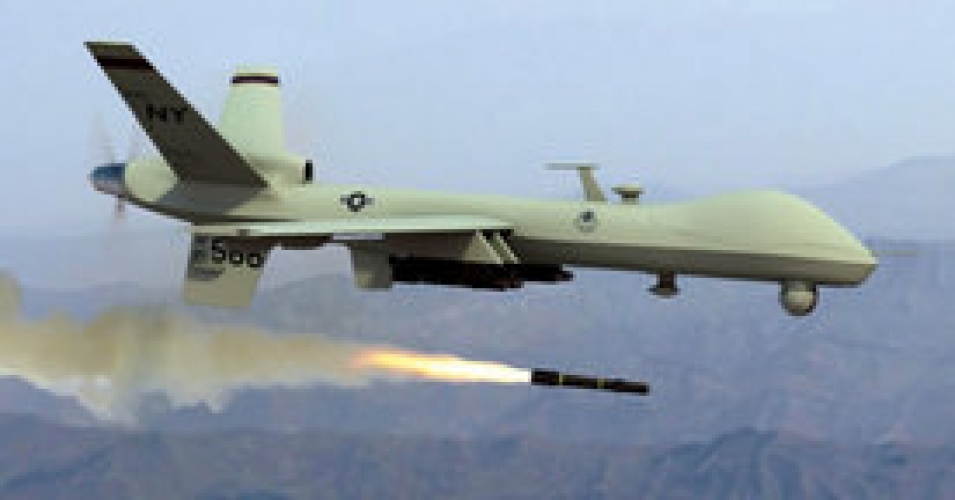
They say it hits with a warning. Only if you consider the constant humming sound that hits your eardrums everyday, a warning. In Waziristan’s non-polluting environment in the absence of industrial units and vehicular pollution, it is pretty much a hiss.
At lower altitude – and fraction of seconds before the missile hits – the hum turns into groan. It is not for nothing that locals, in their tongue, call it “whispering death”. The whisper here is also symbolic; a substantial part of the world’s population only talks about drones in whispers; and that too, only those people who know about it. The world of Predator drones is a murky collusion of silence, opacity and undisclosed complicity.
In October 2012, during my trip to Peshawar in Pakistan, I got the opportunity to meet for the first time people who have been directly affected by drone war in Pakistan; they are not exactly media’s most heard voices, either globally or in Pakistan’s elite English newspapers.
The survivors narrate a sordid tale of how drone war has turned from an attempt towards inflicting surgical strikes to a psychological warfare that takes enormous toll on the population.
 Ashfaqullah, a boy in his mid-teens, explains the everyday pressures that the drone culture has inflicted in the region. “You constantly hear the hum. It never stops. It’s like somebody watching your back. You feel threatened sitting with friends. It might be mistaken for a gathering and hit. You avoid any sudden movements. It has become a part of our life.”
Ashfaqullah and his friend Khalil Khan had witnessed the infamous drone attack in the town of Datta Khel that took place in March 2011 killing over 40 people and injuring scores more. A meeting between local businessmen and tribal elders of the area was convened in order to settle the dispute over an adjoining mine. The leaders had given a notice to the government officials detailing the meeting. However, in the late morning, a drone sent several missiles right in the middle of the gathering killing over 40 of them. The strewn body parts were barely sorted to give them a proper burial.
Datta Khel is by no means an exception. There are several organizations including The Long War Journal and The New America Foundation that have come up with figures of civilians killed. Although they vary dramatically, considering an unusually high level of secrecy that the American administration maintains over these attacks, it is expected that between 2,562 and 3,325 people were killed in Pakistan alone between June 2004 and September 2012, of which anything between 474 and 881 were civilians, including 176 children. The numbers of those injured is almost double of that.
What leads to such high civilian casualty? Experts suggest that there are two major factors involved here. The first, and possibly the deadliest, is the very perception of terrorist that drone operators have. In the case of “kill lists”, one is at least certain that a particular individual is being targeted. The CIA and the US military have prepared overlapping “kill lists” that is updated regularly. Insiders say that the military’s list is finalised during Pentagon-run inter agency meetings that is later approved by the White House. The final list go through White House counter-terror adviser, and the newly-announced CIA head, John Brennan to the President. President Obama is believed to sanction some of the most serious ones himself. But the attacks often deviate from these lists. These are called “Signature Strikes”.
Says Robert Naiman, Policy Director, Just Foreign Policy, “In the case of so-called ‘Signature Strike’, the assessment of whether or not the person is a terrorist is hazy at the best. Therefore, it is not uncommon to hit any gathering that appears to be a Taliban gathering. Very often, funerals and marriages have been wrongly targeted. These men are not on any list, not even the suspected list.”
The second reason is what experts call, “double trap”. In case a target is hit and there are civilian causalities who are not dead, the locals try to evacuate them for medical attention. However, in the “double trap” strike, a second hit follows, even while the evacuation is in process, killing more people. In fact, locals in Pakistan suggest that such is the fear of the second strike that at times injured are left unattended for hours, killing many of them.
Insiders who know how this war is being fought, claim that more often than not, the people who control drones consider every adult a potential suspect. With such a broad brush to play with, there is little surprise over mounting civilian casualties.
Former Secretary of Defence, Leon Panetta, in the past has not only called the drones “precise”, he also labeled it as “the only game in town” for the disintegrating al-Qaeda. That is a commonly-held view inside the US security apparatus. However, David Kilcullen, the celebrated key adviser of former US Army General David Petraeus, testified in front of the Congress, claiming: “Since 2006, we have killed 14 senior al-Qaeda leaders using drone strikes; in the same time period, we’ve killed 700 Pakistani civilians in the same area.” That roughly gives you a ration of 50 to 1. Talk of precision.
The natural question then is this: why go ahead with it? Experts sggest, there are many reasons.
“From a totally American perspective, I can think of three justifications. Drone strikes are less costly in terms of dollars. Second, drone strikes are less expensive in terms of lives lost. In the world of drone warfare, no one returns with post-traumatic stress, none back with missing limbs. Which leads me to my third justification—that drone strikes are less costly in terms of objections in the court of public opinion. Insulated by technology, the strikes appear to us—and more important, to those around the world—on our TV screens as little more than a scene from 24,” Mark McKinnon, the celebrated media adviser to many Republican big-shots once famously quipped.
Although McKinnon is a conservative, he has done some plain speaking as far as the drone war is concerned. I am not sure about the public opinion in the US, but the legal aspect of the entire drama has started catching up.
 Last week, the UN announced an inquiry into the use of armed drones for targeted killing. The announcement came through the London-based UN Special Rapporteur on Counter-Terrorism and Human Rights, Ben Emmerson. The inquiry is the result of direct requests made by several countries and bodies involved in the movement. The inquiry will examine over two dozen cases of drone strikes conducted in Pakistan, Palestine, Somalia, Yemen and other territories. The inquiry will specifically “look at the evidence that drone strikes and other forms of remote targeted killing have caused disproportionate civilian casualties in some instances, and to make recommendations concerning the duty of states to conduct thorough independent and impartial investigations to such allegations,” the report suggested.
This inquiry has followed an absolutely damning report last year by Stanford and New York universities’ law schools that was prepared based on interviews with victims, witnesses and local and international experts.
“Their presence terrorises men, women, and children, giving rise to anxiety and psychological trauma among civilian communities. Those living under the threat of drones have to live in the face constant worry that a deadly strike may occur any moment – and the knowledge that they are powerless to protect themselves,” the report says.
According to the report, “these fears have affected behaviour. The US practice of striking one area many times and evidence that it has killed rescuers, makes both community members and humanitarian workers afraid or unwilling to assist injured victims.”
However, none of this has deterred the CIA from carrying forward their agenda. If anything, it has only increased. And with Brennan at the helm of affairs at CIA, there is further chance of escalation. Brennan in 2011 had said that there was “no credible evidence” of civilian deaths from strikes. Such was the reaction to the statement that one expert quipped that either Brennan was a “fool or a liar.”
But the legal immunity that drones enjoy in the US has been baffling, to say the least. It has only emboldened the CIA to expand its reach to Northern Africa. Although the numbers there are not as outrageous as Pakistan, it has started to expand. Only this week, the US has set up its first drone base, in Niger, in order to carry on the war against what it termed as “al-Qaedah in the Islamic Maghreb”.
 Reacting to the news, former British diplomat and foreign policy expert, Craig Murray, who was dismissed from the British Foreign Service because of his refusal to assist CIA in its Extraordinary Rendition Prohran, quipped, “The problem is that there is no such thing as ‘al-Qaeda in the Islamic Maghreb’. The US seems to confuse al-Qaeda with Starbucks. al-Qaeda does not have branches everywhere, a highly organised supply chain, and transfer pricing. It is true that long standing ethnic militias in the Maghreb have adopted the styles and terminology of radical Islam, and have tenuous and occasional links with other radical Islamic leaderships. But their income and supplies come from unrelated activities – chiefly extortion and smuggling – which have been going on long before al-Qaeda existed. These groups are disparate. There is no connection between the group which took western oil workers hostage in Algeria, and the Tuareg militias who contolled Timbuktu.”
Such level-headed views notwithstanding, the US is all set to escalate its attacks. In the months to come, it will put it in collision course with the law. However, unless a worldwide opinion is formed against it , the US will continue using its as an alternative to the more complicated and costly, UNSC mandated boots on ground. Till the, the cowboys sitting with the joysticks in the control room will keep wishing ‘Happy Hunting’