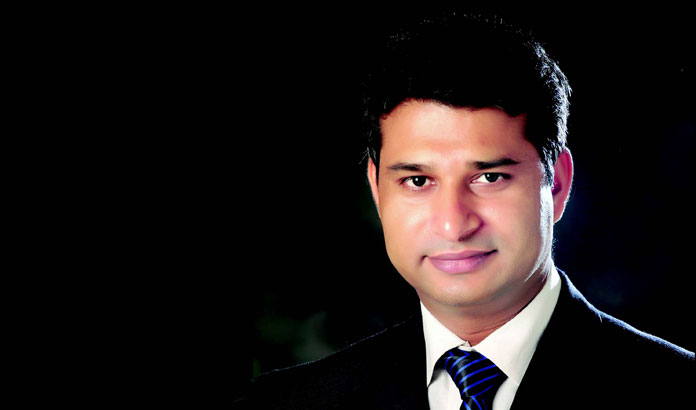
Q. What has been your journey like as an HR professional?
A. I started my professional journey with Salora International Limited, a consumer electronics company as a Management Trainee and grew to the position of HR Head within a short span of 5 years. My biggest challenge at Salora was to re-position HR as a business partner rather than just a transactional division. I was also entrusted with the task of entirely automating all routine HR functions and implementing ERP.
Later, I got an opportunity to work with Gillette – P&G one of the world’s most admired brand with world class people and world class products. I see it as very special opportunity where I worked closely with the sales team, customers and enforcement agencies on product integrity issues. It helped me to get a 360 degree view of the business, and its value chain. Indeed “A rare experience” which added to my experience pot.
From Gillette I moved to Huntsman, a speciality Chemical Business. The challenge before me was to acquire and integrate businesses. I led the complete acquisition and integration of CIBA speciality business. The second challenge was to transform the business and make it a profitable one. It is a fact that people deliver the business -business doesn’t deliver it -self. So, we launched a series of employee engagement initiatives, reward and recognition programs to build a culture of innovation and created a very strong, agile and responsive organisation. One of the key challenges that was addressed was the integration of two cultures & “Me” issues of the teams.
After a short stint at Polygenta Technology, I moved to Monnet Ispat and Energy. I was motivated by the large scale and the complexities of the business. My current role involves, working closely with the CMD and I am also involved in driving major organizational transformation initiatives, significant cost saving steps, building differentiated talent models, attracting and developing the best talent and building a culture of engagement, agility and innovation – in the process contributed significantly to improvement in top line and bottom-line. In fact, given my strong cross functional understanding and drive, I have been given the additional responsibility as interim Chief Marketing Offices where I lead the entire retail transformation and e-tailing strategy.
Q. What were the biggest challenges you faced?
A. As you grow professionally what seems a big challenge once gets dwarfed by newer and more complex issues to solve. However there are a few listed below which have left an indelible mark in my growth as a professional –
At Salora, I was given the opportunity to head the HR function. It was a difficult proposition to be accepted by those colleagues who were my seniors or had mentored me during my management trainee days. It is here, that I learnt a very valuable lesson that people will accept you when they trust you and see you as enabler and facilitator of their purpose. It is important as a professional to bring a distinctive value to the workplace and learning opportunities to the team. Therefore, I believe respect is the by-product of the value you add to the organisation and the people.
Another challenge I faced was at Huntsman when we set a very ambitious goal of 50% growth of top line and 50% growth of EBITA. As we all know that it is ultimately the people who achieve business goals and not business itself. As the Head of Human Resources and Change Management it was an imperative for me to create the HR infrastructure so that it could deliver its results. I took up the challenge and created strong employee engagements, facilitated goal setting and rolled out a robust reward and recognition program covering the entire spectrum of the business. As a result of this we superseded all the targets we had set for the year. It was an amazing learning to see how a strong employee engagement at the work place could transform the entire business.
The biggest challenge when I joined Monnet was of implementing policies that involved workforce optimization. My resilience and determination were truly tested at the time when the sales team needed to liquidate piled up inventory. I was given the charge to lead the sales team and increase retail market penetration. I simply focused on creating a warm and friendly environment and deployed two management tools – Motivation and Monitoring and soon the results were before everyone. We not only achieved the highest ever retails sales targets but my sales team felt a strong sense of achievement. What I learnt from this experience is that difficult objectives can be achieved by exercising the right balance between empowerment and control and that people deliver if you make them believe that ‘they can’.
In a business dependent on a large work force there is the constant threat of external elements wanting to destabilize the company for personal gains. Keeping workmen focussed on Monnet Mission & Goals via positive communication, counselling and coaching is a relentless task and which happens to be my tough daily challenge.
Q. What are the challenges HR faces in the new era of the ‘digital age’?
A. In today’s digital era the context is set by technology and with HR being a change agent it is imperative we embrace technology to enable business outcomes. Lots of job are becoming redundant – medium-skilled jobs have disappeared and are being replaced by technology, so there is either low-paid work or specialised high-paid work, with a huge emphasis on education and lifelong learning. This makes it imperative to build learning organisations which are agile and innovative.
Another important aspect of the digital era is that HR is now being driven by data and decisions are based on HR analytics. Hence HR professionals need to be well equipped with technology and use it for decision support and enhancement.
Q. Any advice you would like to give on how to manage people/teams as the workforce becomes more diverse, and the ways of working change?
A. India is a multicultural and multi ethnic country and equality is one of the core principles of our constitution. The cultural diversity has never been an issue for companies working in India. However, gender diversity is an issue. We see lesser women at the work places. They are mainly dominated by men. Researchers in the field of management have concluded that organisation should value diversity to enhance organisational effectiveness.
Organizations that fail to make appropriate changes to more successfully use and keep employees from different backgrounds can expect to suffer a significant competitive disadvantage compared to those that do. Alternatively, organizations which are quick to create an environment where all personnel can thrive will gain a competitive cost advantage over non-responsive or slowly responding companies.
Leadership support and genuine commitment to gender and cultural diversity is crucial. Top management commitment is crucial but not sufficient. Champions are also needed at lower organizational levels, especially key line managers. Continuous sensitisation programs are required to break the stereo types. I also suggest that a senior management committee do regular audit to uncover sources of potential bias.
As a leader must know when to exercise managerial courage and when to speak truth to the authority.
Q. How effective and how important are rewards and recognitions in strengthening employee engagement and retention?
A. Effective R&R programs transform the workplace into a game zone and create thrills and high sense of achievements. When people experience a high sense of achievement and thrill they become more engaged and productive.
The reward and recognition programmes should be designed in a manner that it helps to drive business performance, increase employee engagement, and ultimately, assist in attracting and retaining the best talent.
Recognition, programs also help in instilling a sense of achievement within the organisation. I believe when people feel a sense of