Y Gee Mahendra’s Paritchaikku Neramachu Stage Drama Photos
Merely six years or so ago, when the inaugural edition of Jaipur Literature Festival was held, no one, not even the optimistic organisers, would have thought that it would go on to become arguably the biggest literature event in Asia, if not the most serious one. And it is in its sheer size that lies both its attraction and repulsion. The sixth annual DSC Jaipur Literature Festival, in more ways than one, has added up on that reputation.
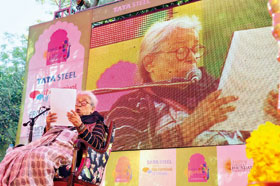
The 2013 edition of the DSC Jaipur Literature Festival was launched with a keynote speech by celebrated author and activist Mahasweta Devi. In her speech, she reflected upon her long career as an author and described how regional writing draws its inspiration from the rich world of ideas and incidents that mean so much to people who are not in the limelight. “The air I breathe is full of words,” she reflected, and I am sure no one in the crowd would have disagreed.
Speaking about thetribal and rural cultures from which she draws the inspiration of her writing, she maintained that a writer must deal with the “culture of the downtrodden” to get a proper grounding in literature. In fact, she proposed that the “right to dream” should be made the foremost fundamental right for all human beings.
In the keynote address, titled O to Live Again, Mahasweta Devi revealed, “My early years proved to be formative for my future work as a writer and activist. I also have a different approach to my writing process and I mull over the subjects in depth before setting out…”
The festival, down the years, has developed a clear pattern on which it pushes itself beyond the limit. There is a potent mixture of debates, readings, recitation and exchange of ideas. Normally, a topic is proposed and writers whose works have revolved around these topics are asked to strike a conversation, quite often, but not always, through a moderator.
The festival has the distinction of bringing together people with extreme and contrasting ideologies on a single stage to explore new ideas. And it has served the festival and the audience well in all these years. So you have “Godless Commies” rubbing shoulders with religious gurus and thinkers, and the spirited proponents of free market capitalism taking on leftists on a single stage.
This year, the festival explored themes as distinct as the history of miniature painting and war reporting, Sharia law and LGBT literature, the art and state of the Jewish novel, the 18th century sexual revolution, and the literature of 9/11.
Seperate sessions also focussed on the new writings in Latin America and among both Iranians in exile and the domestic Iranian readership. Domestically speaking, sessions focusing and critically analysing the economic prospects of India as well as on an exploration of the mixed legacy of the British Empire drew the biggest crowds. And, like most literature festivals worldwide these days, it had something to add to the much explored theme of the decline of America and the rise of China.
Some of the writers that attracted massive viewership included Commonwealth Prize winner Aminatta Forna from Sierra Leone, Booker Prize winner Howard Jacobson, and two Orange Prize winners Linda Grant and Madeline Miller. It also saw some of the most respected novelists in the Arab world, including Ahdaf Soueif and Tahar Ben Jalloun.
In spite of the threats from the Hindu right wing, quite a few Pakistani writers managed to attend and enthrall the audience, including Nadeem Aslam and Jamil Ahmad. From Latin America, Chilean writer Ariel Dorfman, the playwright known for the much appreciated work Death and the Maiden, carried the flag. No literature festival can function without some quintessential Brits. Here too, the audience got the taste of celebrated historical novelist Lawrence Norfolk, as well as three of Britain’s arguably most popular literary writers, Sebastian Faulks, Deborah Moggach and Zoe Heller, whose award-winning books have been mounted into critically acclaimed and intellectually layered cinematic adaptations such as Birdsong, The Exotic Marigold Hotel and Notes on a Scandal. On the poetry front, the audience had the chance to listen to some of the most prominent poets from Europe, including the highly acclaimed Simon Armitage and John Burnside. The session featuring Armitage drew an unparalleled crowd.
If the sessions on fiction writers and poets drew huge crowds, the sessions featuring the non-fiction writers and writings saw even bigger ones. And why shouldn’t it,considering this year’s edition featured as many as three winners of the Samuel Johnson Prize for non-fiction, Frank Dikkoter on Mao, Wade Davis on Everest and Orlando Figes on Stalin’s purges? On the other hand, Pulitzer winner Andrew Solomon enthralled the audience on his acclaimed new book, Far From the Tree.
For public consumption, the festival had Diana Eck from Harvard, whose book India: A Sacred Geography has caught the nation’s imagination. On the other hand, philosopher Michael Sandel brought his immensely popular BBC Radio 4 series, The Public Philosopher.
If Harvard sent its best bet forward, then Columbia was not far behind. The audience enjoyed the session of the much-appreciated post-colonial and post-modern literary critic Gayatri Chakravorty Spivak. Rivals Oxford too sent one of the most potent weapon from its arsenal; acclaimed authority on Eastern Europe, Timothy Garton Ash and the Shakesperean Christopher Ricks. On the arts front, the conversation between Anish Kapoor, Marc Quinn and William Kentridge left the audience clamouring for more.
The more nuanced among the readers particularly loved the sessions by Elif Batuman of the New Yorker and Ian Buruma of the New York Review of Books.
Another session that drew an enthusiastic audience was the one featuring Sebastian Faulks, who wrote the latest book in the James Bond franchise, Devil May Care, and Ian Fleming’s biographer Andrew Lycett. This session, hovering around the life and times of Fleming and the inspiration behind James Bond, helped the readers to look into the world of world’s best loved spy. It was interesting to note how Fleming drew heavily from his own experiences as a spy during the World War II and those of his seniors to create the character of James Bond. To that extent, it would not be an exaggeration to say that James Bond was basically a composite of what Fleming and his senior spooks were in their private spheres.
An interesting session, titled Beyond the Khyber: Future of Afghanistan, explored the situation that will arise from the withdrawal of Western troops from Afghanistan next year after another failed intervention. Leading experts on Afghanistan, Edward Girardet, Jason Burke, the South Asia bureau chief of The Guardian, and Lucy Morgan Edwards, activist and journalist, all of whom have covered the country for many years, put forward some interesting concepts that will come into play. Moderated by journalist and author Faisal Devji, the session sadly was poorly attended considering the perpetually escapist Indians decided to seek solace in the spiritual mumbo-jumbo of the Dalai Lama, who is increasingly making less sense these days, than listening to an issue that is going to hit them in the face pretty soon.
Contrary to popular opinion, both Jason Burke and Edward Girardet thought pretty poorly of India’s so- called influence in Afghanistan. In fact, Burke was categorical in explaining that India’s influence in Afghan affairs post-withdrawal was minimal and that the biggest influence India has in Afghanistan is in the form of Shahrukh Khan. Beyond the realm of soft power, there is pretty little that India has on display beyond the Khyber.
In another session, interestingly titled Dispatches, and attended mostly by journalists, four celebrated war correspondents described the life of the journalist in a war zone, and talked about how such experiences can be transformed into works of literature. Jason Burke, author of the acclaimed 9/11 Wars, Anjan Sunderam, author of the eagerly-anticipated Stringer, Lucy Morgan Edwards, author of The Afghan SolutionandEdward Giradet, author of Killing the Cranes, opened their hearts out before the audience in Jaipur.
Another session, The Decline of America: Westerners and Resterners, explored the theme proposed by Edward Luce in his new book, Time To Start Thinking: America and the Spectre of Decline, where he had argued that the US faces a world of rising new countries that will compete with it fiercely as its own power will decline. Ian Buruma, Peter Hessler and Frank Savage, the author of The Savage Way, analysed Luce’s ideas in conversation with the author. It was generally argued that in order to slow down and plug this steady leakage of power, the US must change course internationally and, more importantly, domestically.
Like in the past, the sessions throughout the day were followed by some enthralling musical performances in the evening. While Susheela Raman and her unique half-London, half-Rajasthani band featuring Kutle Khan, Nathoo Solanki and Sam Mills jammed with Mian Miri Qawwals; participants from the Indian edition of Coke Studio brought the best from the world of fusion. However, it was the Chicago Children’s Choir that stole the show hands down. Founded in 1956 during the Civil Rights Movement, Chicago Children’s Choir is a multiracial, multicultural choral music education organisation that has performed far and wide, both inside and outside the United States.
However, like in the past, the festival was not without its share of controversies. A clearly ill-considered and, in many ways stereotypical, comment made by India’s leading public intellectual, Ashish Nandy, ruffled quite a few feathers and then some. Similarly, the threat held out by the Hindu right wing prompted the much-loved Pakistani writer, Muhammad Hanif, to give the event a miss.
Also, it will not be an exaggeration to say that after years of operating on a single pattern, the festival has started to appear a tad laboured. More often than not, the topics are decided as per the participation of the authors and that makes these topics repetitive. For example, in almost every edition in the last few years, the festival has explored the themes of the art of short stories, the art of poetry and reportage as literature. The lack of freshness is becoming evident and stark.
On the management front, it can be safely said that this year’s edition was probably the most well managed one considering how crowd control measures were put in place. However, putting a nominal price on the tickets as opposed to making them free, as it is now, will go a long way in screening elements with nuisance value.
The line between a serious event and a tamasha is so fine in India that one does not even realise when one has crossed that boundary. Sadly, lately the festival appears to have drifted towards the other end.
The organisers will do well in shedding the flab the event is beginning to acquire. They can start with doing away with all the cliches that tend to stereotype India. Nothing will please me more than seeing the turbaned, mustachioed, bagpipe player and the fire-eaters vanish with the camels and elephants.


 Merely six years or so ago, when the inaugural edition of Jaipur Literature Festival was held, no one, not even the optimistic organisers, would have thought that it would go on to become arguably the biggest literature event in Asia, if not the most serious one. And it is in its sheer size that lies both its attraction and repulsion. The sixth annual DSC Jaipur Literature Festival, in more ways than one, has added up on that reputation.
 If the sessions on fiction writers and poets drew huge crowds, the sessions featuring the non-fiction writers and writings saw even bigger ones. And why shouldn’t it,considering this year’s edition featured as many as three winners of the Samuel Johnson Prize for non-fiction, Frank Dikkoter on Mao, Wade Davis on Everest and Orlando Figes on Stalin’s purges? On the other hand, Pulitzer winner Andrew Solomon enthralled the audience on his acclaimed new book, Far From the Tree.
 Contrary to popular opinion, both Jason Burke and Edward Girardet thought pretty poorly of India’s so- called influence in Afghanistan. In fact, Burke was categorical in explaining that India’s influence in Afghan affairs post-withdrawal was minimal and that the biggest influence India has in Afghanistan is in the form of Shahrukh Khan. Beyond the realm of soft power, there is pretty little that India has on display beyond the Khyber.
 However, like in the past, the festival was not without its share of controversies. A clearly ill-considered and, in many ways stereotypical, comment made by India’s leading public intellectual, Ashish Nandy, ruffled quite a few feathers and then some. Similarly, the threat held out by the Hindu right wing prompted the much-loved Pakistani writer, Muhammad Hanif, to give the event a miss.