
 The year 2013 is set to be an interesting year for the Indian retail sector. Despite the background of global financial uncertainty, the easing of FDI legislation looks likely to give the sector a shot in the arm.
With government signing off 51% FDI in multi-brand retail and 100% FDI in single brand retail two things are likely to happen. Firstly, multinationals are expected to follow the lead of IKEA by entering the market. If, as expected, the Swedish furniture retailer is granted permission to follow their global retail model rather than having to dilute their offer to meet the exacting criteria of “single” brand, market entry will look even more appealing. Secondly, in response to global entrants, domestic retailers are likely to begin – or at least should begin – the process of raising their game so that they can compete against the arrival of long awaited, much hyped retail brands. India’s consumers, particularly its younger demographic, are passionate about new experiences and brands – “New” plays out well in India. Retailers cannot rest on their laurels, because standing still in a rapidly developing and fast growing market like India is dangerous.
Indian retail: From simple to splintered
So, given this scenario, progression is a must in 2013 and the first area to address is the customer journey or experience. Globally, FITCH has concluded that rather than simple, the customer journey is now splintered. In the past there were shops and the journey was physical and linear, but the Internet and new technologies mean that the journey is now dynamic and more complex.
India is still heavily reliant on bricks and mortar but inevitably on-line shopping channels will begin to play a greater role. The only difference is likely to be that, unlike in the West, there will be a leap and it will be smartphones rather than the PC that will drive e-commerce growth. While this sounds some way off in India, here at FITCH, we are already working with a number of savvy local retailers who understand that the Internet is set to become a major influence on their brands and business models. These retailers are thinking like start-ups by embracing the opportunity to think differently and challenge preconceived thinking.
It is possible for Indian retail brands to influence the consumer across multiple stages of the shopping journey since it is no longer confined to a store but encompasses in-store, on-line and out-of-store. Winners will be the brands that can take this splintered experience and make it coherent and seamless.
 Retail is a state of mind
FITCH has carried out a global study, looking at current attitudes to shopping in the US, UK, UAE and the BRIC economies.
FITCH concluded that there are three customer mindstates that remain relevant across geographies, typologies, income and socio-economic groups and retail categories. Those states are Dreaming, Exploring and Locating. Customers switch between these states throughout the customer journey. Our findings provide India’s retailers with real direction.
Dreaming is when a shopper looks for ideas and inspiration. They want to explore across categories and brands to find inspiration, learn something new and have fun. Exploring is when the shopper already has category specific purchase intent, but is still open to suggestions and is willing to be influenced. Further, ease of browsing and access to information help the shopper narrow down choices.
In the Locating mindstate, the shopper is looking for specific and pre-selected brands, products or services. They want to find things easily and welcome timely and relevant reminders, reassurance is crucial.
Inspire me!
FITCH found that the 31-year-old Indian woman fashion shopper is the happiest shopper in the world. 85% of shoppers in the lower income bracket are happy with their typical fashion retail experience. This figure rises to an astonishing 93% within the upper income bracket. Indians are also far more upbeat about the less glamorous category of Grocery than their counterparts in the West. Indian consumers enjoy shopping but more can be done to influence their buying behaviour.
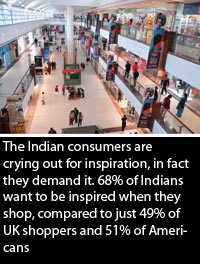
The Indian consumer are crying out for inspiration, in fact they demand it. 68% of Indians want to be inspired when they shop, compared to just 49% of UK shoppers and 51% of Americans. This is a compelling statistic that provides brands with an opportunity to create real differentiation and a more meaningful shopping experience through tools such as story telling. This applies to retailers and product brands, whether you are an organised host retailer or an FMCG brand competing on a crowded, unorganised shelf, engaging stories cut through and make connections.
The emphasis here should be on “differentiation”; within the retail sector it is too easy for brands to follow apparent category conventions and established rules of the sector. This approach only leads to duplication and more clutter. India’s retail brands are perhaps freer than they realise to create new and persuasive experiences in-store and on-shelf; India’s consumer is ready to embrace them.
In order to break free of calcified thinking, brands need to understand what makes them different and understand why a consumer would pick their brand over another. Once this has been identified brands should be bold and confident enough to develop decisive design concepts that encapsulate what we at FITCH call a Big Idea, or a creative platform that guides design development and evaluates how it delivers against the brand’s promise.
Looking forward
India’s recently splintered customer journey offers retailers a great opportunity to re-engage with the shopper across multiple shopping channels, including the Internet. The key is ensuring that, for the customer, the journey is seamless, not splintered.
In India the real goal is helping consumers Dream and Explore. Communicating effectively, and indeed seamlessly, across these new shopping channels is a must. But, in addition to this, retailers must also look to create an emotional connection with our shoppers who are so hungry for a Dreaming-rich experience. Retailers could do worse than ask themselves two core questions. What am I doing to inspire those that are Dreaming? And, What am I doing to engage those who are Exploring?
There are few barriers in place; the only real barrier is clarity of thinking and the ability to reconsider the traditional customer journey. Those that are disciplined enough to address those two questions, by exploring the mindstates of their customers so that they deliver physical and digital touchpoints that meet consumer needs and desires are likely to be rewarded. The Indian consumer is ready, 2013 will show us whether India’s retail sector is ready.
Looking forward
India’s recently splintered customer journey offers retailers a great opportunity to re-engage with the shopper across multiple shopping channels, including the Internet. The key is ensuring that, for the customer, the journey is seamless, not splintered.
In India the real goal is helping consumers Dream and Explore. Communicating effectively, and indeed seamlessly, across these new shopping channels is a must. But, in addition to this, retailers must also look to create an emotional connection with our shoppers who are so hungry for a Dreaming-rich experience. Retailers could do worse than ask themselves two core questions. What am I doing to inspire those that are Dreaming? And, What am I doing to engage those who are Exploring?
There are few barriers in place; the only real barrier is clarity of thinking and the ability to reconsider the traditional customer journey. Those that are disciplined enough to address those two questions, by exploring the mindstates of their customers so that they deliver physical and digital touchpoints that meet consumer needs and desires are likely to be rewarded. The Indian consumer is ready, 2013 will show us whether India’s retail sector is ready.