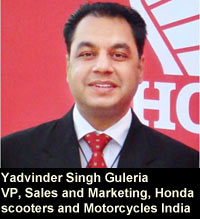
 Honda has a new technical center at Manesar. What’s special about this facility and what benefits will it provide to Honda scooters and motorcycles?
This is the first Honda technical center globally to be under one roof, which operates the DEBQ technology. DEBQ stands for Development, Engineering, Buyers & Bought-out parts (bop) and Quality. The basic objective of this plant is to increase the frequency of new product launches. In minimal time, we are able to launch new products in the market. With the help of this technical center we would be able to understand the need of the local market and customers. In this technical center we have involved our local suppliers and vendors. This will enable us to improve the quality of spare parts to a world-class level. And we would be able to lower down the cost of parts with the help of this new facility.
You have introduced Honda Eco-technology in your three scooters- Aviator, Activa & Dio. Can you tell us what this technology is all about? Will it help to differentiate your scooters from those of your competitors?
Honda Eco-technology, for which we have filed for a patent, has helped to improve the friction and the overall efficiency of the vehicle, besides reducing combustion. More than 100 parts have been changed in the 110cc engine with the help of this technology. It will also help to reduce the weight of the critical components. The use of this technology has helped us to increase the efficiency of our scooters by 11% and now our scooters give 60 kms to a litre. This mileage is a benchmark for scooters around the world. In India, customers have a mindset that the 60 kmpl mileage comes only with motorcycles. But now our scooters have joined the league, which gives us a distinct advantage vis-à-vis the competition. For example, suppose there is customer who rides 24,000 kms in two years. That is equivalent to driving 1,000 kms/monthly. In case he drives one of our scooters he would be able to save Rs.4,000 a year.
Fiscal 2012-13 proved to be a tough one for the two wheeler industry. How did Honda fare? What are your plans for the future?
FY-13 has been good for us. However, the industry has been in the grip of negative sentiment on account of the persisting economic slowdown. In the motorcycle segment there was no growth. The overall two-wheeler industry grew by 4-5%. But Honda managed to perform well and has achieved 37% overall growth. Out of this the contribution from motorcycles is much higher – about 54% growth was achieved in the segment last year. In case of scooters we have grown 24%. We will be able to perform well in the future as well as we plan to launch a new product every quarter. We would also continue to focus on improving the mileage of our vehicles.
What is the secret sauce that is helping HMSI drive sales and push growth?
Our operations in India as well as globally are based on the 4S concept, i.e Sales, Service, Spares & Safety. The 4S concept allows walk-in customers to see Honda motorbikes on display and experience the after-sales facilities offered. Also, customer satisfaction remains the top priority. In our effort to become the one-stop motorbike centre of choice, we have embraced the 4S concept to further drive our objective of providing consistently high standard products and best-in-class services. This can be experienced at our 4S centres, which feature a comfortable customer lounge, fully-equipped service station and ample parking space.