 Trends at mobile world congress 2013
The Mobile World Congress, the world’s premiere mobile event, known for showcasing the latest innovations in the mobile ecosystem, was held this year from February 25-28. Over the course of the event held in Barcelona, Spain, more than 72,000 attendees from 200 countries to showcased the latest in mobile technology. The clear themes and trends to emerge this year are the focus on differentiation, user experience and the need for innovation and competition in the marketplace. Sony, ZTE, Huawei and Nokia were among the big companies who had new devices to show. Samsung showcased its 8-inch Galaxy Note – which engendered much buzz in the tech press. Asus’s 7-inch Fonepad also reflected the new trend towards enormous mobile phones, which is pushing the boundaries between tablet and phone even further. Among other players, LG outed a few handsets, HTC’s One made its first public appearance and Firefox OS made a grand entrance with additions to the new platform from a few different handset makers, including Sony and LG.
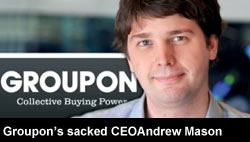 Facing mounting losses, GROUPON FIRES ITS FOUNDER CEO
Groupon, the group buying website founded four years ago and dubbed the world’s fastest growing company and valued at $13 billion (£10 billion) by 2011, fired its quirky founder and CEO Andrew Mason amid worries that people are tiring of the myriad of online restaurant, spa and Botox deals that Groupon built its business on. Groupon Inc. makes money by taking a cut from the online deals it offers on a variety of goods and services. Investors have questioned whether that business model is sustainable and leads to growth over the long term – and whether the company can not only grow its customer base but make more from each subscriber. The company once hailed as the fastest-growing startup in history rose to prominence in 2010 as the demand for sharply discounted online coupons for everything from neighbourhood car washes to spa treatments peaked. But the loss-making company is now valued at $3 billion and the founder – once heralded as a star on the cover of Forbes magazine but more recently described by analysts as a “goofball” – became a liability.
FACEBOOK BUYS MICROSOFT’S AD PLATFORM
Facebook has bought the advertising management and measurement platform Atlas from Microsoft for an undisclosed sum. Buying off Atlas shows Facebook’s renewed focus on competing with Google by growing its advertising business. In a statement, the company said Atlas would give advertisers a better idea of how their campaigns were doing and would “help advertisers compare their Facebook campaigns to the rest of their ad spending across the web on desktop and mobile.” Facebook says Atlas is already in use by many advertisers on the site, but the company is planning to build out both its measurement systems and its user interface. As Facebook works to monetize its system, integrating Atlas will become particularly important – despite fast growth, it’s been hard to find good metrics on how well its ads actually work.
 READER’S DIGEST in a soup
New York based Reader’s Digest parent RDA Holding Co. has filed for a pre-negotiated Chapter 11 bankruptcy plan, which it hopes will help it to convert about $465 million of its debt into equity held by its creditors. Its international operations are not part of the filing. It is the second time the company filed for bankruptcy protection since 2009. But despite emerging from bankruptcy as a smaller company with less debt the company has still continued to struggle since then. Its business plan and financial forecasts did not adequately account for the steep declines that the media industry has suffered over the last few years. Reader’s Digest paid circulation fell 0.6 percent to 5.5 million at the end of last year, according to the circulation-tracking company Alliance for Audited Media. According to RDA Holdings, the company will keep publishing the magazine during the bankruptcy, and aims to be out of Chapter 11 within six months.
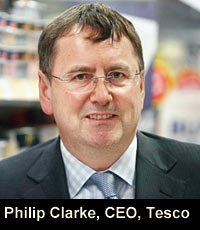 TESCO‘s image makeover
In response to horse meat being found in some of its meat products, British supermarket retailer Tesco has created a new Food News website with the aim to demystify its food supply chain and allay consumer misgivings about its food products. The website offers details of the testing of its food provenance and has a number of lofty pledges such as “We’ll put in place better controls” and “We’ll bring food closer to home.” Nearly £300 million has been wiped off the value of Tesco after a number of its burgers were found to contain horse meat. The products were made at two plants in Ireland and one in the UK and were sold by a number of retailers including Tesco. The retailer says it does not know exactly how many of its burgers were contaminated or how many it has withdrawn from sale since the scandal broke out in January.
 How much AD MOOLAH will ipl6 rake in?
Advertising rates for the sixth edition of the Indian Premier League, which will run from April 3 to May 26, are down to Rs 4-4.5 lakh per ten seconds. Last year, during the final stages, the broadcasters were charging Rs.10 lakh for a ten second ad slot. But despite declining ratings and public interest in IPL, attempts are being made to match the on-air revenue generated by IPL-4 and to exceed the targets of IPL-5. For IPL-4, the best in terms of on-air revenues, the broadcaster clocked a little over Rs.1,000 crore. For the IPL-5 season, the figures reportedly came down to Rs.750 crore or so. With 76 games in IPL6, the broadcaster Multi Screen Media is looking to earn Rs.950 crore as advertising revenue. With 10 lead sponsors, the channel hopes to lock in Rs.400-500 crore. As the series kicks off, there will be other kinds of on-air associations, partnerships and spot buys, like for sixes and fours, run-outs, breaks and highlights, among others. The quest for high-value advertisers continues even for the teams. Franchises are looking for at least 40% increase in fees, but companies are not willing for a hike of more than 15-20%.
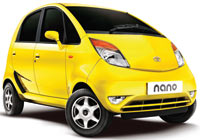 Tata’s INNOVATIVE FINANCE OFFER
It looks as if the automobile industry in India, which has lately been beset with a sharp slowdown in sales, is taking a leaf out of the fast moving consumer electronics business in a bid to spur sales. In an innovative selling method, the first of its kind for the automotive industry, Tata Motors has come out with an offer for customers to buy its Nano vehicle through a credit card, the same way a mobile phone or a laptop is bought. The company has partnered with five banks – Axis Bank, HSBC Bank, ICICI Bank, Kotak Mahindra Bank and Standard Chartered Bank – for the scheme. Customers in India, who have credit cards belonging to these banks can avail of this special scheme in 26 cities, across 75 Tata Motors Dealerships. Further, the offer also comes with an option that enables potential buyers to convert the entire amount in monthly instalments at no interest over a period of 12 months and at equated monthly instalments of Rs. 8,333 per lakh. The Tata Nano base model is priced at Rs.1.5 lakh (ex-showroom Mumbai) and the higher end is priced at about Rs 2.16 lakh. Whether this innovative offer will help push Nano sales remains to be seen but Tata Motors is clearly hoping that buyers will find the offer irresistible.
 PERNOD RICARD pips mallya’s USL
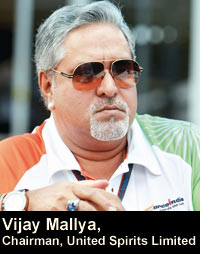
French firm Pernod Ricard, which owns brands like Absolut, Ballantine’s, Beefeater, Chivas Regal, Jacob’s Creek, Jameson, Kahlua, Royal Salute and Seagram’s, has overtaken Vijay Mallya’s United Spirits to become the most profitable spirits marketer in India last year. According to its financial results filed to the Registrar of Companies, its sales in 2011-12 crossed the $1billion mark, rising 34% to Rs.5,941 crore. On the other hand, its net profit soared 77% to Rs. 593 crore during the period. In comparison, United Spirits reported standalone sales of Rs.7,763 crore last fiscal with a net profit of Rs. 343 crore. On a consolidated basis, its sales during the fiscal 2012 stood at Rs.9,356 crore and net profit amounted to Rs.187.2 crore. Paris-headquartered Pernod Ricard is second to Diageo, which is in the process of acquring United Spirits from Mallya, in the global sweepstakes. Its 2011 revenue was at $11.09 billion compared to Diageo’s $17.28 billion but it claims leadership in the premium segment. That is also the reason for its growing profits in India where the trend towards premiumisation is driving the trend of up-trading from regular to premium IMFL.
 MEDIA INDUSTRY TO GROW 11.8% MOVEMENTS PAGE
The media and entertainment (M&E) industry is likely to grow at a marginally lower pace this year at 11.8% over 2012, and will touch Rs.91,700 crore, says a Ficci-KPMG report. Last year, the domestic M&E industry grew at 12.6% to Rs.82,000 crore from Rs. 72,800 crore the year before, said the report. The report is bullish about the future, saying the sector is poised to clip at a healthy CAGR of 15.2% to reach Rs.1,66,100 crore or Rs.1.67 trillion by 2017. Hoping to overcome the sluggish conditions of the past year, the industry is aiming to cash in on the impetus introduced by digitization, continued growth of regional media, upcoming elections, continued strength in the film sector and fast increasing new media businesses among other contributing factors. The report states that Radio is anticipated to see a spurt in growth at a CAGR of 16.6% in the 12th Plan period (2012-17), post the rollout of Phase 3 licensing. The report pointed out that total advertising spend across media was Rs.327.4 billion in 2012 but advertising declined 4% as it grew only 9% (2012) as against 13% (2012) and 17% (2010). Print advertising continues to be the largest beneficiary with a total advertising share of 46% of the advertising pie at Rs.150 billion, the report said.