 For a country that relies heavily on fossil fuels for its energy requirements, it is a matter of serious concern that successive governments have failed to reduce India’s dependence on imported fuel. Dwindling domestic coal production, an increasing dependence on imports and spiraling energy demand has had an adverse impact on the country’s already stressed energy infrastructure. The seriousness of the crisis was in full glare when the country faced its worst blackout ever in August last year. But instead of showing any improvement, the crisis, however, threatens to deepen further. India’s coal and gas producers admit that there is little scope for growth in output in the coming years.
With the energy sector coming under increasing duress, two recent decisions have served to turn the spotlight on a raging issue facing India’s power producers and the impact that these decisions could have on the power sector and the consuming public at large. Last month the Central Electricity Regulatory Commission (CERC) allowed Tata Power and Adani Power to hike electricity tariff in view of the rising cost of imported coal. The two companies had argued that with domestic coal production lagging demand, power utilities were left with little choice other than to bring in costlier coal, leading to higher costs of electricity generation. Coastal Gujarat Power Ltd, a wholly-owned subsidiary of Tata Power, had petitioned the CERC seeking relief on account of the unforeseen, uncontrollable and unprecedented escalation in the price of imported coal. The electricity regulator had earlier allowed Adani Power a tariff hike that it had sought for its 1,980-MW Mundra generation unit on similar grounds. Emboldened by these decisions, Reliance Power too has moved a petition seeking a tariff hike for its Sasan unit.
 No doubt, the decisions of the CERC will help private power producers to cut their losses. But at the same time, it has left the government in a delicate situation. In allowing private power producers to hike tariffs and its compulsions in protecting the interests of consumers, the government faces a policy dilemma that analysts believe is largely of its own making. Noted environmentalist and Director General of the Centre for Science and Environment Sunita Narain says the government has got its coal and gas policies totally wrong. “The country needs to go in for a transition to building and investing in gas-based power plants, just the way it was done in the case of CNG for vehicles in Delhi,” she argues. According to Narain, the country needs to follow the example of Delhi, where polluting, coal-based power plants have been closed down. Over the past few years, Delhi and its surrounding regions have invested in building gas-based power plants. Delhi has shut down its coal-based IP power plant and is waiting to close the Rajghat power station. It has built Pragati, Bawana and Rithala plants, which are gas-based. The combined installed capacity of these power plants is over 1,730 MW. In addition, the city is ready to invest in a plant of 700 MW at Bamnoli and is working to convert three units of the Badarpur power plant to gas. There is, however, a small hitch to building more gas-based power plants. “There is no gas to run these commissioned plants. The country, they say, has run out of gas!” says Narain. As with gas, coal too is in short supply, even though India’s coal reserves are among the largest in the world. But state-run monopoly Coal India has been unable to meet the growing demand. Even the government’s policy is not conducive to tapping the country’s coal potential. In a recent report, the CAG came down heavily on the questionable manner in which the government allotted coal mines to various private parties. A similar kind of policy dysfunction plagues the gas sector as well. This too has drawn flak from the CAG, which has criticised the government for its lop-sided hydrocarbon production sharing contracts. The government’s actions in the allotments of gas fields and the manner in which it allowed capital costs to be rigged to reduce revenue-sharing with government caused huge losses to the national exchequer, the CAG has reported. Many analysts also lay the blame on the government’s door for the low levels of gas production in the country. They argue that gas production is being allowed to be kept artificially low because it suits the interests of Reliance Industries, which wants gas prices to be hiked. There appears to be enough substance and weight in such opinion, or why else, if gas exploration prospects were bleak, would British oil major BP pick up a 30% stake in RIL’s gas blocks for $7.2 billion? For sometime now, Reliance and BP have been lobbying with the government to be allowed to sell gas at market rates.
Social activist and Aam Admi Party leader Arvind Kejriwal also finds fault with RIL and thinks it has been a recipient of undue favours granted by the government. “In 2006, Mani Shankar Aiyar was removed from the Petroleum ministry and Murli Deora was brought in so that RIL could increase the price of gas from $2.34 per mmBTU to $4.2 per mmBTU. In 2012, Jaipal Reddy was removed and Veerappa Moily brought in because RIL again wished to increase gas to $14.2 mmBTU, and to condone RIL’s excuses about falling gas production.” According to Kejriwal, RIL has been a beneficiary of huge government largesse over the last decade despite its violations of various agreements with the government. “Benefits given to RIL are among the reasons for causing a rise in gas prices,” he said.
While there is no dearth of opinion about whether price of gas ought to be increased or not, one thing is clear. The government has so far failed to apply the right policy decisions to crucial economic sectors like power, coal and oil & gas. This has led to a situation wherein these sectors have come to develop systemic ills that call for structural changes in policymaking. Former Union Power minister Suresh Prabhu says that applying second generation reforms and addressing fuel supply issues have become critical to solving the problems of the energy sector. Speaking to B&E, he said, “It is possible to fix most of the problems in a time-bound manner if we are keen to resolve them. However, unless we solve the fuel-related concerns, the country will face much bigger challenges in the future as the import bill will further increase and add to the country’s deficit.” Stressing on the need to prioritise efforts towards addressing the concerns of power sector, Prabhu says that India will “have to address the fuel issue, on both gas and coal, to improve fuel supplies and help stranded plants.” Power sector expert T.L. Shankar also believes that the government must address power sector issues on an urgent basis. “The losses of Discoms have gone up to over Rs.2,000 billion from Rs.410 billion in early 2000. If we had addressed this effectively, we would not have to face the current situation,” he said.
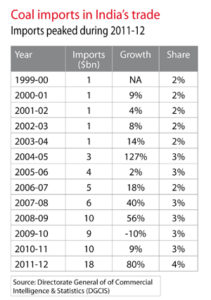 None of these issues is new or unique and policy mavens are only too well aware of the problems. The irony, however, is that little is being done to mitigate the consequences of policy mistakes. One good initiative that could have addressed most of these concerns was the Electricity Act of 2003. The Act was a progressive and reform-inducing legislation that came with several remedies for the ailing power sector in India. It encouraged private sector participation and sought to move the regulatory responsibilities from state governments to regulatory commissions. As a comprehensive piece of legislation, it introduced new concepts like power trading and open access. In introducing the legislation, Parliament announced that it “has progressive features and endeavours to strike the right balance given the current reality of the power sector in India.” Sadly, most of its policy prescriptions have not been implemented and remain stuck in limbo. Ten years since the legislation came into force, most of its proposals have not yet come out of the woodwork.
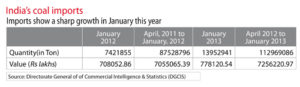 As a result of the policy inertia, the demand-supply gap for fuel is set to widen even further. For example the projected demand for coal at 981 MT and the projected domestic availability of 715 MT will leave a huge shortfall of 266 MT in 2016-17. If production is enhanced, the demand-availability gap would reduce to 186 MT. “This requirement would need to be met via imports, making power companies vulnerable to balance of payment problems. This impact could be more hard-hitting given the resource nationalization agenda being followed by the supplier countries leading to spiraling coal prices in the international market,” says former FICCI secretary general Rajiv Kumar. A report of the working group on coal and lignite for the formulation of the XII Five Year Plan estimates that coal-based generation in the terminal years 2016-17 of the XII Plan could be around 975 billion units. With thermal power accounting for 66% of the installed capacity, there will be a substantial increase in the use of washed coal and imported coal at power plants. As a result, coal requirement for the power sector works out to 682 MT (overall projected demand at 982.5 MT) in FY17. The report also points out that under the most optimistic scenario coal production may reach 795 MT in 2016-17, against the anticipated production of 551.9 MT at the end of the XI Plan in 2011-12. “This production is achievable only if the requisite clearances are fast-tracked and delivered within the specified time schedule. The issues affecting land acquisition, rehabilitation and resettlement, law and order, and evacuation infrastructure will also have to be addressed in a time-bound manner,” the report states.
Undoubtedly, coal imports are going to be India’s biggest challenge in the coming years. With demand set to accelerate further and production levels unlikely to keep pace, the dependence on imported coal will increase even more. With renewable energy still in its nascent stage, it’s time to rejig our existing policies to take on the current and emerging challenges.