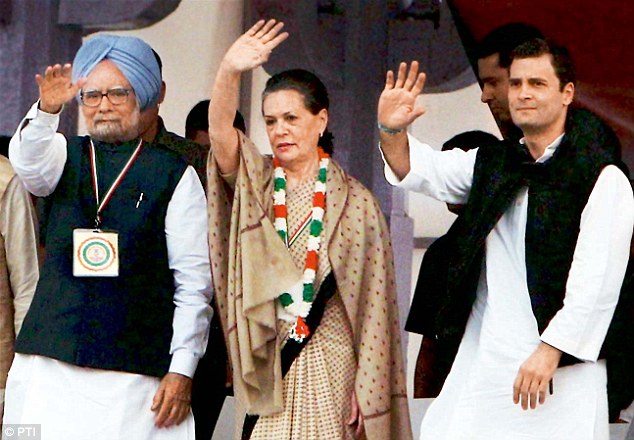
Three weeks ago, with yet another looming political crisis over the resignations of union ministers Pawan Bansal and Ashwini Kumar, an SOS message was sent from 10 Janpath to the Prime Ministers’ Office (PMO) which indicated that Madam Sonia wanted an urgent meeting with the prime minister. At the meeting, Congress president Sonia Gandhi indicated that Bansal’s resignation be accepted pronto and be forwarded to Rashtrapati Bhavan for completing formalities.
The next day, Congress general secretary Janardan Dwivedi convened a hurriedly-held press briefing at the party headquarters on 24 Akbar Road where he told reporters that “there were no differences between the party and the government’’. According to party insiders, Manmohan Singh despite the mountain of CBI evidence against Bansal, was keen to continue with the tainted minister – until his hands were forced.
Cut to the next scene. Rahul Gandhi holds a meeting of the Delhi Pradesh Congress Committee, keeping in view that the capital is going to polls later this year. There were voices of usual Congress dissent: one local leader held Sajjan Kumar responsible for the potential loss of votes in Delhi and Punjab. Another complainant blamed Delhi Chief Minister Sheila Dixit for promoting camps in the Delhi Congress. Rahul cut them short saying he was not going to tolerate dissent, asked them to get their acts together and issued a stern warning to all rebels: fall in line or else.
At yet another meeting to discuss UP, the party was divided into five zones, given the vastness of the state and keeping the 2014 general elections in view. When the names of members of these informal committees were made known, there was both shock and surprise. Most names were new or little known. Before the others could react, Rahul decided to use his veto. He said it was incumbent on state leaders to prepare jointly for elections.
In addition, there was a terse warning to the ever-warring UPCC; leaders found of deliberately sabotaging prospects would be dealt with sternly.
The three incidents, though unrelated, reveal that with crucial state elections in late 2013 and general elections next year, Sonia and Rahul are both keen to nip in the bud the party’s primary bane – infighting. In the case of Railway Minister Bansal, office bearers of the Chandigarh Congress Committee wrote several petitions to 10 Janpath alleging that his nephew was de facto running the railway ministry using his uncle’s clout. Party sources say that to begin with Sonia took these complaints as just another show of Congress dissidence. Union Information and Broadcasting Minister Manish Tewari was entrusted with the job of ascertaining the veracity of charges against Bansal. Tewari’s probe more or less confirmed what was being alleged. Armed with the CBI evidence, Sonia then took the view that party representatives from Chandigarh were in the right and from then on, the oust-Bansal momentum got a fillip.
When despite the signals, the prime minister did not yield, Sonia’s key aide Ahmed Patel had to sound out the PMO three times; yet it took a visit from Sonia herself to the South Block to underline the fact that the minister not going would hit the image of the party, already reeling under a slew of corruption charges beginning with the 2G scam. Sonia’s tough intervention paved the way for not just Bansal’s ouster but Ashwini Kumar’s removal as well. The way in which CP Joshi was hurriedly anointed railway minister had the unmistakable 10 Janpath stamp on it; party insiders say Manmohan Singh would hardly have moved with such speed.
 That the mother-son duo has things even more in their control than before is evidenced in a new line which is slowly but steadily emerging out of Congress headquarters: given the anti-Congress sentiment thanks to economic mismanagement by UPA 2, it may not be a bad idea to introduce totally new faces so that public anger be contained somewhat. That underlying philosophy seems to have been implemented in Karnataka in good earnest with the super fast selection of Sidharamiah as chief minister, by passing the time tested Congress tradition of the state observer talking with elected MLAs to choose a leader. The legislators were called in for a secret vote where Sidharamiah got the most support. Again, say party leaders, the Karnataka decision has the mark of Rahul Gandhi on it. In what appears to be a shift in tactics, other hopefuls like Mallikarjun Kharge never got a chance to lobby before a name was announced! Likewise, Congress spokespersons at 24 Akbar Road was changed at the last minute and in a jiffy while veteran leader Rashid Masood was appointed in charge of eight west UP districts against overwhelming opposition, both from within the state and at the centre.
Insiders say that the pace of developments have been so fast, that it is becoming difficult to say who is more powerful, Sonia Gandhi’s 10 Janpath or Rahul Gandhi’s office on Tughlaq Lane? The most interesting development – which has gone unnoticed so far – is the advent of old favourite Vincent George who is now acting as a liaison between the two power centres in the heart of Lutyen’s Delhi.
As far as the selection of candidates for the various impending elections are concerned, the super team under Rahul has already started work; names from the tehsil to city level have been, or are in the process of being, identified and the party is known to have adopted a ‘best of three’ system for zeroing in on a final name.
Involved in this opulent exercise are known Congress stalwarts like Jairam Ramesh, AK Anthony, Ghulam
Nabi Azad, Vishwijit Prithvijit Singh and a plethora of Congress general secretaries and secretaries.
In the case of UP, since the SP and BSP have already announced the names of their party candidates, it has made the Congress’s task more circumspect and the party is taking its time in finalizing names, giving ample indication that fresh faces are most likely to be inducted and old names can be utilised for campaigning.
But the latest burst of adrenalin provided by the Gandhi leadership has made it clear to party candidates that they would be better placed moving around in their constituencies than hanging around with party bosses trying to curry this or that favour. Crowds at various Congress offices have thinned down; veterans are advising prospective candidates to spend more time in their constituencies instead.