
It was the 1970s when magazines, tabloids and dailies across the globe – as if acting conspiratorially – bombarded the world with articles peddling the importance of brands. Brands were suddenly looked upon as a sure shot way, by companies, to get through the growing competition and rampant product proliferation. These intangible assets all at once achieved fame and were purported to be the lethal weapons that could bring unrivaled powers to a firm’s arsenal. Many, in fact, lived up to what was being expected out of them. For instance, brands such as Google, McDonald’s, WalMart, et al, have today virtually become the synonyms for their respective industries, thanks to their brand strength and to investments that went in to create such brands.
Somewhat similar was the story in India, a comparatively young nation which had finally started opening up to the rest of the world. In fact, if you were born in the seventies’ India there is no chance that you would have stayed away from the suddenly erupted fascination towards brands. There was hardly any reason of you not growing up with soft drink brands like ‘Campa Cola’, ‘Gold Spot – the zing thing’, or ‘RimZim’. While these drinks quenched your thirst, there were ‘Chandamama’ and ‘Indrajaal’ comics to fire your imagination. You could feel you mother’s love when she served you ‘Fryums’ and ‘Dippy’s Squash’, while you worked on your school assignment using ‘Hero’ pens filled with ‘Chelpark’ ink. Later, in your adolescence, you would surely have vroomed on a ‘Bajaj Chetak’ or a ‘Lambretta’ and licked a ‘Dollops’ ice-cream with your first love.
But as you continued your journey into adulthood, these and many other brands disappeared or fell by the wayside as dead brands. The only place for them now is the land of nostalgia. So, what happened? Weren’t they iconic brands with cult following? Weren’t they strong enough to stand the test of time?
The truth of the matter is that brand strength does not protect you: when market tastes change; when competitors develop more effective business models with which you struggle to compete; or when disruptive new technology displaces your product. Frankly, there is a danger that marketing executives cling to a big fat lie about the endurance of brand strength, which flies in the face of observations about what really happens. Agrees Nigel Piercy, Professor of Marketing at Warwick Business School, as he tells 4Ps B&M, “It is apparent that traditional strengths of brand-based competition may be increasingly questionable in 21st century markets. Having the most valuable brand in the world did not protect Coca-Cola from a change in drinking tastes across the world or an anti-US backlash in some areas. The strength and value of IBM’s branding did not protect it from Dell’s direct business model in the 1990s or competition from cloud computing right now.” The same thing happened with these brands. They died because of obsolescence, company mergers & acquisitions, product failures, category extinction and last but not the least-willful slaughter by the brand owners.
 Murders & Acquisitions
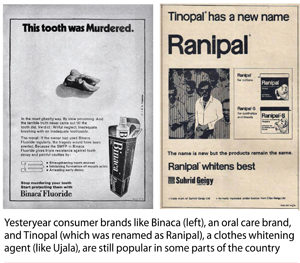
Mergers & Acquisitions (M&A) amongst companies is by far the most notorious culprit that causes brand death. When companies come together, the need to consolidate and streamline becomes a priority. There often isn’t room for multiple brand names, regardless of their legacy or brand equity. Each time a merger or acquisition occurs, a brand with a history, a significant market presence and a loyal following may disappear. For instance, when TOMCO (Tata Oil Mills Company) was acquired by HLL in 1993 many illustrious brands were pruned to suit the acquirer’s brand portfolio. As a consequence, soap brands like Jai, Moti and detergent bars like OK, 501 were consigned to an abrupt death. GM did the same with Daewoo car brands Cielo and Matiz. Internationally too this is an accepted norm with examples like Compaq getting butchered post acquisition by HP.
“Unfortunately a lot of companies that acquire brands don’t know what to do with them,” says Ramesh Chauhan, Chairman, Bisleri International, who, in 1994, sold five aerated-drink brands – Thums Up, Gold Spot, Limca, Citra and RimZim – to Coca-Cola, only to see them mostly being left to drift or die. In fact, Gold Spot was the most iconic Indian soft drink brand in India after Thumbs Up. It was “the zing thing” firing the imagination of the youth in the 70s and 80s and had some of the craziest commercials. Gold Spot was positioned as the “uncola“ and was the leading alternative to the Cola drinks, like Thumbs Up and Campa Cola during those days. But then, the acquirer showed no mercy. Despite the drink’s popularity, it was withdrawn from the market to make space for Coca Cola’s Fanta. Even Parle’s Citra met the same fate. Along with other Parle brands, this clear lemon and lime flavoured soda was sold to Coca-Cola in 1993 which phased it out by the year 2000 to make way for Coke’s international brand, Sprite.
Another case is point is Dalda, the iconic vanaspati brand that was the market leader till the 1980s. In 2003, when US agri and foods company Bunge bought Dalda from Hindustan Unilever for Rs.900 million, although the brand had travelled the arc from being the proxy for its product category to a marginal existence, it still had the capability to be back in the reckoning. But it couldn’t. It met the same fate as many of its counterparts. The reason was simple. Bunge was essentially a commodity player and lacked the marketing mindset to revive Dalda. No doubt, the company launched refined oil variants under Dalda, but it was too late. Result: Dalda now has a share of about 2% in refined oils. Although, in vanaspati, Dalda is still among the top brands with 12% share, the segment itself has shrunk significantly.
A much worse fate was met by Binaca, an oral care brand whose popularity in the 1970s and 1980s was next to that of only Colgate, and which was also a prefix to a much-loved All India Radio programme, Binaca Geetmala. Today, Binaca has faded to near oblivion. Dabur bought it from Reckitt Benckiser in 1996 – insiders say for “less than Rs.1 crore” – with the intention of reviving it to ride into the white toothpowder segment. Well, that never happened. Dabur’s excuse, “the category was stagnant and margins thin.”
 Complacency, the biggest enemy
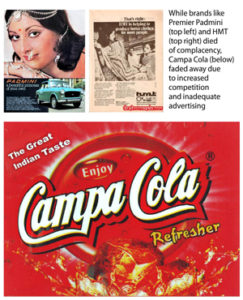
They say, “Complacency is one’s biggest enemy”, and that’s what exactly happened with the erstwhile leader in colour television – BPL. Originally known as British Physical Laboratories, the company started out with medical equipments and later tied up with the Japanese electronics major Sanyo for its electronics products. The flagship product was the colour television which took off with the Asian Games in Delhi, followed by the Olympics in 1984. The company benefited from investing in technology and brand. It outspent the competition, came out with superior products, built an extensive dealer network and became the leading brand of colour television in the country. In fact, in its heyday, the brand value of BPL was valued at Rs.1,400 crore – a trend-setting parameter which many Indian companies followed later. But within the next decade, the brand almost lost it all. So what went wrong? The reasons are numerous. The company bled heavily due to backward integration and diversification. Then, the Koreans and Japanese consumer electronic majors entered the Indian space. However, experts believe that its biggest fallacy lay in not recognising the possible threat from the Korean brands, Samsung and LG. As industry experts put, BPL believed that Japanese were the only threat, leading to a sense of complacency that hurt it quite bad. Further, BPL failed to take the consumer’s demand into account, leading to a dent in both market share and image over the years. “I think the greatest problem that successful companies face is ‘living in denial’. ‘It can’t happen to us’ is something most leaders of successful companies believe in. As a result, they are the last ones to recognise the problem, and often it can be too late,” says Ramanujam Sridhar, CEO, Brand-Comm, a Bangalore based integrated brand consultancy. Certainly, there is no room for complacency if you are positioned at the top.
Too slow to change
Be it any day and age, companies cannot afford to lag behind in technology and advancement. Those who are too slow to adapt to the changing environment lose the race in the long run. Ideal Jawa is one such case. Ideal Jawa, an Indian motorcycle company based in Mysore, started commercial production of motorcycles in 1961 in technical collaboration with Jawa of erstwhile Czechoslovakia. The company’s motorcycles were known for their ruggedness, loud noise and technology. Even in those days one could start the bike in any gear after pressing the clutch. It was because of these features that during the years 1961 to 1985 Ideal Jawa put up a good show and achieved amazing profitability levels. The peak capacity utilisation was 85% with 36,000 vehicles on a capacity of 42,000 vehicles per annum, a big number considering that owning a vehicle was considered to be a luxury in India of those days.
 Though the collaboration agreement with Jawa, for the availability of technical knowledge, ended in 1968, Ideal Jawa by that time had established an in-house expertise for achieving wholly indigenous manufacturing technology and had come up with an iconic product under the brand name of “Yezdi”, a product that enjoyed cult following for years. In fact, between 1960 and 1985 Yezdi motorcycles were a craze in India and were almost the official feature bike of Bollywood. The bike, which was based on the CZ 250 ridden by rider Jaroslav Falta to the runner-up spot in the 1974 motocross world championship, even won several rallies and road races in India. But then, if you aren’t relevant, you aren’t in business. A company can be highly differentiated and specialised, but if nobody is interested in its product, the company won’t make any money. That’s what happened with Yezdi. Although the main reason cited for the company’s collapse was labour trouble, it was the laziness on its part – not adapting to the changing times – that actually pushed it into oblivion. Increasing levels of pollution control norms made the two stroke bikes that the company produced obsolete. When the company was forced to shut down, it was producing the iconic Road Kings and CL II.
Don’t advertise, and perish!
Advertising in maturing markets is a question of building brand preferences. But in the growing Indian market, even recall can be a tough task, considering the plethora of brands in the fray. This was not the case with Hindustan Motors, the pioneer of India’s automobile revolution, when it rose to prominence from the 1950s to the early 1980s. Its Ambassador (Hindustan Motor’s pioneer product) was called “The King of Indian roads” at that time, despite being one of the lesser cherished legacies of the British Raj. There was an absence of both competition and the need for innovation, either in product or in marketing terms. Today, the car and the company are just about history. Of course, you can still see a lot of them being used by the politicians and bureaucrats, but the consumers have given it a rather undignified burial (as a brand in their perception set), long back.
The decline started almost instantaneously in 1983, when India’s greatest automotive success story till date first came to life in the form of the Maruti 800. Till then, Hindustan Motors was on a high trajectory. Since then, Ambassadors never made a comeback. The domestic sales for passenger cars in India between April to March, 2013 was 18,95,471 units. Hindustan Motors only managed to about 7,000 units. Maruti, in turn, sold a whopping 8,61,337 units in the same period. The brand has reportedly lost some 70% of net worth in the past few years. Had the company spent the past quarter of a century advertising its products well, the story would have been different. It could well have become an iconic brand. After Maruti became a success, Hindustan Motors could have still made a comeback by choosing the right mediums of advertising and creating a niche for themselves. After all, nostalgia is one of the most exhilarating marketing tools. Volkswagen’s Beetle has worked on nostalgia and consistently reinvented itself through focused advertising perception reinforcements.
 Another classic case of missing the advertising bus is of a homegrown cola brand. If you were born in the seventies there is no question of not growing up with this soft drink brand called Campa Cola. The cola drink, which was a market leader in most regions of India for a period spanning several years, was created by the Pure Drinks Group, a former Coke bottler after the exit of the cola multinational in the 1970s. Once described by Italian design great Luciano Benetton as the “best fake Coke” he’d ever tasted, Campa Cola died when Coke and Pepsi re-entered India in 1991. The reason is simple. Campa Cola didn’t pay much heed to advertising, while Coke and Pepsi were busy bombarding the Indian consumers with advertisements and promotional freebies.
Hence, whether it is declining sales, poor economic conditions or corporate mergers, brands will continue to die off, and some consumers will grieve their loss. But the question is: Isn’t reviving a dead brand a viable option? In a country where half the population was either not born, or was in diapers 25 years ago, reviving a nearly two decades-dead brand might not seem like a smart idea. But then these brands are not any other brand. They were icons of their time. And it makes complete sense to revive them as they have the propensity to rise from the ashes like a Phoenix and re-incarnate themselves. However, the resurrection can be in the same form or in another. Apparently, reintroducing dead brands is a legitimate business. “Exploiting the equity of dead or dying brands – sometimes called ghost brands, orphan brands or zombie brands – is a topic many consumer-products firms have wrestled with for years,” says consumer marketing journalist Rob Walker (“Can A Dead Brand Live Again?,” The New York Times, May 18, 2008).
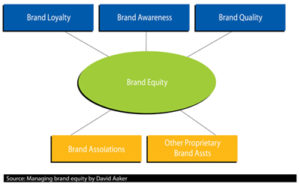
The reason is simple. These brands have mind share of the Indian consumer long before India became an over communicated market. Mind share means there is greater acceptability of these brands if launched. We are sure Coca-Cola would have gathered more market share if they re-introduced Gold Spot rather than launching Fanta in India. Sometimes dying or dead brands may still have significant brand equity in terms of high brand awareness and a strong brand image. In fact, it was this thinking that motivated Ford’s to revive its Taurus brand. Ford realised that instead of trying to use another brand name that meant little to the market, it would be better off using the Taurus brand name that had 90% name recognition and a positive image (as per an article titled “Ford Goes Back to the Future” by David Kiley in Business Week). Thus, shortly after its death, the Taurus was reborn. Considering this, even the cost of marketing would be much lower than marketing a totally new brand in an over-communicated market like India. As David Aaker in his book, Managing Brand Equity: Capitalizing on the value of a brand name, points out, “the revitalization of a brand is usually less costly and risky than introducing a new brand, which can cost tens of millions and will more likely fail than succeed.”
Further, these brands still invoke nostalgia for many of the household decision makers. As a young teenager they were exposed to the advertisements for brands like Gold Spot and BPL and will definitely be inclined to buy the same if it was available in the market.
Critics argue that, “Isn’t a dead brand evidence that the marketplace has simply moved on, and left that brand behind?” But then, there are brands that have come back to life, prominent examples being Mini Cooper, the Beetle, and of course, every revived Broadway show. Even in India there are examples of brands have been brought back from the ashes. For instance, Lifebuoy. A carbolic soap which had lost its sheen and was being used in office toilets, dhabas and other cost-conscious points, has once again emerged as a leading family bath soap.
Thus, brand revival is possible if it is targeted at and accepted by a new customer segment. For example, when video games were first introduced, it was targeted primarily at children. Now adults are leading users. Customers who grew up playing video games continue to do so and their numbers are increasing. Moreover, the brand should not only be able to deliver the perceived value to the TG, but also evoke nostalgia in the minds of the customer. So, Gold Spot or Campa Cola, what’s your bet?!