Bhutan, the tiny picturesque country sandwiched between Asian giants India and China, is unique in one respect. Unlike the comity of global nations, it judges itself by gross national happiness (GNH), the ultimate yardstick of the economic and mental well being of its people.
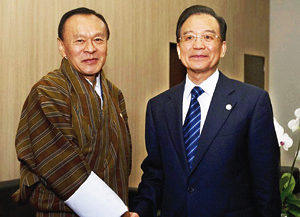
Lately and in the run to its general elections on July 13, there was something the matter with its GNH. The closest Indian ally in south Asia, Bhutan had done something that New Delhi could not believe. Former Bhutanese Prime Minister Jigmi Y Thinley’s meeting with the then Chinese Premier Wen Jiabao at an environmental summit in Brazil last year did not go down well in New Delhi. In addition, the Bhutan government also imported some 20 buses from China. Was it a sign that India was losing its grip on its most important ally in south Asia?
Even while the Thinley government played down his meeting with the Chinese leader, not everyone in New Delhi seemed convinced. Hardnosed South Block mandarins in New Delhi viewed the meeting as a shift in Thimpu’s foreign policy – a shift that appears to have been initiated at the instance of the elected Thinley government.
New Delhi and Thimphu have always shared a ‘special’ relationship enshrined in their treaty of friendship first signed in 1949 and revised in 2007. The revised treaty envisages both sides agreeing to ‘cooperate closely with each other on issues relating to their national interests’ instead of Bhutan being ‘guided’ by India ‘in regard to its external relations’. As part of this special relationship, Bhutan has over the decades been the biggest recipient of Indian aid. Thousands of Bhutanese study in India and New Delhi has helped build several hydro-power plants in Bhutan, with the electricity being sold to India.
 Suddenly this month with Bhutan’s elections on the anvil, this special equation appeared to have received a jolt with New Delhi’s decision to cut subsidies on cooking gas and kerosene to Bhutan. Whether it was an overzealous official acting on his own or a higher political decision remains unknown but in a matter of days, gas and kerosene prices more than doubled in that country, the hardest hit being the poor there.
But if Thinley moves had the potential to drive a wedge between the two countries, results of the elections proved that India mattered. Bhutan’s main opposition party, the Peoples’ Democratic Party (PDP) which campaigned on developing stronger ties with India, won a majority of 32 seats in the 47-member National Assembly. The ruling Peace and Prosperity Party headed by Thinley, was ousted with 15 seats. During Bhutan’s poll campaign – often held in the world’s most inaccessible areas – the PDP criticized the government for its recent deterioration of ties with India. The party had also sought greater devolution of power to the people, a slogan that worked well in rural areas. ‘‘People were looking for a responsible change and we will fulfill the promises made during the campaign,’’ Sonam Jatsho, the PDP’s secretary general told TSI, adding for good measure that “Good relations with India are paramount for Bhutan and this has been nurtured by our leaders for decades.’’ Tshering Tobgay, former civil servant heading the PDP, too sharply attacked the Thinley government for undermining Bhutan’s close historical ties with India.
The little kingdom, long closed to the world, started to open up in the 1960s. Foreigners and the international media were first admitted in 1974 and television arrived only in 1999.
 Prime Minister Manmohan Singh sent a congratulatory message to the leaders of the PDP assuring them of India’s ‘steadfast and unflinching support’ and promising to strengthen ties. Singh said he had already instructed officials to prepare for discussions on India’s planned assistance to Bhutan. “India is, and will remain, sensitive to Bhutan and its interests,” he added as a sign that India was pleased with the poll outcome.
India has said it would review the decision to cut subsidies and work out a solution once India finalizes its financial aid to Bhutan for the next five years. The last aid plan ended in June.
It was Bhutan’s second parliamentary vote. The remote nation of about 738,000 held its first election in 2008 after the Bhutanese king voluntarily reduced the monarchy’s role in running the country.
According to informed sources in New Delhi, apart from the China factor, India has also been miffed at the cost
escalation of power projects in Bhutan which it is financing. In some cases, cost has almost doubled, raising suspicions of some fund diversion. India’s reservations about Bhutan’s policies under Thinley is said to be a key reason why New Delhi reacted very late to bail out the kingdom from its rupee liquidity crunch. It extended a standby credit facility of Rs 1,000 crore for Bhutan only in January this year during the visit of Bhutan king Jigme Wangchuck with whom New Delhi continues to enjoy excellent relations.
Wrote commentator Chiranjib Haldar: ‘‘Bhutan’s historical ties to Tibet and its identity as a Buddhist nation make it chary about Chinese actions in Tibet, especially on the religious front.’’ It showed in the election results.