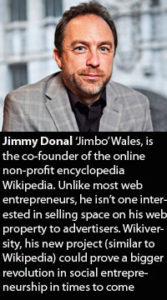
 When Jimmy Wales, co-founder Wikipedia, first got back to our office communicating that he was eager to talk, we hadn’t yet conveyed to him that we considered him a Cult entrepreneur par excellence. It’s not that we quite agree with Wikipedia’s editorial policies (on which Wales’ personally holds little or titular control) – far from it, we perhaps would be their harshest critic – but the social promise that the model has fulfilled till now and holds for the future is reason enough to catapult this sincerest soon-to-turn 47-year-old American into our topmost list of legendary innovator entrepreneurs.
When Brin and Page took their dorm room data mining experiment beyond the confines of Stanford, the world learned to associate search with Google. And when Jimmy Wales brought in his bold venture enabled by ‘open editing’ in 2001, free information in the Internet space about any company, individual, event, entity et al rapidly started becoming synonymous with Wikipedia, and the world of encyclopedias shrunk by hitherto unimaginable proportions. Type a search key on Google today, and you will, with rare exceptions, encounter a Wikipedia article on the term right up there in the rankings. And that is really a testimony to the kind of power it holds among the Internet audience.
Wikipedia was anti-establishment at its very core, and one would not be surprised at the same, if one were to closely examine the credentials of Jimmy Wales himself. Disdain for what passes off as convention and a passionate search for freedom have been part and parcel of Jimmy’s character, whose initial schooling happened in a one-room schoolhouse, run by his mother and grandmother. His most pleasant memory of that time is the Montessori influence on the school, which meant that he could spend a lot of time studying anything he felt like.
His most recent war against the establishment is one where he was joined by most of the prominent websites of the world – the war against the SOPA (Stop Online Piracy Act) and the PIPA (Protect IP Act), Acts which could expand the US government’s power to curb copyright infringement and piracy and act against websites that are dealing in counterfeit goods – critics mention these Acts are just another way to gain ill-thought control over the net; Wales tells us that these Acts are “fundamentally flawed”. Wales has firmly protested against the attempts by the industry, particularly the movie making industry, to back such legislations through all means possible. He famously proclaimed to Hollywood recently that it was doomed and not because of piracy, but because of a growing trend of collaborative story telling and filmmaking. He also laments the recent attempts by the Indian government to act against online firms in particular,
We consider Jimmy Wales, like most iconic entrepreneurs in business history, as a genius, albeit one with a very unconventional perspective towards life. After completing college, Jimmy went on to attend the finance PhD programs at both Indiana and Alabama, but did not write the dissertations in either, because he was ‘bored’! However, he did make a lot of money in the market through very intelligent speculations on forex and interest rate fluctuations. Then he took his life-changing decision to quit the financial realm and become an internet entrepreneur with Bomis (acronym for Bitter Old Men In Suits), a website targeted towards males and featuring user-generated webrings around popular search terms among that target audience.
Using the funding from Bomis, Jimmy moved on to the web encyclopaedia project he was most passionate about, with Nupedia. In this version, articles were supposed to be written by experts and each article was to undergo an exhaustive peer review process to ensure that credibility was at par with encyclopaedias. But seeing how slow the process was, Wales and Larry Sanger (Editor-in-Chief of Nupedia) jumped upon the idea of making the whole project a ‘wiki’ called Wikipedia and enabling independent editors to contribute to articles as they were being written.
Wikipedia was launched on January 15, 2001. Volunteers jumped on the wiki bandwagon almost immediately. Wales has always wanted to give away Wikipedia’s knowledge for free – and has succeeded like nobody else ever could. If Jobs was the autocratic head of Apple, Wales is the epitome of community decision making, where leave critical policies, Wikipedia is more or less managed everyday by thousands of independent volunteers who are not even paid by Wikipedia.
With Wales’ vision, Wikipedia has become the exemplar of Jimmy’s vision to bring “the sum of all human knowledge” free of cost to every human in the world. Wales professes a belief in decentralisation of knowledge, which was the guiding philosophy of the Wikipedia project. “I always do the most interesting thing I can find to do,” says Wales.
Today, Nupedia is extinct, but Wikipedia is no pushover in the numbers game. With over 100,000 active editors globally as reported in the annual report for 2010-11, the Wikimedia Foundation (which officially runs Wikipedia) received funding of around $23 million that year. By the end of 2010, 3.5 million articles had been published on the English version of Wikipedia (currently over 3.9 million in English & 21 million in total for all 282 language versions), and the site got its 1 billionth edit during the year. Experts challenge the Wiki model of revenue generation (through donations only!), but Wales has shunned advertising for Wikipedia. Wales has stood by his stand that advertising would not allow the content on the site to stay neutral and the current mode of targeted advertising is a violation of the privacy rights of an individual. He asserts to us, “I see no problems with our revenue model. People have been asking that question for years, and we continue to be more and more successful with it.” Clearly, one can argue that advertising on the website would increase the revenue base phenomenally and expand the possibilities for the site, especially ramping up an in-house team to counter- balance the thousands of volunteer editors across the world, whose credentials are quite hard to ascertain. Definitely, credibility of data and bias remain an issue even without following an online advertising-based model – issues which Wikipedia itself accepts officially – and the freedom provided to these contributors has to be consistently guarded against misuse.
But to be honest, the bigger promise for Wales – and perhaps various nations – in the future is Wikiversity, a project similar to Wikipedia set up by the Wikimedia Foundation. Wikiversity offers structured teaching in various subjects and topics “to foster learning”. While countries like India are struggling in spreading the reach of university learning centres due to the costs involved in setting up technology and learning networks through vast geographic expanses, Wikiversity offers a readymade university-like learning platform on the Internet; and the best part is that it is all provided free of cost. In other words, governments could use Wales’ Wikiversity platform completely free of cost to teach university subjects through the Internet – and even formally certify the students undertaking such distributed learning post formal tests. Imagine the potential such an idea holds in increasing literacy rates and in reducing poverty globally. And for this very Wikiversity concept, if not for Wikipedia itself (for which Jimmy has been praised ad nauseum), we consider Wales one of the world’s leading social entrepreneurs, in the same league as the contemporary persona of Bill Gates.
He’s our new benchmark in the world of Cult entrepreneurs. He’s making a bigger difference than many nations.