
Supposedly every century brings a revolution and we are, perhaps, living ours – a major societal shift, where the economic crisis, along with other factors like developments in technologies, the changes in the profile and values of young generations and the conflicting forces of globalisation and local diversity, are shaping a new world order. It’s a more globalised world today – one where countries, economies and companies are more interconnected and interdependent than ever before and risks that once seemed improbable and even remote have become the norm. For business leaders across the world, ‘expect the unexpected’ has become the mantra.
The global economic outlook is certainly enough to test even the strongest enterprises. The eurozone is still mired in recession and the US economy is forecast to expand by just 2.2% this year. While market conditions in many countries are still very difficult, CEOs are more positive about the future than they were last year. According to PricewaterhouseCoopers’s 16th Annual Global CEO Survey, 52% CEOs think the global economy will stay the same for the next 12 months and only 28% believe it will shrink. In 2012, by contrast, 48% were convinced the global economy would contract. But then, economic plateaus aren’t exactly grounds for cheer. And that’s the reason why short-term confidence about the prospects for revenue growth has continued falling. As per the Survey, only about 36% CEOs are very confident about their company’s prospects for revenue growth over the next 12 months as against 40% and 48% in 2012 and 2011 respectively.
To navigate through this environment, companies and governments need to develop resilience. This combines an ability to ride out the immediate impact of shocks with a long-term capacity to adapt to constantly changing conditions. “Weaker growth prospects and new risks raise new challenges to global growth and employment, and global rebalancing. Policymakers everywhere need to increase efforts to ensure robust growth,” states IMF in its latest World Economic Outlook (July 2013). Indeed, the current circumstances provide an arena where true leadership is tested and where managers can identify new opportunities or reinvent their existing businesses.
 This means that all the organisational entities in a more networked and less hierarchical society will have to make new choices. Firms will have to adopt knowledge-driven strategies and will have to choose which know-how to focus on primarily. And, based on this, they must see new business opportunities before their competitors, by concentrating on particular areas of thought leadership where their proprietary know-how can be applied. In fact, more than ever before, knowledge in itself is becoming part of value creation in an organisation or an institution.
Considering this business schools too will have to make new choices, relating to how they would prefer to serve the new world order. Where can they add value? What competences can be researched, developed and taught? Where can they ?nd areas of growth? Of course, some of the most intense debates on the structure and future of management education have only taken place since the start of the Great Recession in 2008-09. The reason is simple. B-schools in US have been facing an alarming decline in applications since that time. The Association to Advance Collegiate Schools of Business (AACSB; with membership represented in more than 75 countries) reveals that applications to full time MBA programmes in US dropped by about 20% from 48,515 in the academic year 2010-11 to 38,630 in 2011-12. As per the Graduate Management Admission Council Prospective Student Survey, the percentage of respondents opting for two-year full time MBA programmes dropped from 47% in 2009-10 to 42% in 2010-11 to 34% in 2011-12.
Certainly, the recent financial crises in the West have provoked a range of useful but difficult questions about the purpose and function of business education and research as it shapes business practice. Management education is being scrutinised for its impact on society and B-schools are being considered as “silent partners in corporate crime.” So, the biggest question is: Has the time come for a new revolution in management education? “Present financial and economic crisis and public outcry against the ways business is being done seem to substantiate a positive answer to this question. Management education gets its share of the blame, and a need for a change follows,” says Andrzej K. Kozminski, Founder and Rector of Leon Kozminski University a private, non-profit B-school based out of Warsaw in Poland.
 Since B-Schools have characteristically played the role of icebreakers in higher education and being forward looking, it is more important that they identify and implement new avenues that may bring business practices to a new and more sustainable plateau. But then how? 4Ps B&M identifies a few initiatives that B-schools’ deans, directors and faculty can implement in order to confront future crisis and better serve their social mission.
Build More Entrepreneurs To enable vibrancy and forward thinking in an economy, entrepreneurship is extremely important, and B-schools are expected to churn out more and more entrepreneurs now rather than just keep adding to rolls of large corporations. The 21st century needs business leaders to drive a more inclusive and sustainable growth agenda along with profitability and new ideas from a new breed of corporations are of immense importance. The Global Entrepreneurship Monitor 2012 did a survey across 175,000 people from 69 economies that represent 74% of the world’s population and 87% of global GDP. The survey revealed that some 250 million people in these economies between 18-64 years of age were actively engaged in early stage entrepreneurial activity (0-3.5 year old start ups). Around 63 million of these are expected to hire at least five people in the next five years while 27 million are expected to take in at least 20 people in the same duration. In fact, given the right resources, environment and skilled workforce, entrepreneurs can thrive and lead to massive job creation. A research by Bloomberg shows that “while employment at startups accounts for just 3% of the workforce, hiring by these firms represents 20% of total job creation.” So the impact of entrepreneurship on job growth and economic prosperity is quite evident. In fact, Nitin Nohria, Dean of Harvard Business School has kept entrepreneurship as one of the key focus areas for improvement in the school’s curriculum. One of the initiatives being taken is to complement case studies with a field method, where the students will be engaged in practically implementing classroom studies, which can potentially help in inculcating entrepreneurship, leadership and global thinking. Not to forget, times of crisis provide the breeding ground for entrepreneurs and innovators, and many major companies, like Google, were created in adverse circumstances.
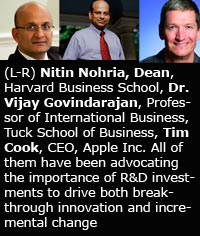
 Drive innovation While market leaders, likes Hyundai and Caterpillar, use a variety of means to generate ideas by closely monitoring their markets, customers, and competitors, focusing largely on creating value through incremental innovations to their products, technology drivers, such as Google and Bosch, depend heavily on their internal technological capabilities to develop new products and services. They leverage their R&D investments to drive both breakthrough innovation and incremental change. In fact, the business universe has several examples of how breakneck growth can quickly convert to an irreversible decline if the innovation pipeline runs dry and gets replaced by commoditisation. A recent case is HP, which, after years of domination in the PC and printer space, is now planning to give up its PC hardware portfolio as well as possible opportunities in the evolving tablet market (it seems to tacitly acknowledge that the HP TouchPad cannot really compete with the likes of the iPad).
The Booze & Hamilton Global Innovators 2012 report revealed that R&D spends among top 1,000 organisations reached $603 billion in 2011, a 9.6% increase yoy, making it clear that the world is slowly emerging from the recent financial crisis with a stronger commitment to innovation investment than it did after the dot-com meltdown in 2000. In the first three years following that collapse, innovation spending increased at an annual rate of 3.5%, compared with 9.5% between 2009 and 2011. Yet despite this significant growth, average R&D intensity (innovation spending as a percentage of sales) actually declined one-tenth of 1% in 2011, because the Global Innovation 1,000 generated sales of a staggering $17.6 trillion last year.
B-schools, therefore, have a far greater responsibility when it comes to breeding a culture of managing innovation. Stanford is one of the schools taking the lead as it has a programme for innovation and entrepreneurship that teaches students how to commercialise new product/service ideas. Moreover, B-schools have to lead by example. Industry has long extolled them to come up with more and more contemporary and relevant research papers and introduce new ideas.
Cultivate Constructive Interaction With Different Stakeholders To be fair, the stakeholder approach to business is an integral part of theory in most B-schools, but it is now time they take it to the next level. B-Schools now need to cultivate constructive interaction with different management stakeholders, particularly governments, since they will become pivotal players in the economy as regulators, shareholders and investors in the coming years. “Given the increasing protagonism of governments in the economy today and the foreseeable structural and cultural changes of the management landscape, business schools must adjust and explore a new paradigm for their relations between business and governments. Entities such as public-private partnerships may well offer opportunities for research, teaching and consultancy and potentially suitable careers for management graduates,” says Santiago Iniguez de Onzonol, Dean, IE Business School.
Not to say there are some advantages for B-schools in this new world too. Firstly, civil servants, public administrators and politicians could become an increasingly relevant applicant pool for degree and custom programmes delivered by business schools. Given the participation of governments in business through bailouts and regulation, government workers such as civil servants will need to update their knowledge and skills to run and understand these new functions effectively. One area of big potential development is public entrepreneurship – that is, preparing public officers with the mindset of creating value for citizens (considered as customers). Equipping public servants with an entrepreneurial, innovative mindset should help them to identify and create opportunities, taking a more proactive approach rather than just administering public resources. In fact, most management ideas and techniques can be translated into government practices, something that explains the growth of MPA (Masters in Public Administration) programmes in recent years across Europe.
Furthermore, CEOs and managers should realise the increasing importance of nurturing creative relations with governments and other stakeholders in general. A research by IE Business School shows that “CEOs at leading Spanish corporations dedicate more than 60% of their time to dealing with their company stakeholders – governments, media and opinion makers, unions, customer associations, NGOs and professional networks, to mention but a few. The spheres of the private and the public are blurred and the profile of managers is becoming closer to that of politicians.”
This calls for corporations to look beyond the traditional confines of the market (competitors, demand, price etc) and find opportunities through interaction with groups such as government, regulators, NGOs, the media and reshape markets in their favour. A number of corporations do this well, but many others are going to have to improve in this area very quickly. Hence B-Schools must not only research and teach these new approaches but practice them as well, as the management education sector faces greater scrutiny from a wider group of stakeholders than at any time in its history.
Realign academic research with the needs of the real business world Since the activities of B-schools focus not on a speculative but a clinical subject – management – a substantial proportion of academic research should deal with real business problems, jointly with top managers. According to the Association to Advance Collegiate Schools of Business, “The rapid change in the size and stature of research in business schools has engendered passionate dialogue and debate.” It criticizes B-Schools for placing too much emphasis on research relative to teaching, and for producing research that is “too narrow, irrelevant, and impractical.”
No doubt investment banks have created, in the past years, some true in-house universities that developed huge research on markets and companies, but they lacked the soundness and independence of academic research. On the other hand, academics have sometimes neglected the practical relevance of their research. B-schools should act as bridges between academia and the real business world. Consulting companies, investment banks and publishing houses are sometimes the source of valuable, original knowledge and business schools can promote an active dialogue with these and other institutions to further articulate multiple ideas to higher grounds. By becoming knowledge “hubs”, instead of reservoirs, business schools may better contribute to the advance of management theory and practice.
Train students to leverage technology to theIR advantage Ever since the CEO has become an integral part of the discussions with technology vendors, the importance of technology to business competitiveness has progressively increased. In fact, a study done by the IBM Institute of Business Value revealed that the entire world economy is estimated at $54 trillion and $15 trillion of that is wasted. The estimate is that around $4 trillion of inefficiency can be removed using Information Technology (IT).
However, businesses, particularly in the SME space, have extremely limited understanding of how it can work for them. B-schools have to adapt their curriculum to this trend. Dr. Hari Krishna Maram, CEO, Bangalore Institute of International Management Studies, tells us that a number of B-schools are “now talking of WiFi campuses, cloud computing & subjects like SAP, ERP, et al are being introduced.” That itself may be too late. A key focus of B-schools must be to not only train future entrepreneurs how to leverage technology to their advantage but to ensure that the mammoth importance (more future than current) of the social era that thrives on the Internet is recognised and internalised as an unquestionable imperative of becoming successful in the coming era. For instance, according to IBM, Business Analytics & Optimisation is a $100 billion opportunity globally and growing at around 8% per annum. Cloud computing, thanks to its ability to convert capex to opex, is now a powerful trend that has captured the fancy of companies globally.
Therefore, managment gurus will have to look at the modern B-school – as part of the new networked society – as more of a network entity itself and less of a classic free-standing organisational entity with its own academic departments. More than ever before, the B-school is networked with business and with other key institutions in society, such as regulators, government agencies, etc. The key will be to develop a value creation proposition for these typically older participants with their own pedagogical challenges. In short, the modern B-school should offer an alternative way of delivering quality and value to its participants, to corporations and to the modern networked society, different from that of the classic, discipline-based, supply-driven business school. After all, good management is one of the best antidotes to most of the world’s illnesses as it promotes convergence and understanding among civilisations. Hence, what we need are good managers and leaders, nothing more but nothing less!