
Claude C. Hopkins, one of the great advertising pioneers and the genius of direct response marketing, once wrote that “People do not buy from clowns,” and that it doesn’t pay to be funny. Hopkins, who shaped the advertising landscape in the early 20s and 30s, is arguably one of the greatest marketers of all time. Even modern day marketing legends give homage to Hopkins and appreciate his “reason-why copy” approach. However, that was almost 100 years back and what might have been true in the time of Hopkins (interestingly, it was the time of Great Depression too!) is not necessarily true today. Over time, the thinking has been buried amidst wild laughter with humour taking on a superstar’s role! Well, the reason is simple. Considering the troubled times we live in (sluggish world economy, high inflation, rising unemployment, et al), laughter – if well packaged – can be a huge high and the ultimate bridge between a brand and its consumers. Not to forget, for an advertiser, the most important question is: How do I get more attention to my message? And funny ads certainly attract eyeballs.
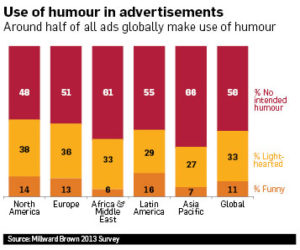 In fact, the humour overdrive has not been without reliable data to back up the trend. According to an in-depth research (which polled more than 29,000 Internet respondents in 58 countries to measure consumer sentiment on 19 forms of paid, earned and owned advertising formats) conducted by Nielsen to study advertising effectiveness of more than 4,000 ads during 2006 and 2012, it was found that humorous ads have ‘consistently resonated’ with viewers irrespective of the state of the economy. In fact, humorous ads were 47% more appealing to consumers in the pre-recession stage than sentimental ads or ads harping on pricing and promotions. Funny ads continued their supremacy even during the recession with 33% more appeal than other ad categories. Even according to another recent study – Does Humour make ads more effective? – conducted by Millward Brown, it was found that about half of all ads around the globe are either “funny” or “light-hearted.” The study also observed a strong relationship between humour and impact and concluded that humour drives involvement, which in turn drives memorability. “On a global basis, ads with humour on average score in the 74th percentile for Involvement (i.e. higher than 74% of other ads), while ads without humour score in the 42nd percentile. The funnier an ad is, the more memorable it is likely to be,” the report stated. In fact, humorous ads can have an especially strong impact on children. According to a study conducted by Mediamarket Research Inc., humour is the most appealing element for children ages 6 to 11.
 Certainly many of the most memorable ad campaigns around tend to be funny. Who can forget the humorous Fevicol ads or for that matter Mentos campaigns, showing consumers surviving what are clearly ridiculous and exaggerated situations to great effect. Yet these ads, even after one viewing, are far more memorable than ones that simply highlight the benefits of the product could ever be. Advertisers use this strategy to attract customers to their product. Raison d’être, in today’s world, where information is readily available at a push of a button, audiences like to be entertained, not pitched. In fact, consumers pay more attention to a humorous commercial than a factual or serious one, opening themselves up to be influenced. Agrees Prathap Suthan, Managing Partner and Chief Creative Officer at the Delhi-based creative agency Bang In The Middle, as he tells 4Ps B&M, “Humans are hard-wired to appreciate humour and laugh. So, if something is truly hilarious, people will enjoy it and this is why humorous ads work many a times.”
Humour not only wins truckloads of awards at the classy festivals, but also produces sweet music at the cash counter. It a big plus considering that more than $550 billion a year is spent on advertising worldwide (according to Nielsen’s quarterly Global AdView Pulse report) and its economic impact touches just about every consumer-product industry, from cars to candy bars. “In earlier times, the X Reasons Why You Should Buy This, delivered in BBC-style English, worked. Today, it doesn’t. People are not looking for gyan, but fun, entertainment, laugh,” says social commentator Santosh Desai.
 Even Michael Porter, the father of generic competitive strategies, had pronounced that to radically gain market share within any industry, one could either be a cost leader or be a product differentiator. But, if one is not able to be either, then what? Then the best strategy of course would be to ensure that your product has the highest brand recall. And humour has been found to be the most effective tactic to support this brand recall. In fact, a study titled “The Effect of Humour on Advertising Comprehension” by Calvin P. Duncan, James E. Nelson, and Nancy T. Frontczak of University of Colorado indicates that “humour (in the form of a one-line joke) does promote message comprehension, and offer support for information processing and operant conditioning explanations of the humour influence process.”
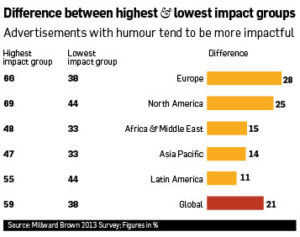 However, humour is a very delicate element and is not easy to handle at all. If it fails, it fails very badly and may totally ruin the overall essence of the brand. Therefore it is crucial for advertisers to find the appropriate type of humour for the appropriate product in order to ensure success. In fact, the key to funny advertising is assuring the humour is appropriate to both product and customer. Reason: It’s hard to be funny, and it’s easy to get distracted by something that may be funny but isn’t strategic. Hence, the balance between funny and obnoxious can often be delicate; and a marketer must be certain the positive effects outweigh the negative before an advertising campaign is launched. “The best products to sell using humour tend to be those that consumers have to think the least about. Products that are relatively inexpensive, and often consumable, can be represented without providing a lot of facts, and that’s where there’s room for humour,” says Mark Levit, Professor of Marketing at the New York University.
Another point to consider when using humour in advertising is that different things are funny to different people. A commercial that may leave one person gripping their sides from laughter may leave a bad taste in another’s mouth. The target market must always be considered. For instance, while an older, more sophisticated audience might be quite receptive to irony and satire, the same might not hold true for younger audiences. Moreover, don’t be overly repetitive – the first time consumers see an ad, it’s funny, but after a while it loses its impact. A case in point is Flipkart’s ad campaign which poses kids as adults. The ‘kids as adults’ formula strips the latest ads of any newness or freshness and secondly the commercials fails in its key task of appraising existing and potential consumers about the reasons that they need to visit the online shopping site viz. special offers, bargain deals and interesting buys for the festive season et al. One of the major keys to a successful humorous campaign is variety. Once a commercial starts to wear out there’s no saving it without some variation on the concept. Hence, a killer ad campaign and innovative marketing insight is about telling a different story and not telling the same story differently.
 Moreover, humour needs to be fully embedded in the ad so that while audience enjoy the effort, they do not forget the brand associated with it. The main purpose of an ad is to give a brand the desired recognition and not just to make people laugh. Agrees Prahlad Kakar, the famous ad guru, as he tells 4Ps B&M during one of the past interactions with the magazine: “Humour in an advertisement is sure to fail if it has been put there just for the sake of it – and without thought. Creative teams need to fully ensure that humour is absolutely needed.” So, in essence, don’t use humour for the sake of making people laugh. Make it a part of the overall brand communication exercise. All you have to do is execute the basics very well. Simply put, one should be able to tell a joke the way it’s meant to be told. An example of an ad campaign that successfully encompasses all of these factors is The Hindu’s long running “The youth are watching” campaign. The campaign packs a humorous punch, but also underscores the newspaper’s key brand imagery of educating readers and spreading awareness about the falling standards of governance in India.
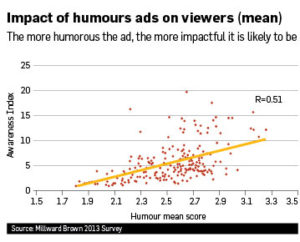 No doubt, humour can make ads more enjoyable, involving, and memorable. But if the humour distracts from branding and communication, it can impede the ad’s effectiveness. Therefore, while using humour in advertising, one needs to be extremely careful. It is a craft which needs to be used very intelligently. Once a joke turns ugly, it is not easy to undo the damage. Only those brands which can master this art are the ones which people really remember for long. In fact, Sir Winston Churchill once said “A joke is a very serious thing.” And it’s certainly true in the multi-billion-dollar world of advertising. While a good joke will get consumers’ attention and enhance affection for the brand, a bad joke might undermine affection for the brand. And with ad budgets running to millions of dollars no marketer wants to irritate his potential customers. Do we need to say more?