On a bright afternoon, on June 6, 2012, in a move that was perhaps deliberately kept out of media limelight, Robert Kaplan and Myron Gutmann representing the Executive Office of the President of the United States quietly signed in a charter forming what is known in closed circles as the Interagency Working Group on Neuroscience, or IWGN. The purpose and scope of IWGN, as officially stated, was “to coordinate activities in neuroscience research across the Federal government”. Cut to the 2013 State of the Union address of the US President Barack Obama, and one could clearly not miss the distinct statement he made citing brain research as an example of how his government would “invest in the best ideas”. Was Obama’s statement a deliberate forerunner to bigger news? One didn’t need to wait for long to get the answer. Cut again to February 17, 2013, and news breaks in global media of how the US government is probably now formally on the cusp of announcing a decade-long never-before-seen mammoth effort to map the human brain. The New York Times reported on the same day, “Scientists involved in the planning said they hoped that federal financing for the project would be more than $300 million a year, which if approved by Congress would amount to at least $3 billion over the 10 years.” Comparisons of the government’s brain mapping initiative are now being made to the Human Genome Project, which is considered the single most important initiative to fully map the human DNA.
In a furiously competitive world, as marketers continue to pour in billions of dollars every year in market research to understand consumers’ needs, wants, demands and the tricky one, the latent demand, such happenings are ruthlessly followed and excruciatingly investigated. Today, with the human genome completely broken down and mapped, doctors can easily pinpoint the exact genetic reason why various parts of the human body behave the way they do in any individual. Will the Human Neuroscience Project (so titled by us) lead to similar results with respect to an individual’s mental faculties and responses? You see, the answer to this question, or rather, the power to look into the mind of an individual would be worth billions of dollars, if not trillions, to the marketing powerhouse global community, considering that a comprehensive understanding of the human brain and ability to forecast and influence consumer buying behaviour could rewrite economic equations like never seen before in the history of mankind.
Astonishingly, Apple Inc.’s iconic founder, the late Steve Jobs, was never in favour of market research. He often said that the consumers didn’t know what they wanted unless one was to build something and show to them. He reportedly told Fortune once that Apple did no market research when it came to developing new products. Apple’s products, as if to support Jobs’ theory, managed to be more successful than any other product ever could be. Uniquely, Apple became the totem pole for the bunch of experts who opposed market research. Apple was glamorously quoted as being proof enough of the uselessness of market research and of analysing consumer behaviour.
 The reality was far from that, and the cover on this supposed inhibition of Apple towards market research was blown late last year. In August 2012, Apple’s VP of Product Marketing, Greg Joswiak submitted a declaration to a US court explaining why specific documents relating to Apple’s market research and strategy should be sealed. The declaration clarified that every month, Apple surveys iPhone and iPad buyers and Joswiak explained what Apple was able to make out of these surveys. Apple wanted all of these tracking studies sealed so that rival companies could never find out what drove an iPhone and iPad purchase or which set of demographics got the maximum loyal Apple consumers. After this declaration, various estimates came out that said that Apple might have spent anything between $300-500 million a year in conducting such marketing research. Evidently, the market research supporters had lost their best argument with that one revelation of Apple.
But where does neuroscience and neuromarketing fit into all of this? Perhaps better than we ever imagined. So what exactly does neuromarketing involve? We’ll start with a seat of the pants’ reply. Neuromarketing takes the help of various brain mapping techniques like Functional magnetic resonance imaging (fMRI), Electrocardiography (ECG), ElectroEncephalography (EEG) and similar techniques to reach out and understand the parts of the brain that decide the buying behaviour of a consumer. Think about it. If marketers could understand why a consumer would prefer a certain product over another, product specifications could be changed significantly based on customer wants.
From the times of Nash equilibrium to the times of Prospect theory, Nobel prize winning concepts have proven that consumers do not necessarily take logical decisions and use the vague space of intuition to base their less than optimal purchase choices. The premise of these theories lies in the fact that around 90% of the decisions we make are taken at a subconscious level. Hence, if a brand can speak directly to our ‘gut instinct’, bypassing our logic and reasoning, they will sell more products.
But there’s a deeper inference in all this. Apparently, all we thought we knew about consumer research was wrong. And what do we mean by that? Over the past many decades, and especially over the past few years, research after research is popping up to prove that responses that humans give verbally – and responses that they themselves believe to be true – may not exactly be what they in reality are thinking. Breaking it down, it means that if you were to ask a prospective consumer which colour of a car would he like, and if he chooses the colour red because he truly believes that to be his first choice, neuroscience allows researchers to determine whether the consumer really likes the colour red or whether there’s some other colour that he might like better without knowing about it.
From the times of Nash equilibrium to the times of Prospect theory, Nobel prize winning concepts have proven that consumers do not necessarily take logical decisions and use the vague space of intuition to base their less than optimal purchase choices. The premise of these theories lies in the fact that around 90% of the decisions we make are taken at a subconscious level. Hence, if a brand can speak directly to our ‘gut instinct’, bypassing our logic and reasoning, they will sell more products.
 A March 2012 Harvard research authored by Carmen Nobel gives the example of junk-food giant Frito-Lay, which hired a neuro-marketing firm in 2008 to look into how consumers respond to images or other stimuli related to Cheetos, the top-selling brand of cheese puffs in the United States. Using EEG technology on a group of consenting subjects, the firm determined that consumers respond strongly to the fact that eating Cheetos turns their fingers orange with residual cheese dust. With this information in hand, Frito-Lay moved ahead with an ad campaign in the US themed ‘The Orange Underground’, featuring a series of 30-second TV spots, in which the Cheetos mascot Chester Cheetah encourages consumers to commit subversive acts with Cheetos. During one such commercial, an airline passenger quietly sticks Cheetos up into the nostrils of a snoring seat-mate. The campaign became a grand success, and even helped Frito-Lay grab a 2009 Grand Ogilvy Award from the Advertising Research Foundation.
This is not a one of its kind example. Companies are increasingly leveraging such neuro-studies into their market research and product development research projects. Daimler-Chrysler conducted a similar study to understand the effect of their cars on the consumer’s mind. The study revealed that images of sports cars generated signals from the reward center of the brain; the same area, which gets hyperactive during the consumption of alcohol or drugs or during sex. Also, when respondents saw the front of the car, the portion of the brain that responded to face-recognition lit up, suggesting some association with a person they knew. These are tremendous insights for a future car design.
In the mid part of the last decade, in one of the notable neuromarketing tests, an American research group headed by Samuel McClure used functional Magnetic Resonance Imaging (fMRI) to examine the correlation between brand names and consumer preferences.
The research offered Coca Cola, Pepsi and another cola drink to the participants, without telling them which drink it was. When consumers did not know what they were drinking, researchers could see the sensory aspect of the brain getting active. But once they were again given the same cola drinks and were told the brand names too, the emotional part got active as well (and the preference shifted to Coca Cola, irrespective of the taste). Look at how insightful such information can be to the marketing president arguing with his CEO for more money to build the brand.
In his book Buyology, Martin Lindstrom, the bestselling writer listed as one of the 100 most influential people around the world by TIME magazine, says that traditional advertising is one of the reasons why 8 out of 10 new product releases fail. To prove his point, in one of the most extensive neuromarketing studies, Martin scanned the brains of over 2,000 volunteers over 3 years at a cost of around $7 million. The study threw up mind-boggling findings. One of these findings was that warning labels on cigarette packages stimulate activity in a brain area associated with craving. This result came out despite the fact that subjects often said that they thought the warnings were effective.
In other words, while the consumers believed that warning signs would dissuade them from consuming cigarettes, the actual result was astonishingly the opposite. It was easy to conclude that having these signs on cigarette packs actually could push the sales up as compared to the popular belief that it will discourage the smokers. Another observation said that the images of dominant brands, such as the iPod, stimulated the same part of the brain activated by religious symbols. Hence, the consumers tend to have a strong loyalty for these brand as they may have for their religion.
It is the result of these findings that neuromarketing has become a huge industry in itself. According to a January 2012 estimate by the Advertising Research Foundation, the neuromarketing industry may start generating over a billion dollar plus in revenues by the end of the year 2013. This is really serious money, considering that the industry is not even a decade old. While none of the companies in the neuromarketing business shared their financial figures with 4Ps B&M, their client list is a testimony that the world’s most popular brands have started roping in these neuromarketing agencies. For instance, Nielsen-owned NeuroFocus has investigated over 50,000 brains so far for its clients like Microsoft, Citi, Starcom MediaVest, California Olive Ranch and of course for the parent company, which we love to vex, Nielsen.
Similarly, London based Neurosense boasts a wide array of clients including Intel, GlaxoSmithKline, P&G, Johnson & Johnson, BBC, Viacom, Coca-Cola and Unilever et. al. The company shares many successful case studies where neuromarketing helped the clients to understand the consumer requirements better and the results were measurable. One such brief that they received from Viacom in late 2008 was that the company wanted to redefine their advertising pricing strategy. Unlike the ongoing approach of pricing TV advertising on audience figures, which assumed that the ads were processed similarly by a viewer regardless of whether or not they appear within an appropriate or congruent programming context, the client wanted to use brain mapping technology to be sure about whether an advert is processed differently by the human brain just because it is placed in a different program slot. Neurosense conducted the study using fMRI to measure the extent to which ads are encoded, understood and liked if placed in a congruent versus incongruent programming context. The result said that the ads placed in an appropriate programming context were shown to be encoded, liked, attended to and processed in an emotionally positive way to a far greater degree than when in an incongruent context. Using these findings, Viacom made key strategic changes to its advertising pricing strategy and since then, Viacom and its partner MTV Networks have managed to double their global advertising sales to over 8 billion pounds a year. That’s the same reason Google Adwords works, as it uses its analytics about various sites to understand which sites would be the most congruent to a particular advertisement.
In a similar way, brands like Mcdonald’s and Proctor & Gamble found out through brain mapping that certain smells can give birth to strong associations. Using these findings, McDonald’s developed a perfume which was subtly diffused in restaurants to increase brand association and boost sales. Proctor & Gamble followed the way with a similar trick. Sales of Ariel washing powder increased by 70% after an artificial perfume was placed under the lid.
 Remember the recent success of PSY’s music video Gangnam Style? The song was released in July 2012 and on December 21, 2012, Gangnam Style, became the first online video to record a billion hits on the Internet and is still the most watched video on the net. Marcelo Peruzzo, Chief Brain Officer of Brazil based neuromarketing company ipdois neurobusiness, decided to conduct a neuromarketing research and measure the viewers’ reactions while watching this video, in order to gain more insights on what exactly made this video so popular. He asked 20 women and 20 men to watch Gangnam Style while researchers from ipdois neuro-business measured their reactions. They used eye tracking of viewers’ eye movements, galvanic skin responses to measure the muscular excitement level and facial coding to understand the emotions of those seeing the video. Using facial recognition software, it was proven that most viewers experienced happiness, sadness and surprise while watching the video, while disgust, anger and fear were insignificant – proving the power of attraction of the video. Peruzzo also found that many of the scenes stimulate the limbic system.
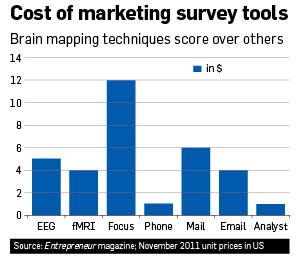
On another front, neuromarketing is relatively cheap too. In a November 2011 study done by Entrepreneur magazine, it was found that the per head cost of doing an EEG or fMRI based study in the US was cheaper than using a focus group (see the comparative chart; previous flap). However, despite all the success that neuromarketing has gained around the world, there are not many takers for the concept in India. While many top companies and executives that 4Ps B&M contacted had no idea of this concept, there were a few surprising exceptions. Vishal Vyas, Sr. Marketing Manager, TTK-Protective Devices Ltd. which has recently come up with its latest condom brand, Skore, is very positive on embedding neuromarketing in the marketing campaign when he says, “If there is any scientific aid which can help marketers to capture consumer insights, it is definitely welcome. In sensitive categories like condoms where consumers are not very comfortable talking about their experiences or views, neuromarketing is really a boon.” Similar views are expressed by K.V. Sridhar, National Creative Director, Leo Burnett India when he says that the concept looks exciting if it can really offer a way to support the findings of a primary research done by a human. However, he does not feel that neuromarketing has reached that stage where it can act as a replacement to the conventional market research. Noted AD Guru, Prahlad Kakkar also has his reservations when he says, “I am not much aware of any such technology but even if anything exists as such, it has to stand the test of time and market before it gets full acceptance.”
Despite the general positive light in which neuromarketing is seen, one can not ignore the critics. Slate magazine’s science writer Daniel Engber raised some serious doubts about the accuracy of the results obtained by brain mapping and its relevance for marketers. He writes, “Scanning one individual’s brain and drawing shaky conclusions proves nothing. A few peer-reviewed studies correlating fMRI predictions of ad effectiveness with actual consumer purchases would mute the critics and do a lot more for industry credibility than any number of glossy articles that end up making neuromarketing look like high-tech phrenology.” There are other ethical and legal issues surrounding the area as well. As the researchers around the world are struggling to attain a go-ahead on issues like stem cell research and cloning etc, it is very tough that attaching brain mapping devices to someone’s brain for a purely commercial purpose will find acceptance.
A recent research paper titled On the Feasibility of Side-Channel Attacks with Brain Computer Interfaces uncovers potential security risks in the use of the consumer-grade EEG headsets. In this paper, a team of security researchers from Oxford, UC Berkeley and the University of Geneva have claimed that they were able to deduce digits of PIN numbers, birth months, areas of residence and other personal information from 30 subjects who were wearing consumer-grade EEG headsets and who were exposed to images of ATM machines, debit cards, maps, people and random numbers in a series of experiments. Critics and researchers are even concerned about a scenario where a potential malicious attacker could write a brain spyware program, which could extract private information from the user. As imaging technologies progress and get coupled with powerful and futuristic software, threats will be bigger.
Having said all this, the field of neuromarketing is still relatively new and there is a lot more to happen in this in the coming times. As big brands have started opting for neuromarketing related services, the future looks bright for the industry. But the marketers have to come clean on issues like privacy policy, medical safety of the subjects. At the same time, more industry-academia collaborations are required to create positive awareness on the subject. Only then we can see this highly potent technology going forward. And as far as Indian corporations are concerned, they need to start by reading this article.