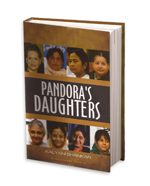
Pandora’s Daughters by veteran journalist Kalyani Shankar aims to illuminate and interpret the strengths and weaknesses of eight prominent contemporary women leaders who have achieved great power in the male-dominated world of Indian politics.
The book features the Italian-born Sonia Gandhi, chairperson of the United Progressive Alliance and president of the Congress Party. Other women leaders are symbol of Dalit strength and four-time UP CM Mayawati, Mamata Banerjee, who created history by forcing out the Communist government of West Bengal, the film star-turned-politician Jayalalithaa, “the next door granny” Shiela Dixit, the first woman president of India Pratibha Patil, leader of Opposition in the Lok Sabha Sushma Swaraj and leader of Opposition in Jammu and Kashmir, Mehbooba Mufti.
Ms Shankar’s crash course on Indian politics and the study of eight Indian women leaders comes from long experience as a political reporter who has witnessed the tumultuous contours of Indian politics for decades. She has also watched the leaders, followers, detractors equally. Pandora’s Daughters is far from being a chronological account, unlike recently published Indian political biographies in the market. Instead armed with observations, interviews and academic analysis, Shankar dissects these women leaders in terms of emergence, style of functioning, the basis of power, their strengths and weaknesses, their character traits and the challenges they face.
Now the moot question: who among the eight women leaders is the Pandora’s daughter? Several factors point out that they all qualify for the exalted status. This is borne out by the fact that in the 15th Lok Sabha, the representation of women is mere 10.8 per cent though it has been rising steadily. Also the Women’s Reservation Bill, though passed by Rajya Sabha, is still awaiting passage in the Lower House. Women and women leaders, then and now, face cultural obstacles, lack of money, time, media access, and muscle power. With these factors in mind, one has to assess these women leaders.
Of course, India has had leaders like Indira Gandhi, the first chief minister of Orissa Nandini Sathpathy and the first chief minister of Uttar Pradesh Sucheta Kripalani. Apart from these eight women leaders, there are many more women leaders in India. But Shankar has chosen only those who have become Presidents and prominent leaders of their parties.
“There are some commonalities and dissimilarities among these women leaders. They fall under three categories. The first ascended to power because of family background (Sonia Gandhi, Sheila Dixt and Mehbooba Mufti), the second through the patronage of a mentor (Mayawati and Jayalalithaa), and third on their own (Mamata Banerjee). Politics infuses every moment of these leaders,” the author writes.
A view persists that of all the women leaders, former president Pratibha Patil does not merit to be in this gallery. That would amount to a very narrow view of Indian politics and women’s representation and policy making.
A woman politician has to meet the demands of family as well as politics. This is one reason as to why women sacrifice. Shankar narrates how one day fed up after a quarrel with her husband Ms Patil handed in her resignation to the then chief minister Vasantrao Naik. Besides being a deputy minister in Naik’s government, she was at the time also a young mother. Had Naik not called the husband and wife and mediated a compromise, Patil perhaps might not have continued her political journey that landed her in Rashtrapati Bhawan.
As Delhi went to polls this week, Sheila Dixit, three-time Chief Minister of the national capital, was a greenhorn despite coming from a political family. She is quoted as saying: “I did not even know what a polling booth was. But my husband and my father-in-law were very keen, so I said okay.”
Shankar has peppered her book with interesting anecdotes and snippets to make the political lives of eight women leaders interesting.
However, about one quarter of the book deals with Sonia Gandhi. It describes how the woman who is often described as goongi gudiya created a sort of records by uniting and leading the party, restoring dynastic politics, becoming the first woman leader of the Opposition, bringing UPA to power and experimenting with dual power centre…
Shankar has been forthright in explaining various other facets of these leaders that enhances our understanding. For instance, their mode of communication, methods of politics, world view, decision-making mechanism, retaining leadership and support base – all have been explained well.
Albeit in total control of their parties, all of them are insecure. “They are loners and do not trust others in the party,” further writes the veteran journalist.
Author:Kalyani Shankar
Edition: Hardcover
ISBN: 978-93-82951-04-9
Pages: 259
Price: Rs 499