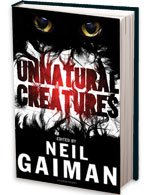
 Much has changed between the year 1885 and today. Much has not. The fearful love for monsters and miracles, for instance, has remained with us. The love for story has. Hence, for all these years, and in fact from much before that, fantastical stories about impossible creatures in believable or unbeliev able lands have been told and retold by us.
Somewhere between the terrible shadows occupied by dragons, griffins, werewolves, and dreadful beasts with no names lies a place that makes us more aware of our being alive. And therefore, time and again, often against better judgment we find ourselves immersed in stories that take us to our monsters, that make us shiver and plunge us into fear, but do so while making the world a far “more magical place” to live in.
One such anthology lies in front of us – Unnatural Creatures, a collection of sixteen stories from the year 1885 onwards, put together by the writer who has read everything, Neil Gaiman, along with Maria Dahvana Headley. In their own words, this book is comprised of “stories featuring unnatural creatures along with several other creatures who are either unlikely, impossible, or do not exist at all”.
The book travels far and wide. It includes Frank R. Stockton’s The Griffin and the Minor Canon (1885), while Megan Kurashige’s The Manticore, the Mermaid, and Me makes it debut. And while making this journey, it makes sure to pick up along the way weird and quirky pieces. Like a story with a title that cannot be written out, but only sketched. (The limitations of my review coincide with the limitations of the written word, and hence I shall not be able to produce the title here for your reference).Gahan Wilson, the writer, is a cartoonist by profession, and hence we have a story that uses both words and drawings to bring to us a very unusual creature that begins as a dot, and then grows and moves to assume much bigger proportions. Or, Maria Dahvana Headley’s Moveable Beast, a story about a feisty girl living in a town popular for being rude, a forest that is home to the beast in question, and a beast collector. The delicious brevity of Ms. Headley’s writing complements the story’s unexpected turns very well.
Nnedi Okorafor’s story Ozioma the Wicked concerns itself with a “nasty little girl whose pure heart had turned black”, or so believes her entire village because of her ability to speak with snakes. All of this changes when they find themselves faced with a giant cobra, and need Ozioma.
Samuel Delany’s 1977 story Prismatica is a claimed homage to James Thurber. It takes its poor but amiable protagonist Amos to the deepest swamp in search for the three broken shards of a mysterious mirror. This fairy tale reveals to us a very differently influenced Delany.
No anthology of stories feels complete without Saki, or H.H. Munro. And though I would much relish introducing his story Gabriel-Ernest in my own words, I would rather quote Neil Gaiman. “Some of his stories are funny. Some are chilling. Some are both”, he writes, before adding, “There’s a wild beast in the woods. Or there is a boy. Or perhaps…”
Neil Gaiman’s own story, Sunbird, is an ode to two influential writers of the past – E Nesbit, and RA Lafferty. This turns out to be a wonderful read, its almost unusual humour melding beautifully with a tale of mythical proportions. E Nesbit’s own story, The Cockatoucan; or, Great-Aunt Willoughby is a witty fairy tale, about a girl who magically ends up in an unknown kingdom while on her way to her aunt. Once here, she faces a “marvelous villain” in the cockatoucan bird.
We trapeze through these and a few more stories, to end up at Peter S. Beagle’s Come Lady Death, a story about a Georgian aristocrat who invites death, the “most natural of unnatural creatures”, to her party, in order to get rid of her monotonous life. A beautiful fable about life, death, and human folly, it is a fitting conclusion to a marvellous selection.
Neil Gaiman, in his introduction, reminds us of what Ogden Nash had said, “Where there is a monster, there is a miracle”. As children we naturally believe all worlds to be possible, and hence unicorns and mermaids live with us as naturally as elephants and giraffes. It is in growing up that we let go of our monsters. Now, that is why you must find your way to these stories. For, as you meander through these pages, you will find your miracles again.