Farmers with ‘ganna’ (sugarcane) emblazoned across their chests blocked roads, sugarcane bonfires were lighted, angry crowds pushed through gates of closed mills and Satpal Singh, a sugarcane farmer in Lakhimpur Keri committed suicide. In Uttar Pradesh where sugar has seldom led to any political sweetness, the latest standoff between mill owners and the government ended after months of bitterness with both settling on Rs.280 per quintal as the price that will be paid to sugarcane farmers.
In the fine point of the agreement is the permission for mill owners to defer part of the payment, look for a better cane pricing mechanism in three months and pay the mandatory commission to cane panels on behalf of the mills. The last would cost the government exchequer Rs.500 crores. The state government had earlier waived off entry and sales taxes, thus offering the industry a relief of Rs.379 crores. Clubbed with the latest waiver, the industry’s sops for this year totalled Rs.879 crores.
Yet Uttar Pradesh Sugar Mills Association Secretary Deepak Guptara dubs the agreement “non viable” for the industry. A release from his office said that the industry had bowed to the government’s wishes “in the larger interests of hundreds of thousands of farmers”.
Those who claim to be speaking for the farmers disagree. Munna Singh Chauhan, State President of the Rashtriya Lok Dal, which claims its largest support in the western sugarcane growing districts, identifies the dangers. “There is potential for mischief in the deferred bit of the payment,” he says. BJP’s State President Laxmi Kant Bajpai asks, “Why is the government silent on the issue of arrears? Why must it continue to deal with erring mills softly?”
 Somewhere in the background of an agreement, which all parties see as flawed, is the threat of a court order that had come on a PIL filed by the Rashtriya Kisan Mazdoor Sangathan convenor V. M. Singh with the Allahabad High Court. The order directed that the Rs.2,350 crore arrears of farmers be paid or else the government take over the management of private sugar mills. Singh says that it was the court’s “shock treatment” that brought about a compromise, as the state would have had to respond to the Court on December 3 – the next date of the hearing. “The government’s intentions were not honourable. Farmers have already been ruined. Mill owners have been earning profits, posting dividends and yet when it came to paying farmers there was a deadlock. If the takeover had happened, mill owners would have been paid only Rs.1,250 a day during the season. It was this threat that worked,” says Singh.
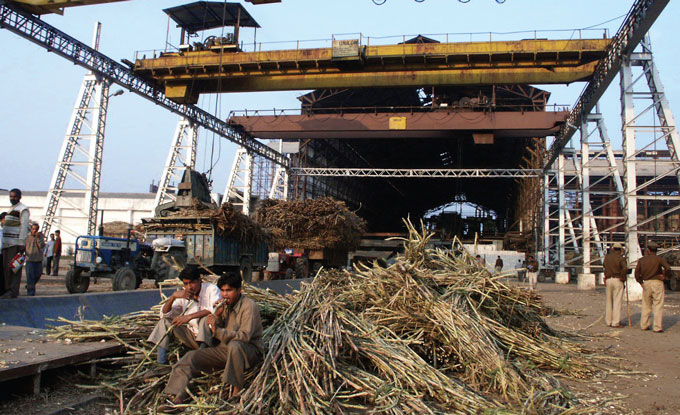
The sugar industry in UP is the country’s second largest after Maharashtra. The state has 121 mills to which some 29 lakh sugarcane farmers bring their produce from 22.7 lakh hectares of farmland. Last year sugarcane worth Rs.22,000 crores was purchased, and 7.4 million tonnes of sugar produced. It’s a size that translates into immense political clout as 125 Lok Sabha seats fall within the state’s sugar belt.
It is for this reason that almost every year, a sugar war erupts between the state government and the mill owners. The state decides the price at which sugarcane will be purchased from farmers. This State Advisory Price (SAP) has always been above the Fair and Remunerative Price recommended by the centre. This year’s FRP for instance is Rs.210.
Mill owners argue that in addition to an arbitrary fixing of SAP, the falling prices of sugar in the international market, reluctance on the part of banks to provide loans to the industry and shifting the burden of subsidy to private mills is ruining their economies. Sugarcane farmers are put in a bind because of non payment of dues and the delayed start of purchasing and crushing by mills which forces them to sell at reduced prices to jaggery mills. A delay in harvest and selling of the crop would mean throwing the next crop cycle out of gear.
A combination of such factors left the UP sugar industry with losses of Rs.3,000 crores in the financial year 2012-13. It is a loss mill owners argue that can be avoided if the government links the price of sugarcane to sugar – a suggestion that leaves sugarcane farmers open to the impact of volatile sugar prices in the international market.
This year’s crisis had been in the making since October when the government first invited mill owners for a meeting to thrash the issue. Industry constantly dithered on the prices it was willing to offer. From Rs.280 it went down to Rs.225 and by November sent letters to the government stating “it is beyond our control to operate under these circumstances any longer”.
Rahul Bhatnagar, the state’s Cane Commissioner says that the government is committed to make sugarcane a viable proposition for all concerned parties, and that it is not guided by politics. “If there was a political aim, why did we keep prices at last year’s level? Levy concessions, reduction in sales tax and entry tax, freeing up the molasses market partially, and a host of other schemes will ensure that mills find it feasible to crush at Rs.280. The mill owners were bound to see the logic behind this,” he argues.
A highly placed official at a private sugar mill in western UP however points out that these concessions will bear results only a year down the line. “These are futuristic, fictitious projections. The impacts will not be felt immediately. Our losses will continue to mount if sugar prices remain low,” he says.
One of the long standing demands of the industry is that sugarcane prices be announced well in advance, preferably before the sowing starts, so that farmers can choose whether or not to plant the crop, and mills given some leeway in deciding how much they want to procure in a season. In UP however announcements are routinely delayed. Last year for instance the SAP was announced only on December 7, well after the traditional start of the crushing season in mid November. With the delayed response came a price hike of Rs.40 per quintal for all varieties. The previous government had affected a similar hike in 2011. Clearly in sugarcane politics, the side which holds out the longest gets the upper hand.
Surya Pal Singh, Senior Vice President of the Officers Association of the All India Cooperative Sugar Factories Federation Limited is of the opinion that the issue has been addressed in an extremely fragmented manner. “Our mills are old and do not have high pressure boilers for fuel savings, are not of an optimal capacity to enable co-generation and we have limited demand for ethanol. These are just some of the issues, yet the entire focus is just on fixing sugarcane prices,” he says.
Add to the above the failure of the state’s sugarcane research institutes to discover new varieties and methods that would lead to enhanced productivity. In the absence of a scientific push, not only have sugar recoveries in the state’s sugarcane varieties been persistently lower than those of states like Maharashtra, the state’s productivity has also been lower than states like Haryana which experience similar climatic conditions.
Abinash Verma, Director General, Indian Sugar Mills Association reacts cautiously to the latest developments. “I hope a long term rationalised sugar policy comes up,” he offers.
Clearly, if those long term measures are not put in place, the state’s sugar industry is headed to a bitter future.