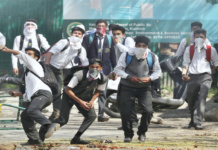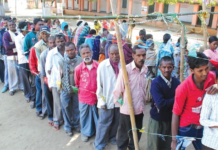
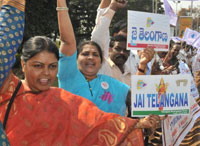
Strikes, protests and bandhs have become the norm in Andhra Pradesh, the largest state in south India thanks to popular demand for the creation of a separate Telangana. With the Congress-led UPA taking a somewhat controversial decision to carve out a new state by bifurcating Andhra Pradesh despite opposition from its state unit and its own state government, life continues to be paralysed here.
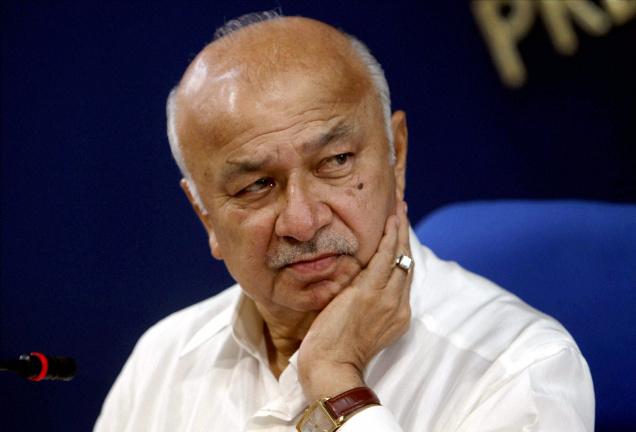
Last week the Union Cabinet finally approved a parliamentary bill for the creation of a separate Telangana with 10 districts, despite the Group of Minister’s (GoM’s) recommendation of Rayala Telangana which was to include 12 districts of Andhra Pradesh. The Cabinet also approved Hyderabad as the common capital of Telangana and Andhra Pradesh for a period not exceeding a decade, said Union home minister Sushilkumar Shinde.
 Critically for the state, warnings on the implications of immediate agitational backlash pointed out by the Justice BN Srikrishna Committee report has been brushed under the carpet. The Committee, appointed by the UPA II to examine bifurcation of Andhra Pradesh, had submitted its findings in 2010. Accessed by TSI, part of the report remains concealed as it was submitted in a separate cover. This part runs through 17 pages and warns of various scenarios and emerging problems associated with the creation of the new state.
There is a good reason why UPA II has not made this part of the report public: It contains uncomfortable scenarios explained in detail and quite candidly.
Chapter 8 of the report has examined the implications of this division on the economy, the Maoist movement, communal situation, education, migration and farming in the case of formation of Telangana and warned the centre adequately about the various scenarios that could plague the new entity.
Maoist violence: In the event of the demand of a separate Telangana not being realized, some militant elements which have been in the forefront of the agitation may go underground to revive the Maoist movement in certain pockets of Telangana, the report points out. However the committee says it could possibly be tackled within a small time-frame with firm political will and strong administrative action.
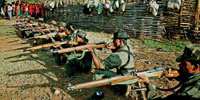 The Maoists who are active in Dandakaranya and Andhra-Orissa Border areas, ie, Khammam, East Godavari and Vizag and certain forest areas of Adilabad, Karimnagar and Warangal may continue to operate along the borders with Madhya Pradesh, Chhattisgarh, Maharashtra and Orissa. Their activities might be more intense in Vizag and Khammam regions but the fall out of violence may mostly be confined to these few districts.
With the creation of a new state, Maoists are set to gain, the report predicts. “It is important to note that it is not entirely a coincidence that the increased spread of Maoist violence in Chhattisgarh and Jharkhand, has been after the creation of these states. Increase in poverty which is a natural corollary to a slowdown in economic activity, will drive more people into the arms of the CPI (Maoist). This may again lead to a vicious cycle of Naxalism, leading to less of economic activity and greater impoverishment, which may provide fillip to Left wing extremism”, the report noted.
 Soft Approach: The report also argues that the newly-formed state is likely to be soft towards them initially, given that they have over the years supported the struggle for the formation of Telangana. By the time the state realizes the full impact of the Maoist menace, it may be too late to handle them with a bifurcated police force contributing to a weaker response. The CPI (Maoist) will also use the political boundaries of state and districts to their advantage. It is not without reason that most of the Maoist zones and sub-zones straddle state and district boundaries.
Poor Inter-State Coordination: The Committee has also pointed out that experience shows that inter-state coordination in anti-Naxalite operations still has a lot of catching up to do and the Maoists have taken advantage of this weakness. Telangana is also contiguous with other highly affected Maoist states , Chhattisgarh and Maharashtra. As such it is likely that the Maoists will extend their activities from these neighbouring states to Telangana, especially the districts of Adilabad, Karimnagar,Warangal, Khammam, parts of Nizamabad and Medak in north Telangana and Mahboobnagar and Nalgonda in south Telangana.
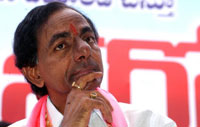
 An important development that needs to be noted is that after K Chandra Shekar Rao gave up his fast protest on November 30, 2009, well known Maoist balladeer Ghaddar organized wide spread protests and later the top leadership of Maoists including Kishanji @ Mallojula Koteshwar held various protests programmes through students of Osmania University and other universities of Telangana. Thus, while students’ involvement in the Telangana agitation became very intense due to the encouragement of the local committees of the Maoists, the Telangana Rashtra Samithi (TRS) was also forced to utilize simmering discontent among the students.
When the intensity of the agitation by TRS started ebbing down, Ghaddar floated a new front called Telangana Praja Front (TPF) on the instructions of the underground\cadre of the Maoists to sustain the agitation for a prolonged duration. This front which is totally Maoist-backed and motivated, tried to project itself as an alternate to KCR and TRS. Thus, the report argues the Maoists are trying to make a comeback through the Telangana agitation.
The impact of possible growth of Maoist/ Naxalite influence in Telangana has to be evaluated in the right perspective keeping in mind that a large number of important and sensitive industries are located in and around Hyderabad.
 Communal Violence: Describing Telangana as having several communally-sensitive areas and admitting that a sense of mutual suspicion exist between the two communities, Justice Srikrishna Commission report warns that “if communal passions become an additional factor in an atmosphere where unemployment, social unrest etc. exist, it may give rise to birth of militant jihadi elements.” it goes on to warn that “both the right wing political parties will be competing to expand their bases in Telangana state and in the process will try to ignite passions creating potential for communal unrest.”
The part of the report, not made public, on “Law and order and internal security dimensions” includes communal flash points and areas vulnerable to riots such as the main Hyderabad city, Nirmal and Bhainsa of Adilabad, Nizamabad, Bodhan and Kamareddy of Nizamabad district, Jagityal, Korutla, Karimnagar towns of Karimnagar district, Zaheerabad and Medak town of Medak district, Nalgonda, Bhongir areas of Nalgonda district, Mahbubnagar and Narayanpet, of Mahboobnagar district and Tandur and Vikarabad of Rangareddy district.
“Telangana has large number of Muslim pockets and to counter Muslim influence, Hindu fundamentalists may compete with them and try to polarise the Hindu population. This unhealthy competition between Hindu and Muslim fundamentalist groups may tend to reduce the influence of the mainstream secular political parties like the Congress and the Communists in the long run,” the report states.
The All India Majlis Ittehadul Musalmeen (AIMIM), the main Muslim political party of Andhra Pradesh, BJP, RSS and the Vishwa Hindu Parishad (VHP) have a reasonably strong presence in the Telangana Region and in general take to inciting passions and indulging in communal rhetoric at the drop of a hat. Both political parties (AIMIM and BJP) will be competing to expand their bases in Telangana state and in the process will try to ignite passions creating potential for communal unrest.
Frustration to escalate: With statehood and Hyderabad as its capital, although emotional aspirations of the people of Telangana to have their own state will be satisfied, economic expectations, including enhanced job opportunities which they naturally expect, may not actually materialize. This may lead to frustration among the youth (who are in the forefront of this agitation), professionals and even farmers. “This frustration may lead to ‘scape-goating’, leading to targeted attacks on Seemandhra settlers and their properties” the report warns.
Investment flow, employment to be affected: Further, the report reminds decision makers of a stark reality: most industries are located in and around Hyderabad. With the bifurcation of the state and Hyderabad in Telangana region, incidents of agitations, dharnas and even violence, are expected. This may result in flight of capital, stagnant growth and disincentive for entrepreneurs, leading to slow down of economic activity. “In the short term Hyderabad may witness a vicious cycle of agitations, slow down of economic activity and greater frustration,’’ the report cautions, adding: “These factors along with irrigation/water issues would have a definite adverse impact on revenue generation and industrial development of the state and may actually offset any gains in terms of additional employment opportunities and promotional avenues that will emerge.”
The Justice B N Srikrishna Committee report has also called for a medium and long term strategy to tackle internal security, pointing out the high possibility of immediate agitational backlash. “The mechanism essentially should cover three areas i.e. i) political management and sensitization of political parties ii) media management and iii) high level of preparedness by the state government ( administration, police, intelligence,) with adequate support from the centre.” It would also be necessary to have in place a mechanism for monitoring the situation and collection of real time intelligence with a view to ensure taking up of effective advance action to preempt any break of violence in the potentially troubled spots.
The committee also identified the likely troubled spots (Osmania, Kakatia, Krishna Devraya Universities) and suggests that trouble makers in the three regions must be identified in advance and suitable action plans prepared for keeping them in check.
The five-member Srikrishna Committee in their deliberations with the state law and order machinery, also discussed the kind of equipment and weaponry to be used and it was generally agreed that it should be such as not to cause fatal injuries, while at the same time effective enough to bring agitationists quickly under control.
The report has also called for the National Integration Council (NIC) to play a pro-active role in the state with a view to foster a sense of harmony amongst different communities so that divisive conflicts are taken care of, disorder and violence is avoided and the important goals and objectives of socio-economic growth are achieved irrespective of the fact whether the division of the state takes place or not. At the moment, though, it can only be secribed as wishful thinking.
With a new Telangana crawling and shedding vestiges of the old Andhra Pradesh, the government would do well to heed warnings from the Srikrishna Committee report that has been deliberately hidden from the public.