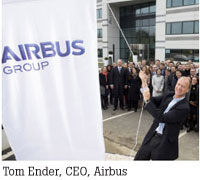
 AIRBUS: FLYING HIGH
After saying goodbye to 15-year old name EADS, Europe’s largest aerospace group took a flight into 2014 with the new brand identity Airbus Group, NV. Dutch-registered French-German-British-Spanish Airbus’s marketers were pretty delighted with the change as the too long and confusing name EADS always posed a challenge for their creative hats. Keeping the momentum the plane maker announced that its net profit rose by an impressive 22%, reaching 1.46 billion euros in 2013. While unveiling the plans to increase output of Airbus’s best-selling A320 jets to 46 planes a month from 42 at present by 2016, CEO Tom Ender pledged, “We’re not planning new adventures in 2014, the focus is on execution, execution, execution”. The arch-rival Boeing also targets to ramp up production of its jet 73 to 47 a month by 2017. Airbus has its eye on the Middle East as the most important market, as it bagged an order for 50 A380 jetliners worth $20 billion from Emirates recently.
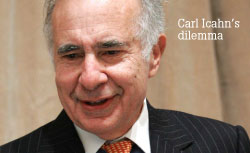 What’s ‘Cook’ing in Icahn’s mind?
Legendary investor Carl C. Icahn surprised Wall Street with his announcement that he is dropping his campaign that began last August when he demanded Apple to buyback stocks worth $50 billion by September-end this year. Icahn, who is Apple’s top shareholders, had been echoing his views by regular TV appearances, twitter feeds and his website on how iPhone manufacturer is undervalued and needs to pay more money to its shareholders. The activist investor took a U-turn after ISS, a top shareholder advisory firm, suggested Apple shareholders to vote against Icahn’s proposal that was scheduled to vote on February 28. Commending CEO Timothy Cook’s ‘opportunistic’ and ‘aggressive’ efforts, Icahn has justified his withdrawal in an open letter saying that he finds “no reason to persist” Apple to return more cash to its shareholders as the company has already accelerated its pace of stock buyback. Apple has repurchased $14 bn of stock in the recent weeks. He also and denied publically of selling any of his Apple shares.
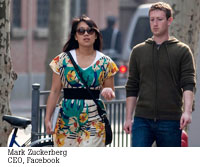 Whats up Facebook?
Facebook CEO Mark Zuckerberg who recently topped the giving list for US philanthropists in 2013, announced that the company is making its largest acquisition by buying smartphone-messaging app company WhatsApp Inc. for $19 bn. Facebook will pay WhatsApp founders Jan Koum and Brian Acton (who was declined a job at Facebook) and its 55 employees $4bn in cash, $12bn coming in stock and $3bn in restricted stock over a span of four years. Explaining why it makes sense to buy Whatsapp, Zuckerberg posted on his Facebook wall: “WhatsApp is used by over 450 million people on every major mobile platform…and it is on its way to connecting one billion people…We’re going to work hard to help WhatsApp grow and connect the whole world.” With the dreams of being on every mobile in the world, WhatsApp has also unveiled its plans of launching voice calls soon.
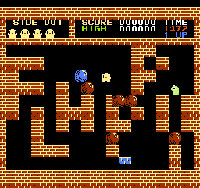 GAME OVER FOR FLAPPY
It was a blow to millions of gamers when 29-year-old Dong Nguyen mysteriously withdrew his free game Flappy Bird from the online marketplace, citing the reason as: “It was just too addictive. So I decided to take it down.” Flappy Bird took a little flight since its launch in May last year, but became a global phenomenon since January when Swedish gamer Felix Kjellberg (better known as PewDiePie on YouTube) featured it amongst his favorite games. The craze can be gauged from the fact that the app has been downloaded about 50 million times and the YouTube video watched 9.8 million times – soaring Flappy Bird to the top of the app charts both in Apple’s App Store and Google’s Play. Some players were seen listing their iPhone on eBay for sale, specifically tagging “with Flappy Bird”. With so many clones like Fly Birdie, Flappy Bee, Splashy Fish etc, bombarding to satiate the addictive gamers, it seems the flapping will continue.
 PEPSI IN ‘MAGIC KINGDOM’
PepsiCo after a period of 25 years succeeded in breaking its rival Coca-Cola’s monopoly with Walt Disney, a realtionship that dates to 1950 when the first Disney television show was aired and 1955 when the first Disneyland park was opened. The company with Tingyi Holding Corp.has signed a deal with Disney’s upcoming Shangahi Disney Park in the dragon land to supply the beverages. PepsiCo is also looking to develop develop exclusive beverage equipments for guests visiting the resort. Although the deal forms a tiny fraction of China’s huge soft beverages market of $69.2 billion, Disney’s switch to PepsiCo definitely marks a blow to the Coca Cola’s long-standing tie-up with the theme park operator. The Coca-Cola presently provides soft to Disney’s 11 theme parks in the US, Hong Kong, France and Japan. The Disney win can do wonders for Pepsi in other markets as well.
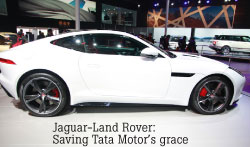 TATA MOTOR IN TOP GEAR, THANKS TO JLR
Tata Motors purchase of British luxury car maker Jaguar-Land Rover (JLR) in 2008 is helping it ride on solid profits despite the gloomy performance in the domestic market. Tata Motors reported a three-fold rise in consolidated net profit to Rs 48.05 billion in the quarter ended December 31 over Rs 16.3 billions year ago. Net sales too jumped by 39%, reaching Rs 63.5 billion. However, the profit figure includes a one-time gain from a stale of stake in four overseas units. Also, it is JLR’s stellar showing that is driving profits for the parent company. The luxury carmaker clocked a profit of $1.01 billion during the quarter ended December 31. In January, it had also reported of19% rise in global sales, selling 425, 006 units worldwide in 2012. There is a soaring demand for JLR’sF-Type convertible and Range Rover SUVs in key markets, including China that accounts for one in every four models sold by JLR globally. The point of worry for Tata Motors is the domestic turf where the sales fell drastically by 35.7% to 132,087 units from the year-ago period.
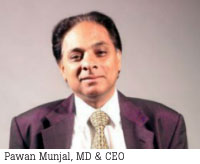 HERO’S TURKEY RIDE
After Africa and South America, India’s largest two-wheeler maker Hero MotoCorp has now set its foot in Turkey, heading towards its aim of reaching 50 global markets by thye year 2020. India’s leading bike maker has signed an agreement with AsyaMakina, a subsidiary of Soysal Group, to distribute its vehicles through its network of 50 outlets. Hero plans to use Turkey as agateway to enter the big European market. While inaugurating Hero-Asya dealership at Camlica in Istanbul, Hero MotoCorpalso launched its 125cc motorcycle Glamour, 150cc bike Thriller and 100cc scooter Pleasure. Saying that the entry in Turkey is a significant milestone in Hero MotoCorp’s global expansion plans, MD & CEO Pawan Munjal further mentioned how his company looks at providing convenient, fuel-efficient mobility to every two-wheeler customer across Turkey. With this foray, Hero MotoCorp is eyeing owning a five per cent market share and selling 2,00,000 units in Turkey. After breaking up with Honda two years back, Hero MotoCorp is now spending heavily in R&D, which was quite clear from company’s huge range of vehicles displayed at the recently concluded Auto expo 2014. Indeed another key step to meet global ambitions.
 FOR EBAY, IT’S A ‘SNAP’DEAL
With the Indian e-tailing industry set to grow explosively to$56 billion in 2023 from a meager $2 billion at present, the online space is witnessing a lot of action from foreign players – the latest beingeBay increasing its stake in India’s second largest online retailer Snapdeal.com to tap the huge opportunity. The US-based e-tailer has pumped in $133.77 million to increase its share of pie from $50 million, which it had funded last April. Both the companies have refused to share any financial detail. The move is towards strengthening eBay’s position against Flipkart and Amazon, which launched its India website in June last year. Analysts are also speculating a complete buyout of the Indian portal by eBay to build a large online presence in India. Devin Wenig, President of eBay Marketplaces indicated the same in an interview to a top technology website that “When we make an investment and are cooperating with a third-parties like Snapdeal, we hope to be successful and hope eventually we can take the next step”. Snapdeal.com, which started in February 2010, today boasts of owning a marketplace with over 20 million members, 500 plus product categories and over 20,000 sellers, banks, staff, vendors and others.
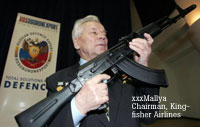 KALASHNIKOV EYES INDIA
The creator of the AK-47, the legendary Russian gun designer Lt General Mikhail Kalashnikov, who died in December at 94, had never returned to India after his unpleasant visit in 2004. But his company Kalashnikov Concern, one of the largest gun makers in the world, eyes India as “a very promising market” and plans to start producing the small arms and high-precision weaponry here in 2014, considered as the biggest market of Russian weapons. The Indian unit would churn 50,000 weapons a year. Kalashnikov had reported losses to the tune of $49 million in 2013 and is looking at streamlining production and exploring foreign markets aggressively. Setting India operations indicate a move towards the revival strategy. Kalashnikhov has also recently inked a contract with the Russian Weapon Company, an American dealer of Russian firearms, to sell up to 2,00,000 hunting units to customers in the US and Canada.
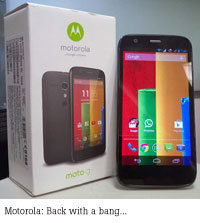 IT’S “HELLO MOTTO” AGAIN
Motorola, which once ruled Indians’ hearts is ringing its iconic ringtone again, is back in India after a gap of two years with its Moto G smartphone, priced at Rs 12,499 (for 8GB) and Rs 13,999 (for 16GB).An Android 4.3 (Jelly Bean) Moto G with the 4.5-inch IPS LCD display was declared sold out with in hours of its launch by Flipkart, the e-commerce website through which it is selling exclusively in India. The company has not declared any plans on being the shelves of physical stores yet. Moto G sports a 5 MP rear camera with LED Flash and a 1.3 MP front-facing camera with a battery capacity that keeps the phone running for up to 24 hours. Soon it will be upgraded to 4.4.2 KitKat. Motorola looks quite optimistic with India return as it shared plans of launching its flagship phone Moto X in India at the Mobile World Congress.