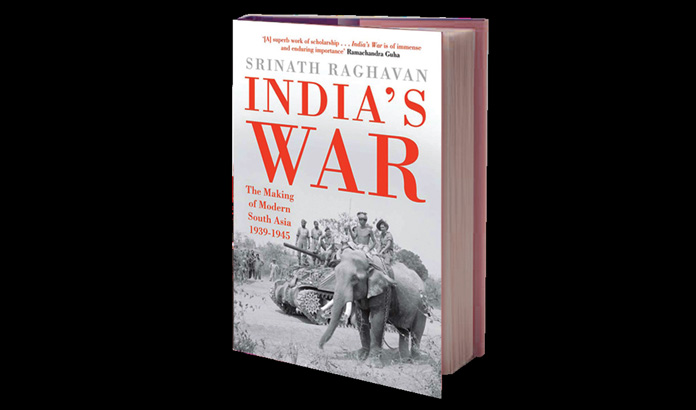
The loss of Burma to the Japanese and its subsequent recapture four years later makes for a very engaging read
Let’s start with the full disclosure first. I was initially very sceptical of reviewing this book. I had not really liked Srinath Raghavan’s previous work on the 1971 War for various reasons, and I was sceptical that I would be left disappointed this time too. But then I had liked his previous scholarships and it was sufficiently motivating factor. That and absence of any better book for review. At the end of this almost-600 pages leviathan, I say, it was a good and deeply gratifying decision. To tell the truth, my initial scepticism was not entirely because of Raghavan’s last work. It has in fact more to do with some of the scholarships that were produced on this subject previously. As recent as in 2015, Oxford historian Yasmin Khan tried to address the issue of Indian soldiers fighting for the Empire in the World Wars and ended up producing a good but a tad self-indulgent book by the name of The Raj at War. On the other hand Cambridge academics Christopher Bayly and Tim Harper’s Forgotten Armies (2005) and Forgotten Wars (2007) were too academic for casual readers. Raghavan, an ex-soldier himself, strikes a careful balance without sounding laboured even once. That’s no less a triumph in itself. The book is divided into several sections each of which deals with a particular aspect of the campaign. A section deals with the political aspect of the mobilization for the war efforts. The fissures inside the Indian political class of that time is brought forth without even once sounding judgemental. It is interesting to read how different personalities saw the World War II through their own prism. While Gandhi and his aides wanted to bargain dominion status in lieu of helping British Empire defeat Nazism; Nehru, an anti-Fascist in his heart, was the most aware on about the consequence that the triumph of Nazism would unleash. Other leaders had their own motivations. Vinayak Damodar Savarkar saw it as an opportunity to infiltrate more and more Hindus into what he though was essentially Sikh and Muslim dominated army. Babasaheb, an anti-Fascist in ideology, also saw it an opportunity for the Dalits to enter in large numbers. Dalits, although part of the British Indian Army since its initiation, had seen their numbers dwindling when British manufactured and started acting upon on the concept of ‘Martial race.” Other sections deal with the exploits of Indian troops at several fronts in Indochina, Middle East and Northern Africa. Raghavan’s detailed accounts is informative without being either cumbersome or emotional. In fact it is his dispassionate tone that sets this book apart from the similar scholarships that has been produced in the last decade and a half. The big picture that he draws here puts India as a regional power in its own right, rather than through its projection as part of the British Empire. One particular section that needs to be mentioned especially is the campaign in Burma. The loss of Burma to Japanese and its subsequent recapture four years later makes for a very engaging read. Especially fascinating is the efforts put by officers and soldiers alike in boosting the broken morale, and preparing themselves to take on enemy in a terrain that they were not accustomed to fight in. Jungle warfare was introduced as part of the training and ace hunter Jim Corbett was roped in to familiarise the soldiers about the nuances of the Jungle. His books were made a compulsory read and Romanised Urdu translations of the same were provided to the British officers so that they can read it to the soldiers. Equally engaging, if not more, was the political tussle between the Indian political leadership and Churchill over the possible independence of India. The American pressure on London and the latter’s propaganda blitz to discredit Indian efforts gives us our first glimpse of how propaganda was used to achieve a short term political goal. The counter propaganda mounted by American journalists Louis Fischer of The National, and Edgar Snow, the author of Red Star over China and a correspondent with the Saturday Evening Post is equally engaging. The book also tries to contextualise the role of Subhash Chandra Bose and his Indian National Army in a no-nonsense, dispassionate manner. This was something which needed to be done especially in the light of nationalism overdose that we are getting lately. “Netaji and the INA’s effort were quite important, no doubt.
I do bring out in the book that the INA’s importance was not really about military contribution, but political impact. It had about 25,000 soldiers, prisoners of war captured by the Japanese, who went over to form Netaji’s Army. The Indian Army was about a hundred times larger, 2.5 million Indians. So why should we only valorise 25,000 people and try to say that recognising the others is somehow a denigration of national history? That’s the lens I am trying to move beyond. Just because some people were in the Army doesn’t mean they wanted British rule. Many fought simply because it was a job; others needed access to food,” Raghavan says in an interview. The role of Indian soldiers in the World War was recognised very late. And by the time it was finally done, popular imagination had moved beyond the WWII. This book is a superb effort in correcting that historical wrong.