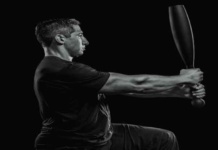
Manohar Aich and Muhammad Ali: A study of lives in contrast…
London: 1952: As the lights hit the stage, a bronze statue of epic proportions, comes alive. No, not very big, but it’s magnificent. With muscles like mating pythons writhing under the thin latex-like skin, the heroic figure, cast in flesh and blood, a chiselled mass that would have made Michelangelo proud, floats and thumps across that stage to a rousing ovation till it hits a final pose of triumph in the heart of the spotlight and stills into a bronze sculpture again. But now when the crowds rise and the applause rises to a crescendo above the gasps of admiration that had first pierced the silence in the hall, you begin to realise that this is no Grecian god wandering off its pedestal but a mere mortal… and yet, what an amazing little mortal.
Manohar Aich walked on to a stage that had once wheezed under the feet of immortal giants like John Grimek, Reg Park and Steve Reeves, (and with Bill Pearl, Frank Zane and an Austrian kid who they called the Oak, who can still be seen walking through Republican office walls in California but whose name I now forget, to follow), and made it his own, his coronation throne, where he was crowned Mr. Universe – the man that lived in the finest physique of its time.
Sometime around 1952: Louisville, Kentucky: On a warm summer day, a boy of colour, less than 10 years of age, accompanies his mother to a store where the little child feels thirsty and asks for a drink of water. But this is Louisville, once one of the biggest slave markets in America. Racial divisions ran deep through the state of Kentucky in those days. Racial segregation was an accepted fact of daily life in the state and too bad if a child was thirsty. If he is black, they wont cut him no slack. Little Cassius Clay Jr. and his mother were humiliated and he was turned out crying and thirsty from that store that day.
By the time the boy was 24, he had won Olympic gold for the USA in boxing (and then, symbolically rejecting his relationship with that moment of national and personal glory by, as some legends say, throwing his medal into the Ohio river after being refused dinner in a ‘whites only’ restaurant), converted to Islam to reject the slave heritage inherent in his Christian name, and refused conscription during the Vietnam war, claiming disenchantment with American foreign policy (in a broad sense) and treatment of people of colour in the United States, and citing his Muslim faith that does not allow him to participate in a “Christian War”. In between, he had also become the World heavyweight boxing champion and a media sensation for his lightning quick hands and feet, his razor sharp with and colourful quips.
The boy from Louisville was known as Muhammad Ali now and was perhaps the most famous athlete of that era. But a prison sentence was looming over the champion’s head, because of his refusal to go to war.
Prison though turned out to be a boon for Manohar Aich. A decade before his triumph at the Mr Universe bodybuilding championship, in 1942, the very year Ali was born, Aich had been drafted into the Royal Air Force in British India. That is where he was introduced to the sport of bodybuilding by a British officer. However, it was another British Air Force officer who gave his career greater impetus by making disparaging comments about the Quit India movement and India deserving her colonial chains. Aich, in his own way, stood up for his people and his country and slapped his superior officer for those words. An immediate court-martial and jail term followed. However, in the monastic environs of a prison block, Aich immersed himself in his physical training regimen. The jail establishment was supportive of his endeavours and Aich emerged looking like a tiny titan from behind those bars after independence. Aich and Ali were the greatest athletes of their generation in their respective sports. While Ali took the world by storm with his fists, phrases and his mega-heart, both inside and outside the ring, Aich kept ploughing a lonely furrow in relative obscurity as he built his own monument to health, strength and longevity in his own muscle and sinew.
Ali took on some of the most fearsome boxers of all time, Sonny Liston, George Foreman and Joe Frazier, and with a sublime display of courage, character and charisma, won belts, championships, million dollar contracts and hearts around the world. Aich’s world wasn’t as well lit, the arc lights not as bright. But within the limited halo of his sport, Aich kept shining like beacon, for the little guys, for every India and Indians, for the pride of a young nation with an old history, helping in his own little way to straighten out a spine bent under the humiliating yoke of being a colony. Glory, unlike Ali’s bolts of lightning on the global stage, were limited to admittedly spectacular and locally celebrated feats of strength – like vaudeville circus acts of lifting great weights, bending steel and breaking chains – and physique shows, but mere starlight in the night sky compared to Ali’s blazing comets that singed our collective consciousness as they streaked through the decades of the 60s and 70s.
Both got pushed into taking a political stance by their circumstances, early in their careers, and became heroes for it. And long after retirement, larger than life Ali was still busy crisscrossing the globe as a goodwill ambassador, as a black man, as a Muslim, as an American, as a champion and as a United Nations representative.
Closer home, Aich got involved with local causes, encouraging local youth to take up a healthy lifestyle and pursue the acquisition of strength and health. Eventually, Aich jumped into mainstream politics, contesting elections in the 90s.
Aich was an icon. Often forgotten, but always there. Whenever the cupboard of sporting glory and national pride, felt bleak and bare, India and Indians could turn to the familiar and comforting touch of Manohar’s muscles – a unique champion whose light grew stronger as the years grew longer.
Ali on the other gloved hand, was the greatest athlete of his time, perhaps of all time. Countries, presidents, dictators, heroes and anti-heroes, they all loved to love Ali, and with a playful jab, a charming smile, a witty word, and a soft whisper, Ali moved mountains, built bridges, healed wounds, rescued prisoners and changed lives.
And yet when in the first week of June 2016, both Ali, at 74 and Aich at 102 exhaled for the very last time into the worlds that they had life into with their inspiring lives, one wonders who might have had the greater regret, if any at all.
Boxing gave Ali the platform which launched his winning personality into our midst and the ornate pages of the history of our world. And yet boxing gave Alzheimer’s, a disease that crippled his mind and his body and tortured and perhaps humiliated the greatness of the man on his long slow unsteady trudge from the ring to the grave. Was the pain of the disease, worth the gain? Could he have done more if he had boxed less? Would his sun have shone less brightly if he had been an artiste or perhaps even a body-builder…or just a political activist?
And surely Aich would have wished for more glory. Surely his greatness deserved a grander tribute. He prayed at the altar of health and fitness, sacrificing his sweat and offering his commitment to the iron in his hand and in his soul, and it paid him back with an adamantine body and mind, both chiselled to perfection and as strong as steady at 90 as they were at 19, well yeah, thereabouts.. Did he at times wish he had picked a different sport? Wrestling perhaps? Or the movies? Perhaps, if he had chased glory for his physique instead of just coming by it because of his physique, the greater recognition could have helped him touch more lives. He would have break the mould, try different things and sacrifice a bit of discipline for it. He might have picked up a little bit of a blood pressure problem in his later years and lived a few years short but his fame might have been greater.
lived a few years short but his fame might have been greater. Would they done it any differently, either of them, if they could have? Would they have exchanged health for glory and lived the other’s life, if they could have?
We will never know, and yet we know, for at least when it comes to our own lives, we make these choices too? Do I go for glory? Do I go for what is healthy? Or as perhaps is more often the case for you and me, we bypass these arduous paths and go for the well paved one.. I go for what is easy…
And that is why unlike these two gentlemen, may their souls rest in peace, when you or I make our exit, we wont have nations and continents mourning, just a family or two.. if we are lucky.
But then, if you are reading this and I am writing this, we still have a choice to make, and I hope when the time comes, we too would exhale knowing we took the right path… the path of least regret.
expert Anupam Ghulati, who commentated for this match said, “I am much impressed. Let me be frank, none of us in the commentary team expected India to play so well.”
India raised the level of its game while it was indeed surprising to see the Australians fumbling. The world champions muffed eight penalty corners and a stroke in this title contest. “Nobody could imagine that Australians will waste a stroke,” Ghulati said, but added, “Let us not get carried away by our making it to the final. The fact remains that we lost it. We have a tough road ahead but this showing will definitely boost the morale of the players and now it is for them to live to the expectation they have raised.”
Ace defender and former India captain Pargat Singh was very careful with his words. “It was definitely a good show. It was our maiden final and the boys showed they have the capability and capacity to raise the game. However, I want to caution the players not to be overconfident or complacent,” Singh opined. Pargat, who is now an Akali Dal MLA in Punjab, further added that “Indians will now be under scanner from other teams in Rio. This superb showing in London can also become problematic for India in Rio because all the other contenders will not take them lightly and they will have different plans in place to meet this new threat’ coming from the former Asian giant.”
This may be true, as this euphoria after the second place finish at London can turn out to be double edged sword. It can boost the morale of the players but can also put them under severe pressure. Sometimes, it is better to have an underdog tag because then the team is not on the radar of other title contenders. It gives a chance to prepare quietly without being under constant glare.
Another former captain Zafar Iqbal, who led India at the 1984 Los Angeles Olympics also echoed Pargat’s view saying that though he was mighty pleased with this show, India will now have to be circumspect more.
“I am impressed because the team played some excellent hockey and they tested the might of Australia in the final. It was pleasing to see players maintaining their cool and never getting ruffled, while the Australians were flustered and panicky. They also tended to be physical,” he added to good measure.
How we handle that pressure at the Olympics will be very crucial. Olympics is at a different level altogether. Teams will come with different tactics and players, so one cannot compare these two events. India finishing second in London does not obviously mean that it will be second at Rio.
There are some views that Australia and Germany did not send their full teams; but the statistic tells us a different story. Australia had 11 of the 18 players who played in the 2014 Champions Trophy. Similarly, Britain had 13 players, Belgium 15 and Germany had 7 players who figured in the last edition of the competition. India were without their regular skipper ace midfielder Sardar Singh and drag flicker Rupinder Pal Singh.
Coach Roelant Oltmans’ decision to give chance to some promising youngsters yielded handsome results. Harmanpreet, Mandeep Singh, Surender Kumar and Pradeep Mor were very impressive on the field. Defender Harmanpreet was even named the Best Junior Player of the tournament.
Off the field, India’s 6th foreign coach, Roelant Oltmans, is turning out to be a lucky mascot. One hopes he will be able to guide the team to a podium finish at Rio or at least end among the first six. Oltmans, who is being praised by all and sundry for the team’s showing, must be aware about the fate that previous foreign coaches met after their failure to live up to the huge expectations of the people and federation.
His predecessors – Gerard Rach, Jose Brasa, Michael Nobbs, Terry Walsh and Paul Van Ass – all were either sacked or forced to quit. The 61 year old Dutchman was initially appointed Director High Performance but after the sacking of Van Ass last year, Hockey India named him the coach of the men’s national team till the Rio Olympics. His tenure is likely to be extended if the team does well at the Games.
Oltmans who has also coached the Dutch and Pakistan teams, was justified in his jubilation saying, “The way India performed in the title contest has boosted our faith of a fine show in the Olympics. I’m delighted with my team. By all yardsticks, their performance in the final was outstanding. I am proud of what we’ve been doing as a team. Our performance is getting better with every tournament. Any coach would be absolutely pleased with this Indian show.” He added, “We’ll use the confidence gained here at the Champions Trophy to give a better display in the Olympic Games at Rio de Janeiro.”
There is no gainsaying the fact that Indian hockey is at a crossroads. After several decades, it is on the verge of a spectacular take off. The nation will wait expectantly for the Olympics to see if the storm in this teacup becomes a tempest or not.