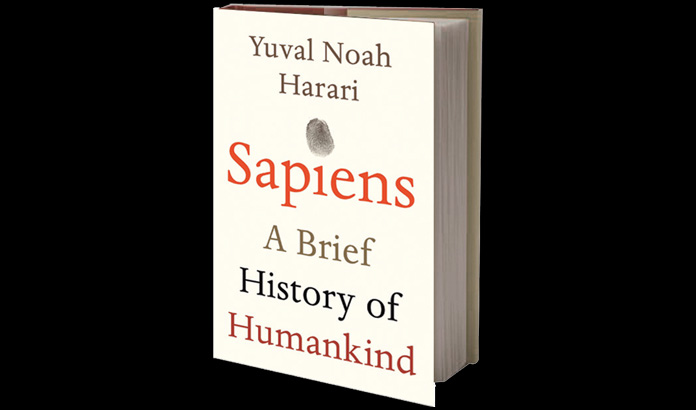
Science books for general readers is probably the most difficult genre that there is. Most writers tend to either sound too academic or too frivolous. The sweet spot that is somewhere in the middle is more likely missed than found. But still, every now and then comes a writer, or more appropriately a book, that takes the world by storm. Perhaps not as big a storm as the Harry Potter series did, but still, on the top of my mind, I can name books like A Short History of Nearly Everything by Bill Bryson or Carl Sagan’s Cosmos. Notwithstanding his batshit rants these days, Richard Dawkins was once a great writer as well. But as I said, they are few in numbers. Therefore, when I picked up Yuval Noah Harari’s Sapiens: A Brief History of Humankind, I picked it with certain trepidation. But let me say this at the very onset that this was probably the shortest trepidations in the history of all my trepidations. Sapiens gets cracking from the word go. As pompous as the title might sound, Sapiens achieves what he set out for. Speaking strictly on classification, the book deals more with social anthropology than it does with the physical one; but the amalgamation is such that you hardly notice the transition. The book deals with several theories that are or were in fad. It critically analyses many of them and comes up with some of its own. However, this might be the only book on the subject which is this irreverent in its tone vis-à-vis Homo sapiens. In fact, too irreverent at times for comfort. The primary basis of Harari’s argument are the three revolutions that have marked the history of the human races. It is these revolutions which have shaped its contours, says the book. “Three important revolutions shaped the course of history: the Cognitive Revolution kick-started history about 70,000 years ago. The Agricultural Revolution sped it up about 12,000 years ago. The Scientific Revolution, which got under way only 500 years ago, may well end history and start something completely different. This book tells the story of how these three revolutions have affected humans and their fellow organisms. There were humans long before there was history. Animals, much like modern humans, first appeared about 2.5 million years ago. But for countless generations, they did not stand out from the myriad other organisms with which they shared their habitats,” writes Harari. But that is not all. It critically analyses several aspects of human life through fresh perspective. Take for example religion. The modern, scientific, man takes pride in his rejection of religion. And that is only logical. For it is by separating religion from science that the modern revolution started. But lately, and with more than a little help from scientists like Richard Dawkins, new-atheism has turned into a cult too. While its proponents are mostly bigots in disguise, their scientific knowledge gives them the veil of respectability. But Harari tackles the issue with great aplomb. Much to the chagrin of the new atheism crowd, he traces religious ritual to be one of the reasons why humans settled first and formed a community. It became the basis of further developments. On the other hand, he is almost scathing in attacking the role that Homo sapiens played in the extinction of several species of flora and fauna. He analyses several evidences and reaches the conclusion that whenever in the history Homo sapiens have populated a land, it has seen drastic fall in the number of native species. “The first human footprint on a sandy Australian beach was immediately washed away by the waves. Yet, when the invaders advanced inland, they left behind a different footprint, one that would never be expunged. As they pushed on, they encountered a strange universe of unknown creatures that included a 200-kilogram, two-metre long kangaroo, and a marsupial lion, as massive as a modern tiger, that was the continent’s largest predator. Koalas far too big to be cuddly and cute rustled in the trees and flightless birds twice the size of ostriches sprinted on the plains. Marsupial mammals were almost unknown in Africa and Asia, but in Australia they reigned supreme. Within a few thousand years, virtually all of these giants vanished. Of the twentyfour Australian animal species weighing fifty kilograms or more, twenty-three became extinct. A large number of smaller species also disappeared. Food chains throughout the entire Australian ecosystem were broken and rearranged. It was the most important transformation of the Australian ecosystem for millions of years. Was it all the fault of Homo sapiens,” asks Harari. The book is full with other interesting bits too. Harari titles the Agriculture Revolution as the biggest fraud to be pulled on Homo sapiens. He goes on to prove how humans traded a miserable agrarian life over a much better hunter-gatherer lifestyle just for the sake of an unsure entity called “better future.” The race, as per Harari, has suffered since then. He also opines that while Homo sapiens domesticated every other specie for its benefit, it was wheat that domesticated Homo sapiens for its own survival. The book is a riveting read. I would have never imagined that one day, a non-fiction on anthropology would read like some page-turner Scandinavian crime fiction. But yet it does. That it manages to do so without sounding frivolous is this book’s and of course Harari’s greatest achievement.
 Who was Narasimha Rao? For party grown sycophants, or for those belonging to the Congress or subscribing to its ideology, the question is quite blasphemous as one never wishes to annoy the powers that be. Still, the question is an important one. If Pandit Jawaharlal Nehru, the country’s first Prime Minister, laid the foundations of a modern, democratic, and secular India, it was P V Narasimha Rao who scripted the economic reforms era, carefully wading through turbulent political waters of his time. There is not a single comprehensive book since his death in 2004 that captures Rao’s legacy. But that nugget changed recently. Half-Lion: How PV Narasimha Rao Transformed India, by Vinay Sitapati is by far the best book in this genre till date, specially because of its critical assessment of the former prime minister. Although the book is sympathetic towards him and ranks him amongst global leaders and revolutionaries, yet, it is not a hagiography. The author, a political scientist who teaches at Ashok University, at the outset places the hypothesis that Narasimha Rao was in reality India’s true transformational leader since Nehru. In the penultimate pages of the book, he answers the validity of this hypothesis on the basis of Rao’s lasting legacy. “Narasimha Rao’s legacy also manifests in the everyday lives of the most Indians,” is one line of the author that gives insights into the author’s bent. Yet, he builds and equally demolishes Rao’s personality and how Rao did what he did. This the author achieves by interviewing more than a 100 people who knew, who worked or who loved or loved to hate Rao and by exclusive access to Rao’s never-before-seen personal papers. Rao was denied a funeral in Delhi and did not have a memorial in the National Capital Region, for reasons that are not necessarily formally documented. Comparatively, memorials of the Nehru-Gandhi clan dot the banks of Yamuna quite expansively. It was only after the Modi government came to power that a memorial to Rao was commemorated at Ekta Sthal, worthy of his post. Apparently, the Congress Party, which was in rule for a decade in Andhra Pradesh (where Rao was eventually cremated) did not build a memorial despite a promise to his family. With this incident in the first chapter, Sitapati sets the tone and tenor of his treatise in political gamesmanship. Having perfected the nuances of describing issues at Indian Express, the author uses his well honed skills quite competently over the next 14 chapters, moving from one narrative to the other seamlessly and immersing the reader into the life of Rao. Born into a Brahmin family in 1921, in Vangara, situated in the Karimnagar district of Telengana, Rao took part in the freedom struggle. A disciple of Ramananda Tirtha – who mentored many of the post-independence politicians – Rao’s participation in the anti-Nizam struggle also shaped his political philosophy for the rest of his life, ensuring that Rao became secular, religious and paradoxically radical, all at the same time. After losing the 1952 general elections, Rao became a member of the state assembly five years later and was selected as a minister. As Indira Gandhi, the then prime minister, began to look for ‘yes men’ as chief ministers of states, Rao was the perfect choice as he was from the Brahmin community, with no factional backing and was an ardent advocate of land reforms and socialism. Quite on cue, two years later, when Rao was asked to resign, he did not rebel. After a brief exile, Rao was appointed as Congress general secretary in 1974; yet, he was pulled apart at the imposition of Emergency but remained mum on Indira Gandhi’s actions and the high-handedness of Sanjay Gandhi. Over the next few years, after holding key positions both in the party and government, Rao mastered the grammar of politics and steered away from controversies. For example, more than a dozen Congress ministers and leaders were indicted for their overt and covert role in the anti-Sikh riots in the aftermath of Prime Minister Indira Gandhi’s assassination. But it goes to the credit of Rao that he was cleared in each sitting commission investigating the riots, and this despite being the Union Home Minister in charge of law and order in the national capital territory at that time. Extremely dejected over not being allowed to contest in the 1991 Lok Sabha elections by Rajiv Gandhi, Rao began planning his life outside politics and Delhi. But both India and Rao’s destiny took a turn and he was instituted as India’s prime minister by a quirk of fate. The rest of the book delves deep into how Rao thereon shaped the course of politics, economy, society and foreign policy and survived his term. Besides managing the party and liberalising the Indian economy, Rao’s tenure is also significant for the Babri Masjid demolition. His error, the author notes, was in reposing faith in VHP, BJP, RSS and sundry Hindu gurus.” There are a significant many, as per the author, within the 131- year old Congress party who feel that Rao was solely responsible for decimating the support of the Muslim electorate. However, despite being a polyglot, Rao failed to communicate successfully with Sonia Gandhi. A great blunder was the advice he apparently gave to Ms Gandhi to stay away from politics. Consequently, he was humiliated till his death and was erased from the Congress party’s narrative. Yet, despite all efforts of the Congress, Rao, constrained by contradictions and all his failings, takes credit for setting India off on a new direction.