Success or failure depends on how well we perform in tests, examinations, interviews – both in personal and public life. The story is the same for each one of us, whether man, woman, child, teenager, professional, young, old, married or single, who is part of this mad race for success. By the time we begin to actually think and ponder over our actions, it is too late.
Radhakrishnan Pillai, a leading management and strategy consultant, in his book, Inside Chanakya’s Mind: Aanvikshiki and the Art of Thinking, points out how people lead their whole life without thinking, and helps us reverse this.
Looking at the title one may think the book belongs to the ‘do-it-yourself’ genre. But Inside Chanakya’s Mind, as the name suggests, is about the principles and experiments of the man called Vishnugupta, whom we know as Chanakya or Kautilya, the author of the Arthashastra, written in the 4th century BC.
We know little about Chanakya other than that he authored the Arthashastra
Arthashastra – a bestseller for 2,400 years and still going strong – is an unrivalled political treatise that has since been used by leaders across the globe. In Inside Chanakya’s Mind, for the first time, Pillai, the author of the bestseller, Corporate Chanakya, distils Chanakya’s age-old wisdom on how to think, and presents it for the masses through his practical and innovative approach.
So, can a person be taught to think? Several educationists and psychologists have argued in favour of developing thinking faculties in a child. The foremost and contemporary proponent of such an idea is the Malteseborn Edward De Bono, who had authored Six Thinking Hats.
Pillai argues that instead of loading a child with information, the child can be taught the right method of thinking-analysis, decision-making, prioritising, planning, structuring, critical evaluation and logic.
“You would question when questions are required. Accept others’ views when it is necessary. Think through all the consequences. Take calculated risks and, without doubt, you will be far more successful. You will be successful not only at the very end, but also at every stage of your life,” writes Pillai introducing the book, stressing on the need to develop the faculties of thinking.
Most of us know little about Chanakya other than the fact that he authored the Arthashastra or that he played a significant role in the establishment of the Mauryan Kingdom. But Pillai has a doctorate in Arthashastra!
Pointing out that the process of thinking is called ‘aanvikshiki’ in the ancient Indian treatise; Pillai suggests that we read the Arthashastra as it teaches us how to think like a leader. After all, who does not want to be one?
‘Aanvikshiki’ is a Sanskrit word, that combines the two words, ‘anu’ and ‘ikshiki’ – the former means atom, the smallest part of anything and the latter means a person who wants to know more – an inquirer, a thinker, a researcher, an examiner or a logician.
Divided into ten chapters, the book explores the faculty of developing critical thinking over 212 pages.
Writing about the concept of alternative thinking, Pillai quotes Chanakya, the Raja Rishi, on the need to develop a solution-focused mindset rather than a problem-focused one.
Pillai, along the way, also narrates interesting anecdotes from the life of Chanakya, who tests and proves several dimensions of thinking. King Chandragupta Maurya became restless when Chanakya became unavailable. Therefore, the king along with his ministers resolved the problem. A few days later, when Chanakya appeared, the king touched his feet in reverence and requested him not to disappear, explaining that his absence meant there was nobody to guide him when he was posed with complex problems. A smiling Chanakya told the king not to depend on anyone to solve his problems!
There are so many nuggets of wisdom that flow from Chanakya, if one cares to listen.
Arthashastra is meant for both individuals and leaders from every walk of life. It has several eye-opening suggestions on the ways and means to operate the economy, conduct statecraft or maintain foreign relations.
Though management has branched out as a modern science and art taught and practised by millions, Chanakya points out that all management starts with self-management.
Pillai has taken several principles enunciated in the Arthashastra and stretched its application to the contemporary scenario. He has picked many aspects, such as town planning, provision of water, building of roads, voluntary services, consumer protection, crisis management, civic amenities, common facilities, public problems, and so on, as illustrated in the ancient treatise and related them to what could be attempted today.
Considered a top global management thinker, Pillai takes the liberty of tickling your mind with questions, one each for every chapter in the book, and provides a guiding sutra too.
Unlike many management books, Inside Chanakya’s Mind is a simple and easy read, even as it peeps into the past, and guides us on how to improve our thinking abilities and helps us realise that ‘Chanakya’ is us. Now it is for you and me to take up the challenge to explore our minds and be a part of adventure and action!
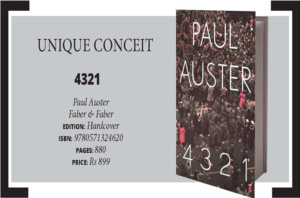 In 4 3 2 1, Paul Auster manages to conjoin gimmickry and genius. Not only that, but except for those who choose to dive into spoiler-heavy reviews such as this one before moving on to the novel, readers will find their perspective radically altered by a detail Auster unveils at its end. So much so that some may well go back for a second perusal – a phenomenon most authors spend their lives wishing for. It’s no mean undertaking, given that 4 3 2 1 comes close to a whopping 900 pages.
Archie Ferguson, born in Newark in 1947 to culturally Ashkenazi Jewish but religiously non-observant parents, comes of age in one of several locations in the Garden State … or else in New York City. During his childhood, his father dies in a suspicious fire at the furniture, appliance and electronics store he and his two brothers own … or he isn’t anywhere near the place at the time. A witty and politically attuned young woman named Amy becomes Archie’s girlfriend, or his step-cousin, or his stepsister. After high school, he relocates to Paris to soak up French culture and work on a book, unless he remains in the U.S. and enrolls in either Columbia or Princeton.
Like everyone’s life, Archie Ferguson’s could have turned out any number of ways
Got all that? On the face of it, the gimmick out of which the author constructs 4 3 2 1 appears unoriginal. In much of his fiction, beginning with “The New York Trilogy” (1987), Auster has wrestled with the tentacles of chance, which can jigger your frame of mind, scramble your plans, and prompt you to traverse this instead of that path, sometimes with momentous consequences. At first blush, it seems that 4 3 2 1 simply takes this preoccupation to an extreme.
Like just about everyone’s life, Archie Ferguson’s could have – in theory – turned out any number of ways. Auster maps out four such trajectories. (For some reason, he doesn’t arrange the text in the manner of one completed version of Archie’s life after another, but rather the first chapter of the first version followed by the first chapter of the second version, and so on, meaning that in order to trace one trajectory all the way through to its end, you have to skip over intervening material between chronological chapters.) In the early going, 4 3 2 1 resembles a Choose-Your-Own- Adventure book that enables the reader to participate in the story by repeatedly choosing from several options for advancing the plot, except here you select only the beginning and then see where it leads.
The novel’s unique conceit, made manifest only at its very end, is that the four written versions of the protagonist’s life were penned by the guy himself, and that one is true while the others are imagined. For Archie, “the torment of being alive in a single body was that at any given moment you had to be on one road only, even though you could have been on another, traveling toward an altogether different place.” So he decided to “invent three other versions of himself and tell their stories along with his own story … and write a book about four identical but different people with the same name: Ferguson.”
It might never have occurred to you that this is the case (for one thing, all four versions are narrated in the third person), but the setup proves plausible. In all four renditions of Archie’s life, even the one in which he dies at the tender age of 13 (the three others take the story up to his early 20s), he is intrigued by “what if” scenarios. Plus, he demonstrates avidity for reading as well as writing, a “compulsion for filling up white rectangles with row after row of descending black marks.”
Crucially, Auster reveals which account of Archie’s life is true. In doing so, he supplies the reader with material to interpret the three other versions in a manner far more penetrating than would have otherwise been possible. For example, in the story variant that you learn is in fact Archie’s autobiography, Amy becomes his stepsister and, despite or perhaps because of her affection for him, she prevents their relationship from taking the romantic turn he so desires. Knowing that this happened in Archie’s real life demands a reconsideration of those versions of the story in which the two do not become step-siblings and consequently give free rein to their amorous feelings for each other. Indeed, it now becomes apparent that Archie has long fantasized about such an alternative scenario.
The process works the other way around, too; certain story elements in the fictional versions of Archie’s life will induce you to examine the autobiographical account in a new light. What to make of the bisexual Archie in one of the three invented chronicles? Is he the real Archie’s alter ego? Do the explicit descriptions of sex with men reflect the real Archie’s desires – and can you glean as much from the autobiographical version, thanks to little indications tucked into corners that you failed to notice when reading it the first time?
In addition to retroactively altering your perception of the narrative, this information enables you to better parse the many layers of the story. Yet the author’s last-minute game-changer goes further, by making you aware of the true depth of your familiarity with the protagonist’s psyche. Having read the four constituent elements of this one-of-a-kind novel, you now realize that not only do you know what Archie did, you know what he thinks he would have done in wholly imagined situations.
 Masha Gessen’s riveting new book, Where the Jews Aren’t: The Sad and Absurd Story of Birobidzhan, Russia’s Jewish Autonomous Region, explores the tortured life of the long deceased Yiddish writer David Bergelson, who wrote beautiful short stories that echoed his literary heroes Chekhov and Flaubert. Bergelson always maintained a fierce love for Russia, the country of his forefathers. It was the only place he ever thought of as home, yet he and his family were repeatedly marginalized as Jews there. It was also where he was eventually charged as a traitor to the Bolshevik nationalist spirit and assassinated, at the age of 68, by firing squad in 1952, on a night that later became known as the Night of the Murdered Poets. He spent the last years of his life In Birobidzhan, near the Manchurian border, clinging to the slightest of hopes that the region would finally serve as a sanctuary for himself and his fellow Jews within Russia’s borders.
Masha Gessen’s genius lies in the pulsing questions that rattle her narrative
In 1929, the Soviet government set aside a sparsely populated area in the Soviet Far East for settlement by Jews called Birobidzhan. The idea of an autonomous Jewish region was championed by Jewish Communists, Yiddishists and intellectuals, who envisioned a haven of post-oppression Jewish culture. By the mid-1930s, tens of thousands of Soviet Jews, as well as about a thousand Jews from abroad, had moved there. The state-building ended quickly, however, with arrests and purges instigated by Stalin in the late 1930s. But after World War II, Birobidzhan received another influx of Jews — those dispossessed by the war. In the late 1940s a second wave of arrests and imprisonments swept through the area, traumatizing Birobidzhan’s Jews into silence and effectively shutting down most of the Jewish cultural enterprises that had been created. By 1948, the entire region was placed under a policy of Russification. Stalin, threatened by the creation of Israel, ordered that the Jewish identity of the place be eradicated. Yiddish books were burned in the town square. Yiddish was banned and Russian was the only language permitted.
Gessen’s genius lies in the pulsing questions that rattle her narrative. She forces us, by closely examining the life path of Bergelson and intertwining his story with her own memories of growing up as a Jewish girl in Russia during the 1970s, to examine questions and complicated truths Jews have grappled with for centuries — particularly Russia’s Jews. Gessen asks us to consider how they can possibly love a country that repeatedly rejects them simply for who they are. How can they forgive their neighbors for turning on them when the political currents shift? How can they cling to fantasies of acceptance when all evidence points to the contrary? How can they remain in love with a language, literature and culture that contains the seeds of their own destruction? Gessen shows us that Jewish identity is often a fluid force filled with conflicting desires. Jews have often been driven to negotiate for their place in the world. This has often involved living with compromise and self-denial, as well as a doublevision that allows one to see competing realities as somehow complementary. This is no easy task and is fraught with unseen dangers.
In 2009, before Gessen left Russia, she traveled to Birobidzhan to see what, if anything, remained of the Jewish world that had briefly thrived there. She found two large avenues, one named Sholem Aleichem and the other named after Lenin. The community struck her as a perverse theme park for Jewish curiosity seekers, even though almost all the Jews had disappeared. There was a Jewish synagogue, but many more Russian Orthodox churches to serve the predominantly Gentile population. There were no Jewish restaurants. A Chinese restaurant served Jewish cuisine, but used pork for most of its dishes. At her hotel restaurant, Gessen ordered gefilte fish, which was on the menu. But it is a dish traditionally served cold, and they served it to her heated.
Gessen visited the Jewish museum in Birobidzhan and found a picture of an old shtetl synagogue that is now a canning factory. A case holding Jewish objects featured a fiddle without strings. Another photo showed Bergelson and other Yiddish writers, along with a plaque commemorating the purges of the 1940s that ended with his death in 1952. Gessen realized later, with horror, that the museum made no mention of the Holocaust. “It was as if the Jews of the shtetlach from that first display case had just vanished,” she wrote, “disappeared into history for no apparent reason. It was as if there had been no reason for the new influx of Jews after the war. It was as though history, and Birobidzhan itself, had just happened.”
Both Masha Gessen and David Bergelson felt compelled to return to their Russian motherland and live their lives as secular Jews, even when there were blaring signals that Russia did not want them. Russia has never really wanted its Jews. Today, almost all of them have left for Israel, America, Canada or elsewhere. There are those who might see Bergelson’s and Gessen’s behavior as reckless and illogical, but Gessen’s extraordinary strength as a writer lies in her ability to show us the contradictory forces that drove both of them to such decisions. Her book is a series of stunning revelations about the immense complications of Jewish identity. It deserves to be read by all who remain challenged by it.
 Years ago, during one of my shooting-the-breeze sessions, a friend of mine raised the subject that there’s a sustained conspiracy in the West to separate Sufism from Islam. Or at least to project it separate from Islam. In doing so, he opined and I agreed, “West wants to present Islam as a rigid, monolith thing to be afraid of.”
His assertion made me think. The example that particularly struck in mind was that of Sufi poet and philosopher Jalaluddin Rumi. Read any translation or treatise on Rumi and you’ll immediately notice that he and others of his ilk have been massively de-Islamised. What is interesting – and important to mention in the era of Trump and Modi – is that this de- Islamisation of Rumi and the likes has mostly been done by the liberals.
The first thing that strikes about his book is the honesty that has gone in its research
A case in point is one of Rumi’s famous Rubais – the one that has been misquoted the most probably. It goes, “Azkufr-o ze-Islam berun, Sahraye-st maraba- meyan-e an faza, Sawdayestarifchoba- d-an rasidsar-ra beneh- ad nay kufr-o na Islam, na an-jajaye-st.”
The most popular – and also widespread – translation is: “Out beyond the ideas of wrongdoing and rightdoing; there is a field. I’ll meet you there. When the soul lies down in that grass, the world is too full to talk about. Ideas, language, even the phrase ‘each other’ doesn’t make any sense.”
This is extremely cute. The only problem is, this is a wrong translation. And in all probability a sinister one.
Do notice that the western translations have changed “Kufr-o-Islam” to either “wrong and right” or “wrongdoing and rightdoing”.
A more accurate translation reads “Beyond Islam and unbelief there is a ‘desert plain’. For us, there is a ‘passion’ in the midst of that expanse. The knower [of God] who reaches there will prostrate [in prayer], (For) there is neither Islam nor unbelief, nor any ‘where’ (in) that place.”
This de-Islamisation of Rumi has been going on for so long that the need for a really honest book on the poet was long overdue. In comes Brad Gooch with Rumi’s Secret.
The first thing that strikes about his book is the honesty that has gone in its research. Gooch has retraced the journey of Rumi through the entire Middle East and Anatolia, starting in 2011 from Aleppo in Syria. The Westbacked resurrection was still to start there. While travelling through the region, Gooch not only physically goes to the places where Rumi spent parts of his life, but also tries to understand philosophical and theological moorings that might have influenced the poet.
In Aleppo, he meets a rather colourful local who tells Gooch that “Like your American poet Whitman, Rumi was a great poet because he never revealed his secret.” The author in all probability draws the title from this conversation.
Rumi was born on September 30, 1207, in what is now modern Tajikistan. At the age of five, he told his family that he saw angels. His life was never to be same again. Around the same time, his family set out for a long winding journey of the region. When Rumi was still quite young he met poet Attar. This meeting left deep influence on his life to come. Gooch handles this segment very effectively and the readers can actually feel the transformation Rumi was passing through.
Because his father was a very learned theologian who was in demand all over the Islamic world, travelling came easy to Rumi. So much so that by the time he reached adulthood, Rumi had already seen the megacities of the era, namely Samarkand, Baghdad, Aleppo and Damascus, among scores of big and small towns and villages. His family finally settled in Konya, a rather cosmopolitan city in the Anatolia region with a much diverse population.
Middle East was going through a political and social upheaval and Genghis Khan and later his sons rampaged through the region burning and pillaging cities to ground.
Rumi, who saw divine Maslehat in these happenings, started to look deep inside. It was around the same time that he met Shams Tabrezi, whom Gooch describes as “a singular outlier mystic in a history crowded with extreme religious seekers.”
Shams Tabrezi was not a very lovable human being, but as a theologian par excellence, he influenced Rumi deeply. They struck a deep bond rather immediately, and often withdrew together for months. This is what made western writers – unaware that people of same gender can share platonic love – concoct the theory that Shams and Rumi probably were gay pals. That rumour has got a life of its own. Gooch leaves the question hanging. He insinuates towards such a relationship, and that is probably the only low point of this book. Gooch also comes out as rather sympathetic to Shams.
What this book essentially does is restore deserved glory to Rumi. It clearly demonstrates how Sufism is part of Islam and one cannot be imagined to exist without the other. The book reads like a breeze, as it focuses less on theological questions and more on how they impacted the Islamic world. This book will go a long way in correcting the mistakes. This is one historical revisionism that is welcome.