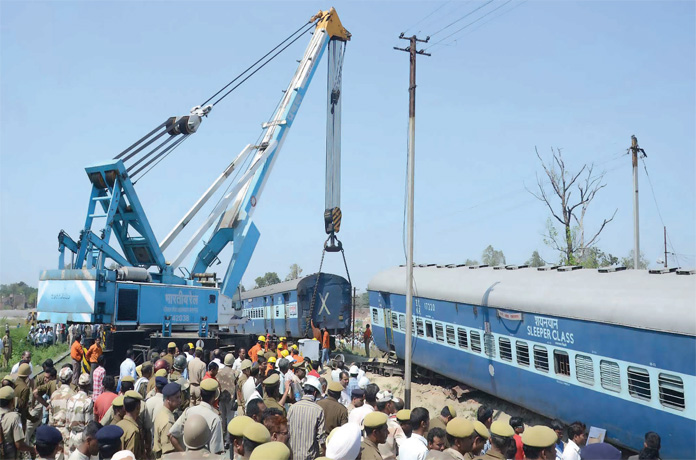
The recent train accident at Rampur on Delhi-Lucknow route has once again put the issue of dipping safety standards in the forefront. To put things in perspective, this is the fifth major train accident in the last six months. Before this, Indore-Patna Express met with an accident at Pukhrayan on November 20, 2016, Sealdah-Ajmer Express derailed on December28, 2016 near Rura and Hirakhand Express met with an accident at Kuneru on January 21 this year. 149 people died and as many as 182 were rendered injured at Pukhrayan, two people were killed and 65 injured at Rura and 29 passengers died in Kuneru, bringing the issue of railway safety in the limelight.
In the year 2016-17 the number of train accidents mounted to 98. Out of this as many as 76 were cases of derailment. In the same duration, a total of 9,278 instances of failure of equipment have been recorded out of which 575 were related to breakage of tracks or welding. In the previous year the corresponding figure of total accidents and derailments was 99 and 60 respectively. The instances of equipment failure were once again close to 10,000.
In the last seven years, as many as 1,000 people have died in the various rail accidents, the majority of whom died in the last three years. Of these accidents, as much as 48 per cent were related to derailment.
However, there is a sudden spike in percentage of derailments in the last two years. At the same time events such as head-on collision, collision at crossings etc. have gone down. Two years ago, the majority of accidents happened at the manned and unmanned railway crossings. For example, in 2014-15, nine out of 10 accidents were related to either breaking down of track or collisions at crossings. Till the year 2013-14 on an average 0.10 accidents happened for every million kilometre of train run. The corresponding figure increased to 0.11 in 2014-15. It has spiked up further in the last two years. The same is true for number of dead and injured. The figure of those dead and injured in the year 2009-10 was 67 and 253 respectively. The corresponding figures rose sharply to 118 and 324 in the year 2014-15.
It has become sort of a routine. Whenever there is an accident, the issue of train safety makes the headline. This is followed by the visits of railway minister and chairman of the Railway Board at the site of the accident. Investigation is ordered and compensation is announced. A lot of talk follows. Some committees are constituted. Their recommendations are partially implemented that too half-heartedly. Then, things get back to normal. It has become rather cyclic. The coverage in media also stops the moment another sensational topic comes to the helm.
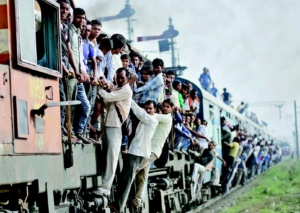 Most of the rail accidents happen because of human error. These human errors can broadly be divided into two categories: errors done by railway employees and those done by people not related to the functioning of the railways. Between the years 2009-10 and 2014- 15, as many as 327 accidents happened because of the mistakes or involvement of people not related with the railways. The corresponding figure involving railway employees was 327 in the same period. In total, as much as 86 per cent of the accidents were caused because of human error. Sabotage ranked second among the various reasons for accidents. In the last six years, as much as 5.5 per cent of the accidents happened because of sabotage. In third place are the natural causes or natural disasters. They make around 3.4 per cent of the total. The last one on the list is ‘equipment failure’ that contributed 2.2 per cent in the total accidents. 1.8 per cent of the accidents have remained unattributed, whereas 0.7 per cent remained inconclusive.
What has happened in the last two years is that ‘equipment failure’ head has seen a sharp spike. In fact, they are the major reason for accidents that happened in the last few years, leaving human errors and sabotage behind. A lion’s share of these is because of the breaking down of the tracks. For example, breakdown of track was responsible for accidents in both Pukhrayan and Rura. In fact, the initial reports suggest that the reason for accident that happened in Rampur was also the same, but it was later hushed up. This is a rather dangerous precedent. Although there is no clarity over how the tracks broke down; whether because of wear and tear or because of sabotage, the very mention of it makes the national news. And justifiably so. What is not done is thorough investigation. A thorough investigation is required to not only pin the blame on the right individual or individuals and bring them to justice, but also for the restoration of faith in the railway management. These incidents cannot be taken lightly and the Indian Railways needs to assure the safety and security of tracks.
While closely monitoring the data gathered in the last two years, it is clear that most of these incidents have happened because of the sabotage or criminal conspiracy. In Kalyanpur near Kanpur, in one such instance, police managed to chase away a gang of criminals trying to cut a piece of the track. However, they are yet to be apprehended. Then the report came that an alleged ISI agent arrested in Bihar admitted to sabotage in Pukhrayan accident. However, the NIA has failed to corroborate these charges beyond reasonable doubt. The apprehended alleged ISI agent had also allegedly confessed to a similar crime where he unsuccessfully tried to blow off a track in Jharkhand through pressure-cooker bomb.
Recently, officials found a 32mm cut in track between Moradabad and Chandausi. A gangman was instrumental in spotting this, which probably averted a big accident. Before this, a similar incident was also reported on Chandausi-Aligarh section near Chandausi railway station. In both the cases the tools used in the cut were found abandoned near the site of the crime. Talking about these incidents, railway minister Suresh Prabhakar Prabhu had said, “There has been a spike in suspicious activities in the last few months. In several cases the accident was averted because of the alertness of the railway staff.” Replying to a question in the Parliament, he had stressed on increasing the forensic abilities of the Railway Protection Force (RPF), and taking the help of foreign investigation agencies in finding out the sudden spike in accidents.
A specialist team form Korean Railway did visit accident sites in Uttar Pradesh on the invitation of Prabhu. They later also met with officials both in Lucknow as well as in Delhi. The report that they later handed over to the chairman of the Railway Board put the blame squarely on overloading and massive traffic on the tracks. This was in contrast with what the government had initially suggested. Korean experts believe that not only too many trains are running on Indian tracks but also those running on it are too overloaded. This has weakened the tracks, and microscopic cracks have emerged at several places. Since these cracks are difficult to be accessed through unassisted sight, they are impossible to pinpoint. The problem is: they cannot be detected by machines as well unless they reach a certain breadth. After this point, the accident can happen any time. While they are detected at times, they go unnoticed at others.
While railway accidents are happening all over the country, some zones and routes are particularly vulnerable. Records suggest that most of the accidents happen in areas that come under North-Central Railway, Northern Railway, East-Central Railway, North-Eastern Railway and Eastern Railway. These zones mainly fall under the Gangetic plain that has massive population pressure. Almost all the routes in these zones are overburdened and see heavy train traffic. For example, Delhi- Howrah, Delhi-Guwahati, Delhi-Agra and Kanpur-Jhansi-Bhopal routes have maximum number of trains passing through them.
Among these routes, Delhi-Guwahati route has a traffic density of 150 per cent whereas Delhi-Howrah comes close with 130 per cent. There are in total 66 routes where traffic density has topped 150 per cent, while as many as 193 routes have a traffic density of between 120-150 per cent.
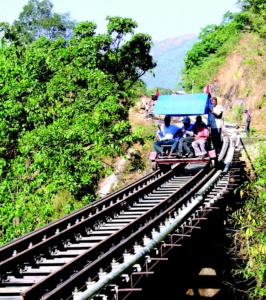 This massive overload leads to jams and delays. As much as 65 per cent of the 247 high-capacity routes are perpetually jammed. This kind of massive traffic cuts into the time needed for maintenance. In most of the Block Sections, there are only two lines: Up and Down. The number of sections with three or more lines is pretty negligible. This means that even a regular maintenance will lead to complete shutdown of the route, which is avoided most of the time. Needless to say that even when maintenance work does happen, the time-gap is massive.
Since Independence, increase in tracks has not matched the massive rise in people and goods traffic. Between 1950 and 2016, while the passenger travel has increased 13 folds and goods traffic has jumped 16 times, the track length has only increased by 23 per cent.
There are other reasons as well behind the spike in rail accidents but no one is willing to come on record to accept them lest sensitivities are hurt. The reason, ironically, is expansion and development works related to railways. This has put further stress on the existing tracks. An official on the condition of anonymity told this correspondent that lots of pending works have been initiated recently and several new projects have also been initiated. This includes repair, doubling and tripling of tracks, electrification and refurbishing of signalling and communication lines. As many as 60 projects worth Rs. 1,000 crore are undergoing at this time. This has put the schedule haywire, leading to even lesser time for regular maintenance.
However, railway unions strike a discordant note here. The general secretary of All India Railwaymen’s Federation (AIRF), Shiv Gopal Mishra, says, “Railway officers are looking for excuses. The truth is, over 40 per cent of tracks are in seriously bad condition and are beyond salvage. But no one seems to have time to change these tracks. While there is significant increase in traffic since Independence, the recruitment has not matched this pace. Till the time we don’t hire as many as 2,00,000 workers in ‘Safety’ category, such accidents will keep happening.”
While most of these suggestions have merit in them, they are also impractical, and impossible to be implemented in the short run. The only alternative is a stop-gap arrangement. At this time, the government seems not to have any clue of it.