The story of Kashmir is nothing short of a political potboiler full of deceit, intrigues, money, vice and gore. It can be converted into a movie guaranteed to become a runaway success at the Box Office. If one has to elaborate on the subject, reams and reams of paper can be exhausted without reaching a conclusion. Having said that and notwithstanding the constraints of time and space I shall try to do justice with it to the best of my ability.
To understand Kashmir and the problems associated with it, one needs either to be Kashmiri or start thinking like one. Unfortunately, post-1984 this has never been the case. This almost century-long a saga of disasters is based primarily on two dimensions, external and internal. And, fortunately both are non-starters. While the internal dimension is based on economics and sentiments more than politics and political doublespeak, the external issue revolves around the conversion of the LoC into an international border coupled with Pakistan continuously pumping in money and armed cadres of several of its terrorist organisations into the Valley to destabilise it. Unfortunately Pakistan, in spite of having been assisted by western think tanks and intelligence agencies for decades together has not been able to understand a simple fact – no government in India can even think of giving away Kashmir, whatever the pressures or motivation be.
At the very outset, may I categorically state, Kashmiris are neither pro-Pakistan nor are they any different in their aspirations from the rest of us in India. Also, they are very clear in their minds that Azadi can never be achieved. A point that needs to be mentioned here is similarity between Pakistan and Kashmir in terms of economic distribution. In Pakistan which is heavily based on agriculture, most of the cultivable land is divided in the top 22 families of the country. In Kashmir on the other hand, which is an almost cent percent deficit financed state, funding received from the central government is distributed in around 150 families of the Valley. Even then, an average Kashmiri has never been interested in indulging in what he is today. But, he is helpless. If he wants to live in the Valley, he has to do as demanded of him by the powers that be. And, let us also not forget, he stands to gain financially by following their diktats. And if he doesn’t, the omnipresent cadres of various terror groups, operating under the Jamaat compel him to do things which go against his basic ethos. But then, does he or she have a choice.
What helps in sustaining this scenario? The answer to this question is not all that simple. Let us deal with it point by point.
In PakIstan whIch Is heavIly based on agrIculture, most of the cultIvable land Is dIvIded In the toP 22 famIlIes of the country
Financing: In the scenario described above, availability and the free flow of finances to fund terrorism is one of the most major reasons why Pakistan has been able to sustain militancy over such a long period in the Valley. This enables them to not only pay their weaponised cadres, but also the full-time workers of the Jamaat who get a monthly salary/ stipend varying according to their rank in the organisation. Other than this, they are able to buy services of even those who are not inclined towards their ideology. These finances have many ways of entering the state. Initially, monies for the purpose were routed through normal hawala channels and also physically from across the LoC. But today, small amounts of money are routed through a large number of savings bank accounts of common citizens who get a percentage of the total amount transferred to their account by someone abroad or even from elsewhere in India. Not only this, Kashmir, which has become a part of the Golden Drug Triangle route after Iran blocked its borders with Afghanistan, quantities of drugs enough to suffice the needs of the Jamaat and terror groups are offloaded in the Valley itself. These are sold locally as well as in the rest of India for the purpose of raising funds for the movement. This is a regular phenomenon. It is a wellknown fact, Burhan Wani converted the saffron town of Pampore into a mandi of charas and synthetic drugs. He used the drug money to finance all his activities. This is not all. Arab Gold is also being smuggled into the Valley from Pakistan for the purpose. It has a ready market. Burqaclad women have played a major role as couriers in this operation. In spite of all these avenues being exploited, these groups still face an occasional cash crunch. Recent bank dacoities and weapon snatchings are fallout of this very situation.
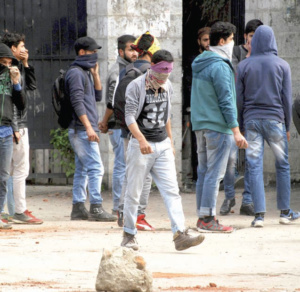
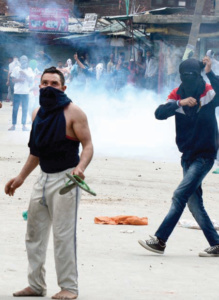 Spurt in local recruitment: The Valley has witnessed a spurt in the local boys joining terror outfits like the Hizbul Mujahideen and Lashkar-e-Taiba in the recent past. Frankly, there is no rocket science involved in finding a credible reason to this phenomenon. Other than peer pressure, idol worship and glamour associated with the likes of slain terrorist Burhan Wani which is certainly a factor, the single largest reason or cause for this is the high rate of unemployment in the Valley. The state government which is the largest employer in the state cannot provide jobs to everyone. There is no industry in the Valley which could provide meaningful employment. And, that is because no investor would want to risk his investments. Apart from the security situation, which no business person would be comfortable with, provisions in Article 370 of the Constitution do not allow ownership rights to a person who is not a State Subject. Therefore, the number of educated unemployed is growing by the day. After completion of his education (at whichever level), a person starts feeling uncomfortable sitting at home when he is expected to contribute to the family income. However, when this does not happen, he gets frustrated. He is most vulnerable at this point of time and this is exactly when he is tapped by the unassuming person of the recruitment network of terror outfits like the Hizbul, etc. He is motivated to pick up the gun. Apart from the various incentives offered, Islam is used to motivate him. There is a full-scale, well-oiled network of experts in place with the Jamaat too to tap on the frustrations of the youth which is at work round the clock, 365 days a year. Stories of jihad are recited to him. Life in heaven, especially the accompaniment of the 72 Virgins, after attaining martyrdom in the path of Islamic jihad is used to entice him into the world of terror.
To understand this phenomenon a bit more clearly, we need to take a closer look at the larger picture of the Sunni Islam the world over. Lack of democracy, coupled with cruel despotic regimes in most of the Arab world pushed the common Muslim towards a brand of Islam which is monotheistic, cruel and revolves around jihad. Though originally conceived by the West and propagated by the ruling class of Saudi Arabia, this brand of Islam is known as Wahhabism. Since it was conceived by the West to suit them, they actively helped in propagating it to such an extent that it gained acceptance the world over. But, after a period when it had served its purpose for the West, it started showing its true colours. It started hurting western interests too apart from bloodying most of the world. Attempts to make course corrections ran aground for one reason or the other. Latest being that of the Arab Spring experiment. The impact of these happenings has not remained confined to the Arab world alone. Various European, Central Asian and East Asian Muslim countries including Pakistan and Bangladesh have experienced phenomenal shift in their theological and spiritual discourse. India too has not remained untouched. Kerala, Karnataka, Andhra, Maharashtra and some parts of UP have already started contributing to the pan-Islamic phenomenon. Surprisingly, the educational quotient of the people plunging into this war in the name of God is not low in all the cases. Even then, illusions of the world after death are packaged and presented so attractively to the young Muslim that he prefers to forget about the life he is living and starts contemplating life in company of the 72 Virgins in heaven. Though impacted by these happenings across the oceans, it is commendable that youth from Kashmir have not actively participated in the panIslamic phenomenon unfolding outside the country. This certainly does provide a window, however small, into the psyche and behavioural pattern of the Kashmiris.
Interestingly, in spite of being a democracy ourselves, we never actually engaged directly with the people of Kashmir. We outsourced this work to contractors who in turn did our bidding. This resulted in political suffocation and frustration. Coupled with the ego and vested interest of people in various organisations and agencies, mandated to control the situation, this toxic concoction of economic depravity, political frustration and one-upmanship allowed the wounds to fester and aggravate to such an extent that it has now become a problem of proportions which is seemingly impossible to control. Needless to say, the situation presented an extremely fertile ground, readymade and available for anyone to sow the seeds of dissent. An opportunity, Pakistan capitalised with great success. This was further irrigated by more than ample doses of religion (redesigned) and fertilised with massive amounts of money, hype and public attention.