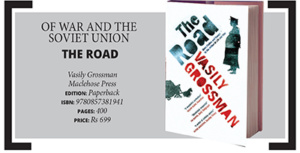
1.The Road
Vasily Grossman is a name that is as synonymous to World War II reporting as Robert Fisk is to Middle East these days. An agnostic Jewish member of the Communist Party in the then Soviet Union, Grossman was initially trained as an engineer. However, like every other Soviet citizen, his life also got massively changed when Hitler decided to attack Soviet Union.
Grossman joined the Red Army’s official newspaper as a correspondent and travelled to the frontline to report. His lucid and rather very detailed pieces immediately became popular with the officers of the Army as well as the common soldiers; not to mention Soviet citizens. His exploits at the front in Stalingrad makes an interesting read in itself. Historian Anton Beevor and Elizabeth Chandler translated his entire war diary and came out with a book called Vasily Grossman with the Red Army.
Elizabeth Chandler and Robert Chandler are also instrumental in translating many of his other writings and bringing it to the wider audience in the Englishspeaking world. This includes his novels such as Life and Fate and Everything Flows. Considered to be subversive writings during the life of Soviet Union, these books were not allowed to be published.
The manuscript was smuggled out of the Soviet Union and was later published as a book in Switzerland.
the road also gives a timeline of vasily grossman’s ideological curve
The Road on the other hand is a collection of many things that came out of the stable of Grossman. It has short stories, commentaries, essays, travel description among other things. It would not at all be an exaggeration to say that this book is a complete package to know the person as well as the writing of Vasily Grossman.
It also gives a timeline of Grossman’s ideological curve. While the first few stories are rooted in Grossman’s unshakable belief in the ideology of Communism, some of the later ones are clearly an indicative of his disillusionment with Stalinism and everything else that it represented. In between are his pieces from war. It also contains one of his most read pieces The Hell of Treblinka.
The book opens with the short story In the Town of Berdichev. Incidentally Berdichev is also the town in Ukraine where Grossman was born. The story was penned in 1934 when Grossman was yet an unknown figure in the Soviet literary circles. The story catapulted him to fame overnight. The story is about a female commissar set during the 1919-21 Polish-Soviet war. The commissar gets pregnant and is sent to find lodging with a local Tatar family. Torn by her commitment towards Soviet Union and that towards her newborn child, commissar takes a decision that endears her to the masses. The story also talks about the milieu in which the story is set. His eye for small details seems to have started at quite a young age. The story was much later also mounted as a feature film, which ironically released in the dying days of Soviet Union.
 Another impressive story is Mama. The story is about an orphan girl who was adopted by the infamous Nikolay Yezhov, head of the NVKD during the great terror. Grossman manages to get inside the mind of the girl as she tries to come to terms with the changes around her. The most poignant part is where Yezhov finally meets his downfall and the girl does not feel any jubilation. Instead she remembers the days when he still loved her in his own way. It is one of the most complex of stories by Grossman.
However, as mentioned earlier, the most impressive piece of this book is his eyewitness account of the liberation of Treblinka liquidation camp. Grossman was attached with the unit of Red Army that liberated the camp, and was among the first to see the horrors of the Holocaust.
Talking about the camp, he writes, “The fenced-off area of the camp proper, including the station platform, storerooms for the executed people’s belongings, and other auxiliary premises, is extremely small: 780 by 600 meters [2,925 by 1,968 feet]. If for a moment one were to entertain the least doubt as to the fate of the millions transported here, if one were to suppose for a moment that the Germans did not murder them immediately after their arrival, then one would have to ask what has happened to them all. There were, after all, enough of them to populate a small state or a large European capital. The area of the camp is so small that, had the new arrivals stayed alive for even a few days, it would have been only a week and a half before there was no more space behind the barbed wire for this tide of people flowing in from Poland, from Belorussia, from the whole of Europe. For thirteen months – 396 days – the trains left either empty or loaded with gravel. Not a single person brought by train to Treblinka II ever made the return journey. The terrible question has to be asked: “Cain, where are they? Where are the people you brought here?””
His account was so impressive and detailed that it was later used as evidence at the Nuremberg Trials. Till date, no one, absolutely no one, has written a more detailed and horrific account of what happened inside those camps in East and Central Europe.
The Road is in many ways also the story of Soviet Union albeit through the eyes of a writer who saw the best and worst of it.
2. The Target
The Target’ bares all – how Jignesh Shah, who innovated commodity trading exchanges for different classes of assets, was destroyed by a sinister plot devised by powerful brokers at Malabar Hills in India’s financial capital, and corridors of power comprising influential politicians and bureaucrats in Lutyens’ Delhi.
Wharton-trained investigative journalist-turned-author, Shantanu Guha Ray through his meticulous investigation brings us the saga of the Rs 5,600 crore payment crisis in the National Spot Exchange Limited, in his latest book.
Financial Technologies India Ltd (FTIL) chairman, Jignesh Shah, was a pioneer, who created 10 world-class exchanges across a variety of asset classes, such as commodities, equity, currency, bond and electricity, in a period of merely 10 years in India and abroad.
Yet, this poster boy of commodity exchanges was harassed by vested business and political interests and interrogated by premier investigating agencies – Economic offences Wing of the Mumbai Police, the Central Bureau of Investigation and the Enforcement Directorate. Shah was put behind bars twice. Consequently, his wealth eroded and reputation was tarnished.
Why was Shah punished? He had stepped on too many toes and tried to democratise commodity exchanges.
Ray, who has been practising journalism for over three decades, specialising in business, investigative and human interest features, narrates the agonising moments of this innovative entrepreneur, who could have been a model for Prime Minister Narendra Modi’s ‘Make in India’ programme.
“Was the cold-blooded and systematic destruction of some of the finest Indian institutions carried out only to promote one company, namely, the National Stock Exchange, and its interests in the market? I think the answer lies in the affirmative,” Ray writes.
The author stumbled upon the story after Inderjit Badhwar, editor of India Legal, was keen to get to the skin of the story that had been covered by the media with extreme bias.
So the author puts together a saga that is not explored by reporters in the 24×7 television channels and print media, who are either caught up in the herd mentality or fail to explore beyond press releases.
 This is where Ray picks up his thread. “Who hated Shah so much?” Ray writes. This billiondollar question emerged in the minds of many rational thinkers, including the author.
He concludes, it was a conspiracy of the high and mighty. Ray has identified three of the principal actors, whose mug shots have been displayed prominently above that of the protagonist, on the cover of the book.
He draws a parallel between Dhirubhai Ambani, who was harassed by then finance minister VP Singh, and his two bureaucrats, Bhurelal and Vinod Pandey. Ray asserts that Shah became a victim of decisions pushed by then finance minister P Chidambaram and two of the powerful mandarins in the UPA government.
the author puts together a saga that is not explored by reporters in the 24×7 tv channels
He also says how Anjani Sinha, the then CEo of National Spot Exchange Limited, blamed Shah when the investigators got to him, trying to save his skin and turning sides as he did so, ignoring what he had earlier told the NSEL board. Sinha, in his earlier stint, had to quit the smaller Magadh and Ahmedabad exchanges after the payment crises there.
Harassment, interrogation and arrests followed. Financial Technological (India) Ltd (FTIL), Shah’s holding company was barred by the Forward Markets Commission (FMC) from running the MCX, a multi-commodity exchange.
It was not only the UPA government that killed Shah’s innovative ventures systematically. Despite BJP’s Rajya Sabha MP, Subramanian Swamy, sharply attacking Chidambaram and his son Karti as the masterminds behind the crisis at the NSEL, little has been attempted by the current dispensation to bring the conspirators to book.
It is important to mention that while different investigative agencies established the entire money trail of Rs 5,600 crore to the 24 defaulting brokers of National Spot Exchange Limited (NSEL), no money trail was established to NSEL, FTIL or its promoters. This was observed by the Bombay High Court in Shah’s bail order, after studying the charge sheet. The Special Leave Petition challenging the same was dismissed by the Supreme Court as well.
Suhel Seth, who wrote the Foreword says “Shantanu has very effectively narrated the entire saga of how India’s indigenous growth story was killed due to some vested interests in corporate and bureaucratic circles much before Make in India was ushered in.”
“The destruction of Shah… would prove fatal for the 108 newgeneration entrepreneurs seeking to develop IP institutions and realise the Prime Minister’s dream of Make in India.”
The author, who had earlier penned ‘Mahi’ and ‘Fixed’ has also won several awards. Ray won Laadli Award for his findings into the scandal pertaining to cervical cancer human trials. His work on water-related issues got him the Wash Award. The Target is interesting not only to understand the rise and fall of Jignesh Shah but also to grasp how the Indian entrepreneurs have to operate in the politico-business climate of India.
3. Final Solution
There is no dearth of books on the Holocaust in the market. There has hardly been an angle from which this has not been analysed. In fact, there are some who would say that this is probably one piece of history that has been over-analysed. And as it happens with anything which is over-analysed; a slew of books denying its very existence has also come to the market. While most of such revisionist literatures were devoid of any academic rigour or merit; a ripple was created when noted British historian, once a darling of mainstream in Britain, David Irving jumped the ship. Although his book was later shot down by a British court, he managed to spread his words far and wide. The rise of modern anti-Semitism has brought new readers to his fold, but it has also brought new scholarships that try to discredit historical revisionism.
David Cesarani’s Final Solution is one such endeavour. Cesarani, a Research Professor of History at Royal Holloway University of London, died a year and a half ago, at a rather sad age of 58. This made ‘Final Solution’ a swansong in his rather illustrious – but cruelly short – career. The basic premise of this book is explained by Cesarani himself in the introduction. He writes, “This account too strives for an ‘integrated history’, but the focus is primarily and unapologetically on the Jews. It also sets out to challenge the traditional concepts and periodisation that have until now framed constructions of The Holocaust.”
While many, including me, would take some offence on this, but it is ultimately a writer’s prerogative as to what should be his focus. There has clearly been an effort to keep focus on the Jews as far as the Holocaust is concerned, treating deliberately or inadvertently others who suffered as less important. However, I still appreciate a writer who at the very onset admits to this and then proceeds to what he ultimately does.
“The nomenclature is itself increasingly self-defeating. The Holocaust, capitalised here to signify the cultural construction rather than the historical events to which it is assumed to refer, has come to imply a unitary event characterised by systematic procedures and a uniformity of experience. But newer histories point to the nuances between different countries, regions, districts, and even adjacent villages. They are more sensitised to variations over time, breaking it down into locales and segments, each with distinctive characteristics that could accentuate the chances of life or death. Certain historians argue that a number of overlapping genocides raged within The Holocaust. Romania, for example, embarked on murderous ethnic cleansing against local Jews to suit a national agenda that was distinctive from, and even cut across, German aspirations. Perspectives on the catastrophe are changing, yet this is barely reflected in the reproduction of an agreed but ageing narrative,” he writes.
cesarani maintains that the killings followed the rhythm of the war
 The book can be broadly divided into three segments. The first 230-235 odd pages deal with the persecution of Jews in Germany from the German defeat in the World War I to the night of September 1, 1939, when Hitler invaded Poland triggering World War II. The second segment contains chapters dealing with the history of World War II and the liquidation of the Jews of Europe to the end of War in 1945. There’s a third segment as well that deals with the treatment of Jews following the War. This segment also includes an epilogue and conclusion.
Although the entire book is an important read, the most important segment is the first one. It is a window to what all happened that led to the Holocaust. It deals with endless measures by Nazi Germany to not only exclude Jews from the “national community”, including snatching away their jobs and property; but also to disenfranchise and dehumanise them in such a manner that when the final act of cleansing happens, the majority of the German people give a tacit go-ahead.
The second segment takes a fresh view of the act. Cesarani maintains that the Holocaust was anything but a coherent policy. He insists, with proper proof, that Nazi anti-Jewish decisions were more often improvised and hazy, than lucid. There was no definite plan till Hitler attacked Soviet Union. While the Nazi Germany suddenly found itself in possession of hundreds of thousands of Eastern European and Soviet Jews, it did not have any definite plan to what to do with them. officers were divided into summarily liquidating them and using them as slave labourers. “Were Jews to be expelled, placed in ghettos, or put to death?” asks Cesarani.
But when it really started, there was no turning back. The detailed account of what happened inside the camps is stunning and repulsive in equal measures. Cesarani makes use of new researches and includes them to great effect. The resulting combination is outright numbing.
Cesarani essentially maintains that the killings followed the rhythm of war, and concludes that fewer would have died if the war had finished earlier. His research does show that as Nazi Germany veneered towards defeat, the killings hit the roof.
‘Final Solution’ is definitely an essential addition to the bookshelf. of all the literature that has come out on the Holocaust, this book will manage to hold its own in many years to come.
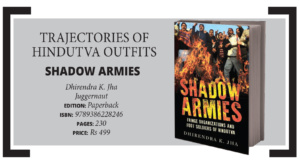
4. Shadow Armies
There could not have been a timelier book than Shadow Armies: Fringe Organizations and Foot Soldiers of Hindutva. It puts all the things happening in Indian politics into perspective. Bit by bit it explains the reasons behind the rise and rise of Hindutva politics over the years, with all its landmark victories as well as contradictions and intra- and inter-organisational conflicts. It ably traces the trajectories of Hindutva outfits across the country. The chaotic antiminority and secular environment in its crude form, as we are witnessing today, is the result of a concentrated effort of several decades.
Written by senior journalist and co-author of critically acclaimed book, Ayodhya: The Dark Night – The secret history of Rama’s appearance in Babri Masjid – Dhirendra K. Jha in this book profiles eight organisations, directly and indirectly, linked to the fountainhead of Hindutva in India, the Rashtriya Swayamsevak Sangh (RSS). These organisations are: Bajrang Dal, Rashtriya Sikh Sangat, Bhonsala Military School, Hindu Aikya Vedi, Sri Ram Sene, Sanatan Sanstha, Hindu Yuva Vahini and Abhinav Bharat. While the first four work under the direct supervision of the Sangh Parivar, a loose yet a formal network of sorts of Hindutva outfits, the latter four operate independently. However, what is important to remember is that they don’t have different goals.
most of these hindutva groups have an umbilical cord attached to the sangh parivar
One thing which comes out very clearly from the study of these organisations is that they might have different shades, often seemingly contradictory to each other, but their roots and ultimate goals are same. At the end of the day, they all serve the Hindutva ideology.
“Some of the ‘fringe organisations’ seem to exist outside the purview of the Sangh Parivar in so far as they are not technically created and controlled by the RSS. Prominent among them are the Sanatan Sanstha, the Hindu Yuva Vahini, the Sri Ram Sene and the Abhinav Bharat. Yet they are not entirely autonomous. Most of them have an umbilical cord attached to the Sangh Parivar, and all of them are ideologically on the same page. Like the RSS and its affiliates, they claim to derive their ideological raison d’être from VD Savarkar’s Hindutva: Who is a Hindu?,” notes Jha.
He also notes, or rather, confesses, “For a long time, I thought they primarily act as recruiting and training centres for their brethren who officially practice politics. This was because I looked at them through the prism of pan-Indian Hindutva organisations like the RSS, the BJP and the VHP. It struck me only when I began to travel for research and talk to people that these fringe organisations could have their own paths of evolution, beset by internal contradictions and driven by local anxieties and motivations.”
The rise and fall of the Ram Sene is the best example of it. The making of Ram Sene, Jha’s research reveals, was a coming together of people sidelined by the Sangh Parivar, namely the Bajrang Dal. According to the author, while Pramod Muthalik, the face of Ram Sene came because of a highly personalised fight within the Parivar, his henchmen (mostly belonging to the backward castes) such as Praveen Walke, Arun Kumar Puttila, Prasad Attavar, Anand Shetty and Subhash Padil joined it due to resentment, given the Brahminical dominance of the RSS and BJP. “Till 2004 we didn’t feel any brazen discrimination on caste lines,” Jha quotes Walke, who was at that time the state convener of Bajrang Dal. “But once the assembly election results that year showed the task was complete,” said Walke stating that “caste became our handicap in the organisation which keeps all its important positions reserved for Brahmins”.
 The chapter on the Ram Sene also ably demonstrates insecurities and vulnerabilities of foot soldiers of Hindutva. There is a fascinating story about the Bajrang Dal, explaining its political economy in the city of Mangalore, arguably the biggest urban centre of Hindutva politics, not just in Karnataka but the whole of south India.
Jha shares with us a telling story of Sharan Pampwell, the Mangalore-based leader of Bajrang Dal and the proprietor of Eshwari Manpower Solutions Limited.“Like a good entrepreneur – obeying the laws of demand and supply – he has put to good use the anxiety felt by local businessmen as a direct result of the Bajrang Dal’s activities,” writes Jha. “He offers them protection by using the foot soldiers of the very same Hindutva outfit he represents. The enterprise he has reared thus works both ways; the businessmen get security from the Bajrang Dal, and the Bajrang Dal activists benefit from regular employment in the establishment rendered venerable by their own acts of violence and hooliganism,” he explains. Predictably, most of his clients are Muslim, the prime target of Bajrang Dal. “Given the kind of activities they (Bajrang Dal) members indulge in, this is the best way to do your business peacefully,” Jha quotes a Muslim shop owner, explaining the rationale.
What is remarkable about the book is that, despite author’s personal dislike for Hindutva politics he avoids judgment. Jha is dispassionate in his approach and relies solely on thorough research and instead of putting words into the mouth of the foot soldiers, he lets them speak. It is a must read book to understand the politics of our times.