Schindler’s Ark
Recently I was at Auschwitz-Birkenau concentration and extermination camp outside of the Polish city of Krakow. It was a rather sobering visit. Nothing prepares you for what you see there, absolutely nothing. It’s a bleak, sordid display that does its job; which is to remind the people that such a monstrosity indeed came to pass.
Another thing that bewildered me was the sheer volume of people from all over the world that come every day to visit this open memorial. I was going through an informative chart about the tourist footfall when I suddenly realised that there was a huge spike in the year 1994 in the number of those coming to visit the place. This was the year after the release of Stephen Spielberg’s ‘Schindler’s List’. The movie caught the imagination of the masses, and suddenly everyone wanted to visit Auschwitz and Krakow. Auschwitz because of the camp, and Krakow because it hosted the famous Enamel Factory of Oskar Schindler, the protagonist of Spielberg’s movie. And that brings me to review an old book, the one on which the movie was based. It’s Schindler’s Ark by noted writer Thomas Keneally.
On the face of it, Schindler’s Ark is a fiction. That’s technically speaking however. What separates it from other fictions is that all the characters in this book are real, and so are all the incidents mentioned. As far as dialogues are concerned, most of them have been taken from testimonies and admissions at the trials that followed the defeat of Nazis by the Soviet Red Army. However, in writing a story, some dialogues have been imagined to fill the gaps. That is where the fiction part has come.
“To use the texture and devices of a novel to tell a true story is a course which has been frequently followed in modern writing. (…) I have attempted to avoid all fiction, though, since fiction would debase the record, and to distinguish between reality and the myths which are likely to attach themselves to a man of Oskar’s stature,” writes Keneally in the preface.
 Schindler’s Ark is the story of Sudeten German businessman and Army contractor Oskar Schindler, and how he saved the lives of over 1,000 Jews in occupied Poland by bringing them to work at his factory in Krakow. Author Thomas Keneally chanced upon the story while on a trip to the US where he came in contact with one Leopold Pfefferberg – one of the Schindler’s Jews. In the following years, Pfefferberg arranged his meetings with other Schindler’s Jews, and based on these interviews, testimonies and archival matters, the book was born.
The novel is a breeze To read in ThaT iT avoids conTrived siTuaTion and dialogues
To those interested in literary fiction, Keneally is no stranger. He has written scores of books that are not just great read, but of substance too. However, with Schindler’s Ark, he has surpassed himself. The story starts with Schindler’s hobnobbing with the Nazi SS elites, and how his being in their good favour helped him get contracts to produce enamelware during the war. It was this enamel factory that became his “Ark” so to speak, where Jewish women, children and elderly – who were to be certainly sent to the gas chambers – as well as others were employed in order to avoid their deportation and almost certain murder.
The novel is a breeze to read in that it avoids contrived situation and dialogues, and depends almost entirely on real circumstances to create drama. Especially commendable is its treatment of Schindler himself. It does not fall into the trap of good or bad early on and portrays Schindler with all his drawbacks and eccentricities. What the author handles brilliantly is his gradual transformation from this womanising, drinking, selfish businessman to a man of conscience who goes out of his way – at times at his own personal risk – to save the condemned Jews. The book is very detailed in its storytelling, which reflects on the legwork the author has put in here. This also makes the whole narrative extremely dispassionate. However, that is not to say that the book is not sympathetic to those condemned. It is. Take for example this paragraph here.
“Oskar knew people would catch that trolley anyhow. Doors closed, no stops, machine guns on walls – it wouldn’t matter. Humans were incurable that way. People would try to get off it, someone’s loyal Polish maid with a parcel of sausage. And people would try to get on, some fast-moving athletic young man like Leopold Pfefferberg with a pocketful of diamonds or Occupation złoty or a message in code for the partisans. People responded to any slim chance, even if it was an outside one, its doors locked shut, moving fast between mute walls.”
The novel’s crisp storytelling makes it a page-turner. However, it achieves much more than that. In writing this novel, the author has dealt with several aspects that are not generally discussed frankly. Say, for example, the phenomenon of “Good German”.
In ways more than one, this book is a clear triumph. More than a triumph it is a historical record. I am not sure you can say this for many books.
Three Thousand Stitches
Sudha Murty needs no introduction. She is a household name in India. Wife of Infosys founder Narayana Murthy, she is the chairperson of the Infosys Foundation in India, established in 1996 by Infosys to support the underprivileged sections of the society. The foundation lends assistance to programmes in the areas of education, rural development, healthcare, arts and culture, and destitute care.
Murty’s claim to fame extends beyond heading the philanthropic foundation. She has a master’s degree in electrical engineering from the Indian Institute of Science, Bangalore. She started her career as a development engineer with TELCO (now Tata Motors) and has also taught computer science at Bangalore University.
A prolific writer in Kannada and English, Sudha is a columnist for English and Kannada dailies and has several titles to her credit, including novels, non-fiction, travelogues, technical books, and memoirs. Her books have been translated into all the major Indian languages.
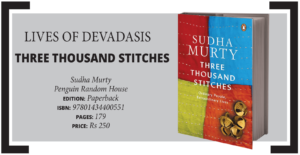
Her latest work, Three Thousand Stitches: Ordinary People, Extraordinary Lives, is partly autobiographical and partly a commentary on India, Indians and their lives. The autobiographical part can be easily understood as the author has narrated her experiences and encounters in a simple and effortless manner. However, readers may have to read between the lines to understand the changes taking place in the Indian economy and society.
Spread over eleven chapters, Murty chronicles her trials and travails from her youth, family, work at the foundation and her travels. In the second chapter, titled, ‘How to Beat the Boys’, Sudha recalls the opposition in her family when she was determined to pursue engineering way back in 1968. “When I entered the room on the ground floor, there were 149 pairs of eyes staring at me as though I were some kind of exotic animal,” Sudha recalls her entry into Basappa Veerappa Bhoomaraddi College of Engineering and Technology in Hubli, a medium-sized town in the state of Karnataka.
 As the only girl student of her batch, she was often ragged by her fellow classmates. As the institute did not even have a ladies’ toilet, she spent four years there deprived of basic privacy! No wonder she was motivated to build 13,000 toilets in Karnataka. Though enrollment of women in engineering courses has considerably improved over the last five decades, it is still less than 25 per cent.
Equally inspiring is the chapter titled ‘A Life Unwritten’, that recalls an episode involving her father, who was a doctor, and his patient, almost 75 years ago. Dr RH Kulkarni was forced – by the henchmen of a rich local zamindar in a village near the forestinfested Changdagad, bordering Maharashtra and Karnataka – to help an unwed girl deliver a baby. It was the first delivery for an untrained gynaecologist. Years later, that infant, a girl child, grew up to be a doctor herself! If you read about the lives he changed on that one night, it is nothing short of a Bollywood potboiler!
as The only girl sTudenT of her baTch, she was ofTen ragged by her fellow classmaTes
An avid Bollywood fan herself, Murty writes about the reach of Indian cinema and its soft power abroad. It made her entry smooth in lesser-known tourist destinations in countries such as Iran, Uzbekistan and Cuba. But the author’s acquaintance with the film world met with disapproval, just as in the case of her determination to pursue engineering. Elders at home blamed Rajesh Khanna, for the low grades scored by Murty and her cousins.
One valuable lesson the author learnt is that we can benefit from the nuances of effective communication. This is revealed to us in the opening chapter – Three Thousand Stitches – that is also the title of the book.
Donating one’s earning and setting up a philanthropic foundation is one thing. But communicating with targeted beneficiaries demands a different skill set. Dressed in jeans, T-shirt and a cap, Murty set out to help the Devadasis who had been exploited as sex workers for centuries. She approached them and began counselling and advising them about AIDS and other illnesses. Her unsolicited advice invited insults, and she returned home humiliated. Her father, Dr Kulkarni, who had vast experience working in the rural hinterland, asked her to change her attitude and her attire. This worked wonders for both Murty, as well as the Devadasis. Seventeen years later, a beautiful bedspread with three thousand stitches was woven by them for their ‘akka’ as their special gift! The author has dedicated a chapter to Varanasi and the waters of the sacred Ganga, in remembrance of her grandmother who could not make it to Kashi during her lifetime.
One of the stories that could engage all readers is the origin of Indian vegetables, and how tomato, potato, chillies, capsicum, papaya, pineapple, guava from foreign shores enriched our country’s gastronomic delights.
Her warm and simple stories are rather inspiring. However, she could have gotten away without recounting the time she was called ‘cattle class’ because of the language she spoke and the way she dressed. Similarly, the chapter, ‘No Place Like Home’, unnecessarily runs into 19 pages! It seems that the editors were overawed by her personality and reproduced her personal diary instead of editing it.
Home Fire
Home Fire, which was longlisted for Man Booker Prize this year, is based on the Greek
play Antigone, where a teenaged girl is conflicted between being a dutiful, law-abiding citizen on one hand and being drawn towards familial sentiments on the other.
The novel takes off with Isma, the eldest of three siblings striving to enter the US on a student visa to pursue her long overdue dream of a PhD. She is restricted to the interrogation room at the airport for hours together which makes her miss the flight – a commonly depicted scene of harrowing airport interrogations these days to portray the routine realities of Muslims who are amid nothing more than going about their usual chores.
The two other siblings are the twins Aneeka and Parvaiz. Parvaiz leaves the city of London to join the ISIS and work in its media wing. This happens after he discovers that their father, a jihadi, passed away while he was being taken to Guantanamo. All three of them have been on the watch list of the intelligence wings since years. Isma reveals to the police about Parvaiz’s whereabouts and this stuns Aneeka, the independent and headstrong young woman. She is more disappointed in Isma than in Parvaiz and a sense of betrayal creeps into her. She remarks over a phone call with Isma, “You have let our brother not be able to come back home.”
Isma represents the voice of adjustment and bargain. After all the enduring years of supporting her two younger siblings after the death of their parents and grandmother, and having lived under the burden of being a dead jihadi’s daughter in the West, she is now resigned and thinks of challenging the norm of battering the dissenting voices as a worthless drill.
Eamonn, the irreverent son of authoritative British politician Karamat Lone who seeks to always place the fact of him being a Muslim behind him, is introduced in the novel first as Isma’s acquaintance in the US who is vacationing over there. Eamonn and Isma build a slow friendship, until he returns to London and meets her sister Aneeka. He falls for her and Aneeka sees this as an opportunity to bail out her twin and get him back home through Eamonn’s influential father.
A discerning conversation between Eamonn and Isma in the first chapter of the novel goes, where he reflects “It must be difficult to be Muslim in the world these days” and she responds by saying “I’d find it more difficult not to be Muslim.” This assertion of hers sums up her thoughts for her beliefs which also allows her to discard such sweeping generalisations at a time when the preconceptions of so many are influenced by the acts of a few.
The novel raTher refreshingly sees generous amounTs of dense poliTical annoTaTions
The novel sees generous amounts of dense political annotations. The author does a good job of choosing to represent racial attitudes through softened undertones, rather than formulating a long-drawn piece on racial discrimination and the ISIS.
 The novel is structured into five long sections and it benefits the reader with each section revolving around a core character – Isma, Aneeka and Parvaiz are the central protagonists in three of the chapters whose experiences give the reader a taste of what it is like to be a young Muslim in present-day London. The two other chapters revolve around the father-son pair Karamat Lone, the home secretary and his son Eamonn. The former goes against the interests of his fellow Muslims in London to realize his political aspirations. The author carves an image of Lone as a convoluted man who adores his family and responds to allegations of turning his back on fellow Muslims by saying “I hate the Muslims who make people hate Muslims.” While Eamonn, his son, is a sensitive character who shares individual connects with each of the characters.
Parvaiz is a generally disorganized young man, with scattered attention and interests. The torture his father underwent is imitated on him as well and this reflects the brutality of the state in the West, its painful realities and hard to chew on mechanisms for ensuring a haven for its citizens.
A weakling that emerges in the novel, apart from a slow beginning, is the use of obsolete provocative titles and news articles to narrate momentous sections of the plot. An illustration, “Pervy Pasha’s twin sister engineered sex trysts with home secretary’s son”, lets the author herself sound banal while making a point by using banal titles. But this does not take away from the seemingly effortless way she prevents rhetoric from falling into the trap of sounding like a lecture. Most of the characters she uses are individually varied in nature and repositories of uncertain behavior. Authoritarian figures are portrayed in thoughtful light by bringing out their respective moral dilemmas.
Home Fire is thought-provoking in not establishing a crystallized image and understanding of a terrorist as opposed to someone who is not, a believer versus a non-believer, a Muslim as opposed to a non-Muslim, the might of the state as opposed to the rights of the citizen and a few other binaries. These are best understood when not put in black and white and the writer does a brave attempt to address these issues in a nuanced manner.
The Violent American Century
In 1941, Henry Luce, the mogul of influential and popular magazines from Time and Life to Fortune and Sports Illustrated, declared the 20th century to be the American Century. By the gauge of prosperity, power and influence, the United States did emerge from World War II as the defining leader of the “free world” and, with the dissolution of the Soviet Union in 1991, of the entire world.
Historian John Dower borrows Luce’s “American Century” as a heuristic device in tracing the lengthening arc of U.S. dominance in weapon development, militarism and military empire—without peer in history—since World War II. Thus, his title: “The Violent American Century: War and Terror Since World War II.”
With exceptional concision, Dower delineates the ongoing structural impacts of World War II to frame more thoroughly and intricately than do U.S. textbooks and war hagiography the war’s influence on most subsequent conflicts and world politics. Dower writes that the “good war,” as it has been christened and cleansed, was “the apogee of industrialized total war.” Civilians were targets of strategic bombing in cities by the U.S. and Britain; new weapons of mass destruction were developed and used; and countries were left “explosively divided.”
Among the war’s legacies were global financial and political institutions, the most idealistic being the UN, with its Universal Declaration of Human Rights; “path breaking war crimes trials” (though the victors never tried themselves for war crimes); and the eventual end of European colonialism. On the bleaker side, World War II concluded with a hostilely divided world and a burgeoning military/congressional/ industrial complex that has governed US response to conflict ever since.
The Cold War with its nuclear terror and proxy wars in Korea and Southeast Asia; the U.S. transition to superpower status in the 1990s; and post-9/11 wars—all are examined with a lens that captures the “essentially bipolar” nature of American macro behavior in the world. Dower describes it as “hubristic and overwhelmingly powerful by material measures, yet fearful and insecure.” Think compulsive national anxiety over an alleged missile gap with the Soviets in the ’50s and early ’60s; the domino theory of the ’60s and ’70s positing that one country’s becoming communist would cause surrounding countries to do so also; the obsession with getting over failure in Vietnam in the ’70s and ’80s; and the manic fear of terrorism today. Fear of menacing, “existential enemies primed the political pump to maintain support for a massive military machine” and the expansion of a national security state.
A balance of terror, via nuclear weapons buildup, marked 40 years of U.S.-Soviet bombast and confrontation. U.S. military planners chillingly projected nuclear bomb attacks on the Soviet Union and China that would kill hundreds of millions of Russians and Chinese. Only recently have once-prominent insiders, including Gen. George Lee Butler, commander of the Strategic Air Command in the early 1990s, and William Perry, former secretary of defense in the Clinton administration, passionately critiqued this psychopathology of deterrence.
among The world war’s legacies were global financial and poliTical insTiTuTions
 A provocative current runs through this book, one that challenges current dogma on the decline in global violence and incline toward global peace since 1945. This proposition of a more peaceful world is based in good part on fewer conflict-related deaths since World War II and the trend in precision weapons. Dower counters this conclusion with a multitude of examples: the growing conflict based refugee crisis that approaches that of World War II; “the political harm to democracy” from the colossal post-9/11 national security state devoted to sustaining “a state of semi-war”; and the costs of war that magnify our debt for decades to come, among others.
Moreover, who is left in Trump’s administration to make a case for negotiation over military intervention? Given the larding of government with generals, private security lobbyists, defense industry personnel and Wall Street war profiteers, there is no one vested in the cause of peace.
Dower opens and closes his book with the words that America’s “prosperity and professed ideals are still beacons to many,” reinforcing the mystique of exceptionalism despite the government’s “intoxication with brute force.”
How does the top global military superpower and largest trader in weapons of war remain a beacon of democratic ideals? A Nigerian friend living in Europe recently provided a partial response: She noted that pervasive counter demonstrations and persistent citizen protest against the Trump administration’s policies—protests against banning Muslims and on behalf of women’s rights, black lives and climate science—reflect our country’s ideals of freedom of expression, equality, and tolerance to the world.
Side-by-side with widespread democratic resistance to domestic policies, there is, however, a national quietism about the seemingly unstoppable full spectrum, international dominance envisioned by both political parties since World War II, as distilled in “The Violent American Century.” Administrations from both parties, for example, engaged directly and indirectly in the overthrow of at least two dozen Latin American governments between. CIA manuals on torture and the army’s School of the Americas have trained right-wing Latin American military officers and police in tactics to conduct the “dirty wars” that ravaged so many nations.