Twilight of American Sanity
A few months ago, representatives from an island just a kilometre away from the US mainland came to participate in a talk show in Washington DC where other participant included the climate change crusader and former vice-president of the US, Al Gore. The island was facing some kind of a catastrophe. In that half of it had been eroded by the ocean in the last century. Al Gore – always armed with scientific and empirical evidence – tried to reason how human induced climate change is driving sea level leading to such incidents. The islanders, led by its mayor of sorts, insisted that this was no climate change but simple erosion. When Al Gore posed the question as to why has this erosion escalated in the last century and eroded half the island while the ocean and the island were there for several millennium; the islanders had no answer. Although a few of them did take exception on Al Gore’s comment vis-à-vis island’s age as they believed that the earth was only “some thousand” years old. In the previous presidential election, the island voted 97 per cent for Donald Trump. While it might sound reductionist, this reflects less on Donald Trump and more on the islanders themselves. And in there hides the psychiatric analysis of the age of Trump.
 In comes Allen Frances’s Twilight of American Sanity. Allen Frances is no small name in the field of psychiatry. One of the world’s leading experts on psychiatric diagnosis, and head of the American Psychiatric Association’s DSM, Frances’s magnum opus Saving Normal, a treatise on the medicalisation of ordinary life, earned worldwide acclaim. If that is not enough, Frances is also credited to have almost singlehandedly created the diagnostic criteria for narcissistic personality disorder. Just the kind to analyse Trump and his voters.
More than three years in the making, Twilight of American Sanity is not an easy read. In fact, it is bleaker than the winters of Northern Finland. The primary argument of the book might ruffle some feathers in that it challenges some long-held popular beliefs about Donald Trump. Frances suggests that while Trump’s entire life is a great indication of his narcissistic tendencies, he does not suffer from narcissistic personality disorder. Frances makes a clear distinction and says that Trump is indeed narcissistic and lacks the ability to pay sustained attention to anything in depth. As an acclaimed psychiatrist, he knows the difference. “Bad, but not mad,” is how he describes Trump in short.
“Mr Trump causes severe distress rather than experiencing it and has been richly rewarded, rather than punished, for his grandiosity, self-absorption and lack of empathy. It is a stigmatizing insult to the mentally ill (who are mostly well behaved and well meaning) to be lumped with Mr Trump (who is neither). Bad behavior is rarely a sign of mental illness, and the mentally ill behave badly only rarely. Psychiatric name-calling is a misguided way of countering Mr Trump’s attack on democracy. He can, and should, be appropriately denounced for his ignorance, incompetence, impulsivity and pursuit of dictatorial powers,” he wrote.
If the problem does not lie with Trump, who’s to blame then? The answer is people. Common Americans. Frances insists that voters in the US have seen massive dumbing down in the last few decades, and they always look for quick-fix, pain-free cure for chronic illnesses. This creates space for snake-oil peddlers like Donald Trump. He insists that while Trump isn’t crazy, the American society is.
“Bad, But not mad,” is how allen frances descriBes president trump in short
The book talks at length about the societal delusions that gave birth to Trump. Most of it has to do with the quest for fast and quick-fix solution of complex issues such as climate change, dwindling of resources, massive gunviolence and advent of technology. For all these issues, illiterate Americans have one easy answer or another. As the opening anecdote shows, climate change is not only denied, the solution is left to the Gods. Gun violence is rationalised by saying that gun is not the issue, people are. Similar no-brainer solutions are given for issues like jobloss and general decay of America.
It is always argued that Donald Trump was propelled on issues like jobloss in White America, especially the Rust Belt. No one asks what solutions Trump has. There are no easy answers and when his tenure ends people will realise the banning of Muslim migrants and sending away illegal Mexicans and other Mesoamericans didn’t actually help. If anything, Trump, like any Republican, would be a disaster for poor Americans. A clear indication of this is the new tax regimen that Trump administration is trying to push across, which, rather predictably, advocates massive tax cuts for rich and a middle finger for the middle class and poor. But then, some of the poorest of precincts of the United States has always voted for Republicans, and are immune to any argument. It is this dumbed down America that foisted Donald Trump above themselves, and the entire world to that extension.
Twilight of American Sanity is a must read. I have not read any book in the last few months that is as compelling as this. Bleak that it is, it jolts us from the stupor. The era of “Trump is bad, America is good” is mercifully over. If change is ushered, it will have to go bottom-up, and not top-down. No quick-fix solution can bring this. And mercifully so.
From Global to Local
In the book From Global to Local, University of Cambridge academic Finbarr Livesey contends that nationalist tendencies, change in technology, consumer desires and threats to the environment are leading to a change from that of globalisation to a phase of localisation. The author cautiously argues that the pace of global trade in goods will reduce as manufacturing is located geographically closer to the consumers. His contention is positioned on certain arguments. One is that additional manufacturing and 3-D printing help in production being localised and hence being more capital intensive. Secondly, the phenomenon of increasing wages in China makes production there seem less alluring. Another point brought forth by him is that consumers demand customised goods to be delivered quick, while the international shipping expenses are dependent on limits put on carbon emissions. The author argues that nationalist tendencies are leading to global trade, tax systems and regulative schemes to prevent production elsewhere away from the consumer base. The vigour of this book lies in the ability to make the reader scrutinise the underlying causes and processes of globalisation.
Beginning 2017, experiences indicating towards a withdrawal of globalised world economy and largely the liberal international order, emerged. The European Union was acquainted with what is popularly termed a refugee crisis and this was a test for its commitment to acceptance, tolerance and co-operation. Around the same time, the UK overturned its political assimilation with Europe since the past four decades and gave a mandate for Brexit. And not to forget something which now seems to be a perfect fit to the jigsaw puzzle, the US elected a president who suggested to considerably alter America’s character as a geopolitical hegemon and the mainstay of international economy. As the US President Donald Trump put it: “We must protect our borders from the ravages of other countries making our products, stealing our companies and destroying our jobs.”
 This book is a contrast to the usual political readings on the shifting tendencies of globalisation, in coming up with technicalities behind the processes of this phenomenon. Livesey suggests that what globalisation may look like in the coming days will be a result less of an ideological battle than by that of something as lucid as the 3-D printer. The focus of his book is primarily placed on the dispassionate, objective assertion of technology. The globalisation of production since the last three decades especially in the context of China has been a consequence of outsourcing labour-intensive manufacturing processes to places where there are low wages. While digitisation has led to information being channelled across the globe instantly and therefore has capacitated companies to handle and regulate uncombined supply flows. But this period of globalisation is completing its course. With robots becoming cheaper, productive and competent simultaneously, and even replacing lowcost labour, production may go back to locations where the goods are consumed – those in the established western economies and hence resulting in the de-globalisation of global economy.
author makes the reader scrutinise the underlying causes and processes of gloBalisation
Throughout all the sections of the book, Livesey makes it interesting by giving the intricate explanations of individual production processes that he experienced in his years as a consultant for multinational companies. An example is the Jopo, which for more than five decades has been the classic bicycle of Finland, and loved across Scandinavia. In 2008, its manufacturing took place in Taiwan and after two years it was swiftly re-shored, because the management realised that improving the manufacturing processes could lead to increased profits and this would be possible only by moving its production back to Finland. Another example pointed out by the author is that of the market for iPhones within China which is now far more than the market for the same in the US and notes that it is not a stretch to predict de-globalisation happen, even if China “will no longer be able to depend on its role as producer to the world to continue its development”.
Despite his unwavering stand on the end of globalisation, Finbarr Livesey’s attempts do not touch upon the key premises and constructs predicating the basis of neoliberal economics and hence leaves the foundations of corporate model intact. The author’s two underlying and correlated presumptions are that progress and development calls for economic growth, and this calls for industrial production with improved technology. This understanding is a reductionist one with an econometric lens. In adapting this, we involve ourselves in contradicting and rejecting our nature, biological sensibilities and therefore life itself. Livesey too observes that nature has its limitations, and he is unambiguous about the perils of climate change. But the only future granted by him is a bleak, unprolific, cold and insensitive one of 3-D printing, robots and of better maintained by distancing ourselves from the natural world – localising digitally. What digitisation will entail for our work, our communities and generally for our sense of who we are is unblurred. The model of genuinely localised economies needed to avert further cultural eradication is missing in this book, but is certainly surfacing in the works of alternative scholars and in movements.
Flight of The Unicorns
India created maximum jobs in 2016 in the Asia-Pacific region! This acknowledgement comes from the United Nations World Employment and Social Outlook 2017. Between October 2016 and October 2017, nine million jobs were lost thanks to the decision to demonetise high-value currencies.
India has about 470 million working people. An estimated 120 million persons enter India’s labour force every year. However, the global report was quick to point out that job creation failed to be on par with India’s rising population.
Consequently, India is facing stagnation in job creation and unemployment is projected to increase from 17.7 million in 2016 to 17.8 million in 2017 and 18 million in 2018.Prime Minister Narendra Modi and his supporters are betting big on start-ups to provide employment.
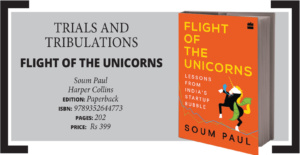 After policymakers, venture capitalists and entrepreneurs, the start-up bug seems to have caught the fancy of the publishers and writers. Soum Paul, who has tasted failures and success in entrepreneurship, has mapped the landscape of start-ups in India in his latest book, Flight of the Unicorns: Lessons from India’s Start-up Bubble. He explores the trajectory of Indian start-ups in the recent past and discovers the trials and tribulations of starting up. Through the voices of many innovators, entrepreneurs and investors, he studies the patterns in successes and parallels from other emerging markets. He builds on theories around what works and what doesn’t and paints a vision for the future of start-ups in this part of the world.
An entrepreneur who has seen both success and failure, Paul, an IIT Kanpur alumnus, and known for his first book, The Topper Prepares: True Stories of Those Who Cracked The JEE, has offered plenty of thoughts from ground zero. According to Nasscom, India is fast emerging as a start-up nation. Private start-ups, such as Flipkart, Ola and Paytm having an equity of $1 billion-plus have inspired and kindled the entrepreneurial interest for the next generation. So Paul’s work is quite timely.
The book is divided into three parts– the first section focuses on the rise and fall of the start-up ecosystem, while the second explores the trends and new rules of the game. The last section explores global case studies.
“From a risk-averse society, we have emerged as one of the fastest growing start-up hubs in the world,” Paul asserts introducing the book for a good reason.
As a concept, India is not new to start-ups. But what is defining the start-ups this time is the rapidly evolving technology, and the opportunities and challenges it offers increasing penetration of the internet, bristling e-commerce and a thriving middle class is equally fuelling the surge of start-ups in India.
this is a must read for those wishing to understand the evolving economic landscape
Paul begins his story with the emergence of start-ups following the dotcom bubble, and the fight against the Y2K bug in the late 1990s, which led to opportunities in IT services, such as business process outsourcing and knowledge process among other things. Then, the author focuses on early pioneers, such as Red Bus, Snapdeal, Flipkart, and many more.
The chapter on Red Bus is of great interest as it describes the trials and tribulations of Phanindra Sama, one of its founders who established the system of e-ticketing for bus travel in India, and transformed the bus journey for everyone including the author.
The second section begins defining start-up models and their various dimensions. Then, it moves on to debate various issues, such as India-first vs global-first or the understanding of the new untapped markets of India. Another chapter focuses on how 51 million small and medium enterprises with a little technology presence offer immense opportunity.
What is amusing and equally thought-provoking is Paul’s first brush with the start-up world. He has honestly admitted how it was a failure. Paul and his friend escaped a bone-breaking experience!
It was the summer of 2004 and on a stroll with his friend Ambarish Gupta (now CEO of Knowlarity Communications) in Bengaluru, they discussed the possibility of making the real estate space more organised and accessible. The idea was to enable the lessor and the lessee to connect directly without having to go through a broker or a middleman. Soon, a company– Inventica Solutions– was born.
Among other challenges, the two friends put resistance from builders and brokers at the top of the list. And sure enough, a threat from a real-estate agent killed Inventica. “If you don’t shut down your company by tomorrow morning, you will soon find your office building on MG Road flattened, and turned to dust. Do you understand what I am hinting at,” the Bengaluru-based agent threatened. Inventica Solutions died five months from its inception. “We were early, too early,” the author writes.
The chapter on health discusses in detail the journey of Bengalurubased technology firm– Forus Health – started by Dr ShyamVasudev and K Chandrashekhar with a mission to eradicate preventable blindness.
Following a drop in valuations and loss of market share, Indiangrown start-ups called for protection from the government in December 2016. “Investors and founders of Flipkart, Ola and Myntra called for policy changes that would protect home-grown startups against what they labelled capital dumping by non-Indian entities.”
This is surely a mustread for anyone who is a start-up entrepreneur, or anyone who wishes to understand the evolving economic landscape in India.
Thanks, Obama
One of the favourite pastimes of Americans is to look forward to books written by White House staffers of an outgoing presidency. Most of the time this part-insightful part-voyeuristic exercise is done by someone who’s at the top echelon inside the presidency, say Chief of the Staff or Secretary of Finance. In the case of President Obama’s tenure, it is the also-counts who have come out with the books first.
What is also interesting about these books is that most of them are rather irreverential in their tone, and rather light on content. The first to come out was from former Deputy Chief of Staff Alyssa Mastromonaco, titled Who Thought This Was a Good Idea? It was followed by Obama: An Intimate Portrait by former Chief Official White House Photographer for US Presidents Ronald Reagan and Barack Obama, Pete Souza. And hot on their heels comes Thanks, Obama: My Hopey, Changey White House Years by David Litt, one of the youngest speechwriters in the history of the White House, who served as a junior speechwriter for President Obama, one who was particularly sought after when it came to penning slightly cocky or an out and out humorous speeches.
When Litt, an Ivy League graduate, joined Obama’s campaign, he was a self-described “Obamabot”. Working through the presidential campaign and riding high on the rhetoric of hope and change, Litt found himself writing for President Obama at the Oval Office. But this is not what he had envisioned for himself.
In one of the early chapters of the book, Litt actually talks about how ironical it was that he was serving for the presidency considering what he wanted to do in his Ivy League dreamy days was to explore the world and work for anyone but the “system”. But here we are.
Litt started his stint as a junior speechwriter but quickly rose to the “special assistant to the president”. He certainly seems to be Obama’s go-to guy for funny speeches. The most prestigious of it all is the annual White House Correspondents’ Association Dinner. Those who prefer this sort of thing, and have seen them on TV or video streaming websites, agree that Obama killed it in every one of them that he participated in. That’s actually a verdict on Litt. Litt’s all-time high came in 2015 with the famous Correspondents’ Dinner featuring “Obama’s Anger Translator”. The “Anger Translator”, Luther was played brilliantly by KeeganMichael Key.
most poignant are sections where oBama delivers a speech following a tragedy
However, this is not to say that there were no slip-ups. Every now and then, Litt admits, he let his imagination run ahead of himself. The culmination of which was the monologue that Litt prepared for Obama for the 2011 White House Correspondents’ Association Dinner. The monologue was particularly scathing towards Donald Trump and his “Birther” conspiracy theory. Litt, like many others, believed that this buried Trump forever. Only it didn’t. It in fact furthered Trump’s resolve to fight the election.
“During the section on Trump, hundreds of Democrats and Republicans joined in bipartisan, mocking laughter. As the crowd applauded the president, the humiliated billionaire turned as red and angry as a blister. Well, I remember thinking, that’s the end of this guy,” he writes.
It’s not all fun and laughter. Particularly poignant are the sections where Obama has to deliver a speech following a tragedy. The most impressionable of them all was at Charleston, where Obama addressed the nation after Dylann Roof’s terrorist attack on Mother Emanuel.
“The church is and always has been the center of African American life, a place to call our own,” Obama said. Litt adds what happened next. “Then, without warning, he paused, looked down, and shook his head…. Then, softly, the most powerful person on earth began to sing.”
 Litt is self-deprecating in his humour all along, and admits to his mistakes readily. He admits how his clever play of word rhyming Kenya with Syria infuriated the entire Kenyan nation and drew brickbats. He also talks at length about some of his own frustrations vis-à-vis Obama administration and its failure to bring tectonic changes that it had promised during the campaign. Particularly interesting is his frustration over the repeated failure of the administration to launch healthcare.gov. When it is finally launched, Litt initially fails to convince his girlfriend to sign-up for the insurance, leading to a nasty fight. However, at the end she comes around to doing it and everything is hunky-dory in the Litt Land.
The book’s major drawback is its idealism, and almost blind faith in Obama. While Litt appears eager to admit to his mistakes, it is an altogether different matter when it comes to admitting that Obama made lots of horrible mistakes. Obama’s complicity in the destruction of Libya and Syria is carefully sidestepped, while other issues mostly see just a tap on the wrist.
But then, the book is not about Obama per se. It is about Litt, and his escapades. And readers will find plenty of them to keep them engrossed. Litt, thankfully, also doesn’t come out as an Ivy League pricks that populate the lengths and breadths of America. He is very sincere in his writing, and extremely funny in telling anecdotes.
Without a doubt, this would be a good new year light read if you were looking for one. Nothing serious, but then who wants serious stuffs at the start of the year anyway.