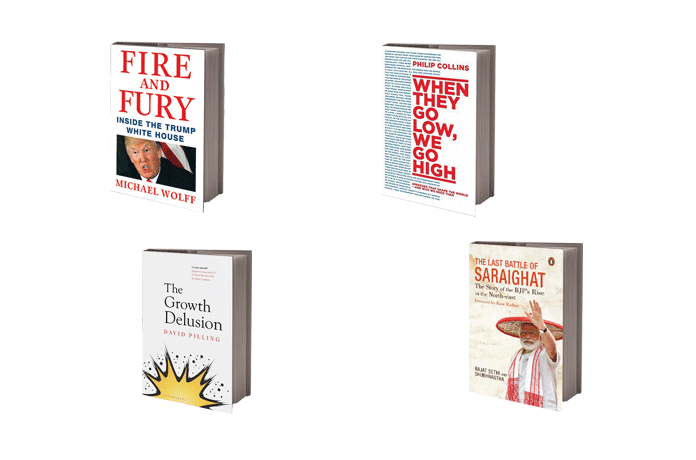
Fire & Fury
In the recent history, no book, absolutely no book, has created as much furore and excitement as Michael Wolff ’s Fire and Fury has done. So much so that even when the book’s extended excerpt was circulated far and wide on the internet, the book’s sale did not take a hit. The popularity had some unintended hilarious side effects as well. It turned out that an author of a book of the same name but different subject started receiving royalty cheques of amounts unseen before. Clearly overeager Americans – mostly from Donald Trump’s stupid base – bought the wrong book helping the unsuspecting academic writer to make some quick bucks in the process. Who is complaining?
So what is it that Fire and Fury bring to the reader? Well, if the book is passed through rigorous editing, it might not even have made the cut. There are just too many gossips with too little attribution or citations. But everything is kosher when it comes to Trump. Or that is what American liberal media thinks. And hence, a book that could not have seen the light of the day under normal circumstances became a straightaway hit.
However, when we treat it like a gossip column, it is indeed a triumph. We have a child-man sitting in the Oval Office, with his hands on the nuclear button. He also, by the way, according to his own admission, has a Diet-Coke button on the table. With his intellect one is always afraid which one will he end up pushing when push comes to shove. Under the circumstances, this book works wonders. It not only gives a peep inside his mind and working, it lays bare the entire thing for the readers to make an opinion about.
Many of the revelations regarding the influence of his kids, his wife and his son-in-law have come out in bits and pieces in the media. However, the book goes on to drop bombshells in that it establishes that Jared Kushner, his Orthodox Jewish son-in-law, is Israel’s man in the White House, and has gone out of his way to work for the Israeli interests, often against America’s own interests. The book reveals that Kushner lobbied with Russia to defeat an anti-Israel motion in the UN. In any other country, this would be a scandal in its own right. But not here. Not in America. Not surprisingly, not one media house said that this is Israel’s interference in US’s matter. Everyone blamed Russia. How did they reach such a conclusion is anyone’s guess.
We have a child-man sitting in the Oval Office doing things at his whim and fancy
The book also reveals the extent of Steve Bannon’s influence on Trump team. This dangerous grand vizier of White Supremism clearly achieved a lot in the last few years to the point where he managed to install a child-man in the White House, who, he thought, would continue to dance to his tune and implement the far-right agenda. He, in fact, did so initially. The so-called “Muslim Ban” was Bannon’s finest moment of his career. But then, Bannon made a fatal mistake. He forgot that he is dealing with a man with a massive ego, who was clearly perturbed by the media’s projection that it was not him but Bannon who was running America. That proved to be too much for Trump. Bannon was asked to leave. Although the relationship did not take a toll. But then, Bannon decided to talk to Wolff. And he took liberties. Talking about Trump’s victory, he said:
“When the unexpected trend – Trump might actually win – seemed confirmed, Don Jr told a friend that his father, or DJT, as he called him, looked as if he had seen a ghost. Melania, to whom Donald Trump had made his solemn guarantee, was in tears – and not of joy. There was, in the space of little more than an hour, in Steve Bannon’s not unamused observation, a befuddled Trump morphing into a disbelieving Trump and then into a horrified Trump. But still to come was the final transformation: Suddenly, Donald Trump became a man who believed that he deserved to be, and was wholly capable of being, the president of the United States.”
Clearly, Bannon flew too close to the sun and was burnt consequently. Trump not only coined a moniker for him, Bannon was forced to resign from Breitbart News, a platform that he made potent through his endeavours, and which later became instrumental in foisting Trump over America.
The book is, of course, more than gossip. It makes a casual reader make an opinion about how White House is working these days (spoiler: it’s bad) and provides experts with enough background material to make sense of the bedlam that America’s foreign and domestic policy formulation has become these days. However, depending on it for deep insight, or to predict Trump’s steps in any way, would be detrimental to any journalist or expert who watches US’s polity and politics from a close quarter.
When They Go Low, We Go High
When the publicist sent me this Bible – size thick book on a collection of speeches for review, I would have tossed it off to “never to be read” basket at the very first look. But I didn’t. The name of the author, Philip Collins, appeared to be distantly familiar. I tried to recall where I had read this name and it came after several hours of effort. Yes, Philip Collins was the chief speech-writer of United Kingdom’s ex-Prime Minister and war criminal Tony Blair. Now come on, if your day job is to write a speech that makes a war criminal, and a serial liar, look passably human to the people he is addressing it to, you got to have some calibre there.
On the face of it When They Go Low, We Go High looks like any drab collection of speeches. But it is not. Looks can be deceptive. Philip Collins is a name to reckon with when it comes to rhetoric. Not only has his speeches helped Blair connect with the masses, whom he took for a ride; Collins’ column in British newspapers gives great insight into the political rhetoric that shapes the politics on both sides of the Atlantic.
In this book, Collins takes as many as 25 speeches transcending place, era and personalities and has dissected them to their bare bones to bring to the readers the subtle art of speech-writing. The selection ranges from Nehru’s famous ‘A Tryst With Destiny’ in India’s constituent assembly to Hitler’s ‘My Patience is Now at an End’ at Berlin Sportpalast to Marcus Tullius Cicero’s ‘First Philippic Against Mark Antony’ in The Senate, Rome. In between, we have usual fare of Abraham Lincoln, Winston Churchill, JFK, Barack Obama to who not.
Every speech receives around 10 pages each. These pages include the biography of the person making the speech, a general summary of the sociopolitical realities of the time in which these were made and then a thorough dissection of what that particular speech was trying to achieve, and how it managed to achieve it.
In the hands of an average writer, this could have been a disaster. All the speeches included in this collection are pretty well-known speeches. They have been analysed and dissected from every possible angle in all these years. However, Collins manages to bring a fresh perspective to each one of them. As a reader, one might agree or not agree with the deductions made, but one cannot say that the points being made are banal.
In many of the speeches, he dwells upon the drafting process as well. And they are superb. He talks at length how Ronald Reagan in his historic 1987 speech at The Brandenburg Gate in Berlin dithered with phrases like “bring down this wall”, “take down this wall”, “take down that wall”, “Machensiedieses tor auf ”, and “one day this ugly wall will disappear” before it turned into the historic “tear down this wall”.
However, my favourite is the section detailing Dr Kin’s ‘I Have a Dream’ speech. Dr King was writing the speech that he was to deliver at the march in Washington on August 28, 1963. Wyatt Walker, his close confidante, asked him to do away with the “I have a Dream” passage, which Walker believed to be dry and banal, not to mention clichéd. So Dr King skipped the lines the next day. However, the resultant speech was not able to raise the masses.
In the hands of an average writer, this book could have been a ceremonial disaster
The great gospel singer Mahalia Jackson, who was standing behind Dr King, shouted, “Tell ’em about the dream, Martin!” Dr King dropped the written text and began the passage.
‘I have a dream that my four little children will one day live in a nation where they will not be judged by the colour of their skin but by the content of their character. I have a dream today! I have a dream that one day… right there in Alabama little black boys and black girls will be able to join hands with little white boys and white girls as sisters and brothers. I have a dream today!’
The rest, as they say, is history.
At some places, Collins betrays his love for The Obamas. I mean the book itself is named after the opening remarks of Michelle Obama’s now famous speech at the conclusion of Democratic National Convention in the year 2016. Then, not surprisingly, he includes a speech of Barack Obama in the collection. Sharing space with the likes of Cicero and Castro is a great honour. I am not so sure what Obama’s speeches achieved to get this admiration. But they are there.
Of Obama, he says, “Read a speech by Dr King out for yourself and you can electrify the air. It’s not as easy to do with a text by Obama. You can’t say it like he does.” That’s a valid point. However, Democrats still went on and lost the election to a goof who cannot put together a coherent passage or make a point. That goes against the conventional wisdom.
The book is a must-read for anyone who is interested in rhetoric and the way it works on masses. But let me warn you that this is not an easy read at all. In fact, far from it.
The Growth Delusion
In The Growth Delusion, author and Financial Times journalist David Pilling examines the way economists and their clan of ‘growth’ have influenced policymaking. “For the purposes of this book ‘the economy’ and ‘Gross Domestic Product (GDP)’ are interchangeable terms” is a footnote on the first page of the book and is somewhat inaccurate. The author’s aim is to establish that although expanding GDP is the accepted signifier of a nation’s economic prosperity, it is indeed nowhere close to corresponding with the real economy. This is a substantial case. Institutional policies are driven rigorously to escalate the most commonly accepted measure of growth -GDP. According to this benchmark, our times have not been more affluent or joyous than today’s. Yet it does not feel like that. The deviation between the definition of economic achievement and the understood actuality by the people is the central discussion in this work. David Pilling writes “There are many competing explanations for what has caused popular rage in countries that have, judged by conventional measures, never been richer. There is, though, a common thread. People do not see the reality of their lives reflected in the official picture, painted principally by economists. ” Our society is such that a conclave of economists within accessible arithmetic codes, determine the structure of public deliberation. Finally, the state of the economy as understood on these terms settles the amount to be spent on education, roadways, military. And the economists determine acceptable levels of unemployment, or if it is advisable to print notes rather than rescuing degenerate banks. He makes the reader reflect on why these such fragmented times are where there is an all-around surge in populism and an ever blunt economic inequality. In terms of economic progress, consuming drugs and prostitution are far more beneficial than volunteer or public services. But in a pragmatic society, the author notes, deliberating on how to assess what improves economies and not just what makes them massive, is required. Unpolluted air, secure streets, reliable jobs, healthy minds – all that is imperative for our welfare, remains outside the cognizance of the usual measure of progress.
Pilling’s asset is an easy reading of his narrative. Weighty discussions are brightened by a flow of some concerning anecdotes, which include thrilling depictions given by statisticians and other analysts. He expresses that we chase the idea of maximising growth while not pausing to reflect about the costs. It begins with household chores and other informal work that is eliminated as it is not paid labour. Technological advancements are usually underrated and alterations in the scope of services are mostly overlooked. Social degeneration affects the conditions of life, while its costs largely reflect on the GDP. If expanding this cumulative indicator is the only measure of economic progress, the woes of growing inequality are concealed. GDP standards in developing nations are painfully faulty, lacking substantial progress as well as the constancy of severe poverty. While pollution does not deduct from GDP, the expenditures of curtailing it increase the GDP. Worse than this is a crime, where both the offence and its prohibition lead to raise in this measure. It also discounts the damage due to reducing natural resources like ruining of rain forests and soil erosion. Lastly, GDP does not take into account happiness, and Pilling inadequately suggests that this is the real aim of the economic exercise. Nonetheless, since GDP employs costing to measure value, the most meaningful aspects like secure communities and better health systems, are precisely undervalued. In this work, serious environmental effects of economic transition are also entirely investigated. For instance, the brunt of Beijing smog is contradicted with the phenomenal heights of growth in China.
Weighty discussions are brightened by a flow of concerning anecdotes
Various proposed inclusions and alterations are a point of discussion in this book, but Pilling notes their basis on subjective readings of the comparative significance of the many aspects of economic progress and collapse. He writes “the problem with our obsession with growth is that we do not count the negatives. You cannot call it a trade-off if you only measure one side of the equation.” While the book brings forth two fundamental questions, it falls short in examining them in detail: Why did economic progress become tantamount to national triumph, and why did GDP rise become tantamount to economic progress? The author contends that our unflinching adherence to growth is feeding misled policies and adding to an increasing apprehension of experts leading to disturbances in the groundwork of our democracy. To meet these contestations, this account offers GDP 2.0 which should take stock of the population statistics, distribution of wage, the accounting of public assets and other lacking variables. And this emerges as the biggest strength and weakness of Pilling’s inquiry. Those who are anticipating a sweeping dismissal of growth will be disappointed.
Finally, it ought to be noted that it is not usual that a book on economic measures is synchronously significant and out-and-out entertaining as seldom does a reading of GDP and growth crackle with this kind of ingenuity and wit.
The Last Battle Of Saraighat
Located in a remote corner, besieged by insurgency, lack of development and poor connectivity, the North-East has little appeal for India. It hogged the headlines due to terror attacks, raids by the army on insurgents’ hideouts, or when the chief ministers heavily, dependent on central funds, cried over the step-motherly treatment of the region. Ruled by the Congress, the entire northeastern region has today turned into a saffron bastion. In the seven out of the eight states of the North East, either a BJP-led government (Assam, Manipur, Arunachal Pradesh and Tripura) or an NDA government (Nagaland, Sikkim, Meghalaya) is in power. Mizoram goes to election by this year end.
While it is debatable how the entire region has been swept by the saffron surge, the credit goes to the ruling BJP and its ideological mentor, the Rashtriya Swayemsevak Sangh, for swaying the voters to ensure its victory.
While no definite book has been authored yet on this issue, a recent work that traces the ascendancy of the BJP to power in the North East, especially in Assam is The Last Battle of Saraighat. It focuses on the assembly polls in Assam in 2016—a political watershed in the history of Assam as it ended the Congress’ political monopoly. It has given a boost to the BJP, for a wider acceptance at a national level that was being viewed as a party of Hindi heartland.
The book has been authored by Rajat Sethi, a public policy and management graduate from Harvard University, and Shubhrastha, a spin doctor. While Sethi is currently the political adviser to the chief minister of Manipur, Shubhrastha works with the office of the BJP National General Secretary, Ram Madhav in the North-East. So, in a way, it is an insider’s tale.
This is no reason to turn away from the book. Instead, the book should be read by all those who wish to understand the NorthEast, especially politics in Assam, from the BJP’s perspective. Interestingly, the introduction to the book is based on a conversation with Dr Nani Gopal Mahanta, head of the department, political science, Gauhati University.
Despite being BJP insiders, the duo has been able to capture how the saffron brigade identified the Congress’ partisan attitude towards Assam and was able to whip up the collective consciousness of the people against the ruling party and turn it into their favour.
In doing so, the BJP has evoked the centuries-old battle of Saraighat, to build the anti-Congress narrative, in which the Assamese soldiers, led by legendary general Lachit Borphukan, fought against the mighty Mughals. The authors draw a parallel between the BJP’s landslide victory in 2016 Assam elections and the decisive victory of the Ahoms in 1671.
The authors say, “Right from the beginning, the BJP’s Assam campaign was soaked in rich historical anecdotes. From resurrecting and venerating the historical icons of Assam, such as Sukaphaa, the first Ahom King, to Lachit Borphukan, the valiant Ahom general, the party ensured that it touched the emotional chord of people before even talking about politics and elections.”
Strongly etched in people’s imagination, the battle remains an emotional, cultural parable in Assam so much so that Lachit’s bravery is celebrated in the state as Lachit Divas and the best cadet of the National Defence Academy in Guwahati is conferred the Lachit Borphukan Gold Medal.
As illegal migrations poured into the state from Bangladesh, has agitated the ordinary Assamese. The BJP intelligently weaved with the Mughal invaders of medieval era with the battle of Saraighat to exploit the prevailing xenophobia. “By calling the elections ‘the Last Battle of Saraighat’, the BJP evoked a complex history,” write the authors, adding how it became a rallying cry for the 2016 elections. Also, the book discusses in detail how the immigration problem with various dimensions—language, land and religion—was well exploited by the BJP.
The authors hold several of the national leaders responsible for the national consciousness never becoming central to the North-East identity. Topping the list is, of course, India’s first PM, Jawaharlal Nehru. He comes under severe criticism for betraying Assam during the Cabinet Mission Plan of 1946, which clubbed Assam with Muslim-dominated provinces. This sidelined Assamese stalwarts, such as Gopinath Bordoloi.
As early as 1998, when the first NDA government, led by Atal Behari Vajpayee, came to power at the Centre and conferred the Bharat Ratna, India’s highest civilian honour, on Bordoloi.
BJP has evoked the centuries-old battle of Saraighat, to build the anti-Congress narrative
Even national poet, Tagore, is targeted for committing a ‘historical blunder’, by omitting the Northeast in his song, Jana Gan Mana, which was later adopted as the country’s national anthem.
Among many other factors discussed, which led to the rise of the BJP, the book mentions the Nellie Massacre, which “… polarised the entire state on the issue of ethnic clashes and violence,” the authors write. But one wonders whether the authors were oblivious of history— as to who actually stoked the communal fire in the state, or whether they deliberately chose to omit it, so as to rewrite a new history of Assam.