The gradual destruction of feudalism and the disintegration of landed-gentry families is an ongoing process. Different states in India have experienced this phenomenon to varying degrees and at varying times. The states with a strong theatre tradition have also used this theme in their plays. Naturally, Maharashtra has seen its own share of such plays and their productions. But among them all, Mahesh Elkunchwar’s Virasat remains unparalleled in its treatment of the subject.
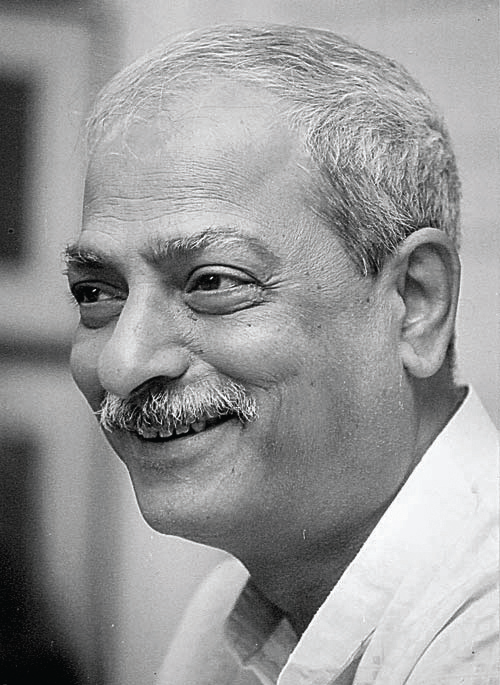 In 1982, noted playwright and a professor of English, Mahesh Elkunchwar, wrote the Marathi play Wada Chidebandi (The Stone Mansion). With the penning of its sequels Magna Talyakhathi and Yugaant; this turned into a 9 hours magnum opus, popularly known as Virasat in Hindi. The translation was done by celebrated writer Vasant Deo, who also has in his translated kitty, plays like Yayati by Girish Karnad, and Shantata Court ChaluAahe! by Vijay Tendulkar.
The story revolves around the time when the “Wada Culture” in rural Maharashtra had started to decline amidst all social and economic upheaval. The timeline is variously located anywhere between mid 60s to late 70s. This signifies that like any decay and decline, this was a painfully slow process and involved more than one generation.
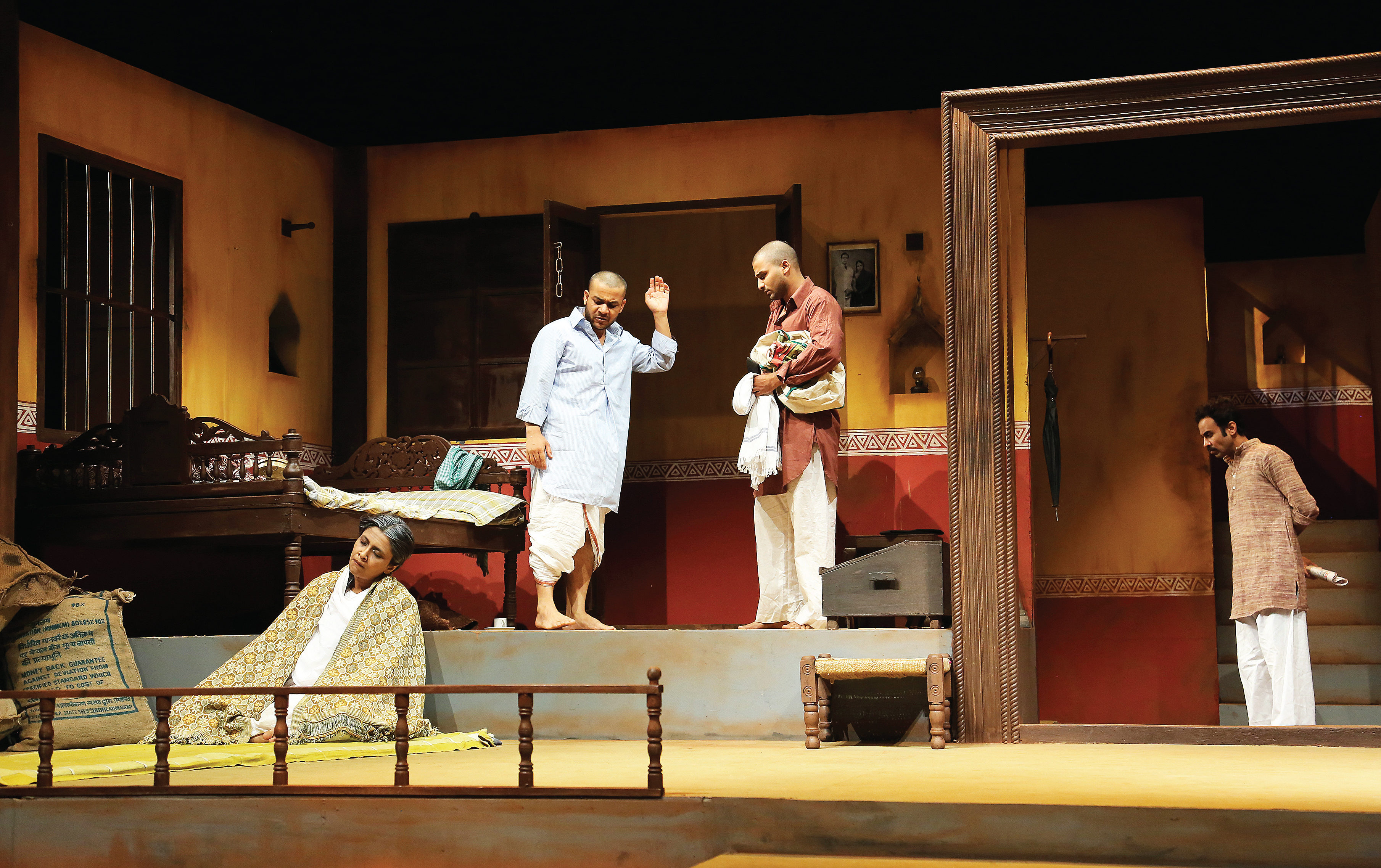
The play chronicles the life of the Deshpandes of Dharangaon, once a feudal, economically well-off landed-aristocracy household, which is in decline. While the trilogy stretches for three generations chronicling its rise again and then the final fall, the production performed by the first year students of the National School of Drama, under the direction of Aniruddha Khutwad, only deals with the original text, ‘Wada Chidebandi.’
“The subject is an invisible part of me. I am from a village from the ‘wada’ culture. I was born in a ‘wada’. My father was a zameendar (landlord). Luckily, my father did not face the same decline because my father was wise. All of us brothers got out. Only one stayed back to look after. But I was sensing nearby ‘wadas’ crumbling,” said Elkunchwar once in an interview.
The play opens with the death of the patriarch of the house ‘Tatyaji,’ who held the house of three sons and a daughter together. However, the rot and decline had already set in during his lifetime and it had advanced by the time of his death. The elder son, Bhaskar, is the patriarch now and his wife has started to exert herself after years of submission under ‘Aayi” or the matriarch of the house. They have a son, Parag, who has fallen into bad company in his late teens and has taken a liking for liquor. The daughter, Ranju, is not very good at studies and spends time either dreaming about Bollywood or hobnobbing with her “English Teacher,” who also doubles up as her lover.
Sudhir is the middle one among the brothers and works in Mumbai. He and his wife Anjali come to the village hearing of the death of ‘Tatyaji.’ Sudhir had migrated long ago to the city, the only one in the household to have done so. His son, Abhay, is mentioned throughout the play but is away in Mumbai preparing for his exams.
Tatyaji’s mother is in a semi vegetative state and does not know that her son has died. The youngest son, Chandu, is unmarried and past that age. But he has taken up the burden of the household chores physically. Sister Prabha is a bold and expressive female. Beyond her marriageable age, she holds the grudge against her father and the household who did not allow her to go to Nagpur for higher studies. She is the one who speaks her mind and still harbours the desire to study further.
They all have gathered in a very stifling environment. The Shraadh of their father is due, and because of their feudal background, they want a grand feast. But this desire is not matched by their financial capabilities. Consequently, every member of the household is at war against each other. The whole setting appears to be loaded, waiting to explode.
And explode it does. It all starts when it is known that Sudhir has bought a Colour TV in Mumbai. This is seen as a wasteful activity by Bhaskar who feels that he has been looking after the household and the agriculture all alone and that Sudhir does not help in anyway. Sudhir of course believes that he is getting nothing out of his share in the property in the village. He and his wife are upwardly mobile and want their son to achieve big.
Chandu hurts himself by colliding with the household tractor. His situation is pitiful as the wound festers but the household cannot afford to have him treated at a hospital. It is also shown that except Chandu and the matriarch, everybody else in the Deshpande household wants to have their share in the ancestral property and family gold.
“The playwright has provided an interwoven narrative that works at several levels. If you read the play, the big picture comes up effortlessly. My work was to enhance that visually through characterisation. The focus was of course on the decline of feudalism. But we are not being judgmental. We don’t take good or bad position. We just say that it was in accordance of its period and the economic and social factors that had started to prevail then. It ushered the democratic mooring to the villages which had hardly understood the significance of independence three decades or so ago,” says Aniruddha Khutwad, the director of the production.
The situation is further aggravated when Ranju elopes with her “master,” who later abandons her relieving her with all the jewelleries she had stolen from the household when she had left. That too bang in the middle of the Shraadh and the impending feast.
Prabha remains the most intriguing character of this play. She is suppressed, unmarried, but has the desire to study further and make a living out of it. At a certain level, it appears that such a character would be unthinkable in a landed-aristocracy family of the 70s. But Khutwad disagrees. He says that if Elkunchwar has placed a character as Prabha, he must have had a reference for it somewhere. “I have had my own experiences where I have seen a certain masculinity in even those females who were otherwise suppressed. They create their own space somehow,” he added in good measure.
Household’s tractor, a symbolism of feudalism, is a character in itself. Several productions of this play has had physical tractor present on the set. Khutwad chooses to use it in absentia. It is referred to by several characters but is never seen. In the trilogy, the tractor gets buried in the mud at the end, signifying that the process of the decline of feudalism is complete. Elkunchwar once mentioned in an interview that director Satyadev Dubey had once mentioned about such a household who never could use the tractor and hence the tractor and the house got buried together, metaphorically. And that Elkunchwar got the idea for this play from that anecdote. It is also curious why Khutwad did not want the tractor on the stage, but to remain unseen.
“For me tractor is an imagery. Physically bringing it would reduce it to what it is, i.e a mere tractor. I prefer the image of the tractor that comes through the eyes of the various characters of this play. Bhabhi keeps dusting it. Chandu gets hurt from it. Tractor is different in every character’s eyes. I found it important to bring that image rather than physically putting it there,” explains Khutwad.
It is also evident in the play that hardly any character in the play is in black and white. Everyone has a tinge of grey in him or her. It is anybody’s guess how audience of the time, i.e early 1980s when the play was written and first produced, would have perceived this play. It is important to mention here that audience of that era were not very accustomed to such characterizations.
“I have read most of Elkunchwar’s plays and I believe that ‘Existentialism’ has a huge influence on his works. Same goes for individualism. His female characters bring in these ideas very forcefully. The concept of grey character comes from ‘Realism.’ Elkunchwar has a great grasp on ‘Realism.’ It is thus a logical progression. Also, when we talk about plays that are ahead of their time, we talk about plays like this.”
Some of the strongest scenes have been handled tactfully. There’s a scene where Bhaskar steals the family jewelleries and tries to rope in his wife in his act. He asks his wife to adorn every piece of it. But as soon as she does that, she goes into trance and consequently rejects her husband’s scruple. The scene takes place in dead night and is very forceful in its impact. His wife relives the splendid moments lived by the females of the household when they would have entered the house as brides adored in all the jewelleries.
Khutwad captures the authentic milieu for the action and comes out triumphant in his direction. The lack of space does not deter him in any way. He has used silences and long pauses tactfully too. Elkunchwar as a playwright was known to be perpetually unhappy with how directors mutilated his long pauses and silences with background voices. Khutwad tries his best to stick to the original.
“I have tried to understand the play through the pains of characters like Prabha, Chandu and Parag. They are the most deserving and endearing characters of the play, but it is them who don’t get anything from the inheritance.”
He has made some changes too. In the original text, Anjali is a Deshastha Brahmin, like the household she is married into. In one of the early productions, Anjali was shown as a Konkanastha, thereby contrasting her from the real or perceived generousness and extravagance of the Deshasthas. Khutwad’s Anjali is Konkanastha too.
The changing socio-economic realities are brought subtly through the dialogues. During one of the fights, Bhaskar says, “Do you know, out of the seven houses of Brahmins three have remained? People have opened liquor shops, run trucks, built brothels. We cannot do this,” thereby underlining the difficulties that such a family faced while coming in terms with the changing realities on the ground.
There’s an all round good performances by the First Year Students. In fact, I had gone with low expectations considering the actors were greenhorns, but was left pleasantly surprised. Susheel Kant Mishra as Chandu, Debarati Sikder as Aai, Abhijit Solanki as Bhaskar, Indira Tiwari as Bhabhi, and Sarfaraz Ali Mirza as Sudhir are all impressive. However, the star of the production is Pooja Vedvikhyat as Prabha. She imbibes the milieu and character in a way that leaves you astounded.
Virasat remains a valuable documentation of the changing socio-economic realities of India. In a largely urban audience, the play managed to leave deep imprints. It only further enunciates the timeliness and the universal language of this play.