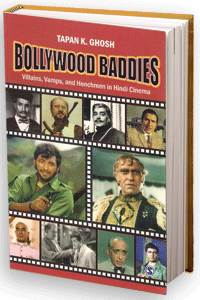
Would popular Hindi cinema have been quite as colourful, engaging and full of high drama without the nefarious nudging of its dreaded villains? The answer to that question is an obvious no. “Villains are the unsung heroes of Bollywood cinema, just in case the notion of heroism is extended to imply everything that is both moral and immoral, virtue and vice spun together,” the author of the book under review writes. Indeed, a hero wouldn’t be as grand as, say, the invisible do-gooder protagonist of Mr. India if he did not have a comic-book Mogambo to reckon with, or as engaging as Jai and Veeru of Sholay without a law-unto-himself Gabbar Singh lurking around them menacingly? Why, then, has it taken so inordinately long for a socio-cultural analysis of the role of villainy in Mumbai’s cinematic landscape to be attempted? But better late than never.
This comprehensive study of villainy in Hindi cinema by Tapan K Ghosh, former head of the department of English, Rabindra Bharati University, Kolkata, is by no means the last word on the subject. In fact, no book about the villains of the Mumbai movies can ever hope to sum up the entire story, given how vast and multi-layered it is. The author comes close to accomplishing the impossible.
Bollywood Baddies: Villains, Vamps and Henchmen in Hindi Cinema, while only a beginning, is certainly a much-needed addition to the exploration of an important aspect of the imagination of Mumbai’s commercial filmmakers that has, down the years, dictated the broad parameters of the good versus evil formula, inspired no doubt by the nation’s epics.
This book will definitely serve as a relaible launchpad for any film scholar who desires to conduct a further probe into the phenomena that the likesof Gabbar Singh and Mogambo were and will always be.
Ghosh covers a lot of ground in terms of specific films and characters that have defined villainy in Mumbai cinema, ranging from the exploitative zamindar Harnam Singh (Murad) in Bimal Roy’s neo-realist Do Bigha Zameen to the reprehensible, bloodthirsty cretin Kancha Cheena (Sanjay Dutt) in the no-holds-barred 2012 version of Agneepath, made two decades after the original film in which Danny Denzongpa played the evil character.
Bollywood Baddies starts, of course, with the negative character – the anti-hero – that Ashok Kumar played in 1943’s Kismet, and then goes on to trace the evolution of screen villainy in the context of the socio-political and economic concerns of a newly independent nation, and in that of the changing landscape thereafter.
That, as is pretty obvious, is a wide spectrum to cover, and the portraits that the author etches, though often shot through with startling insight, are not consistently absorbing. Not that the failing in question takes anything away from the overall triumph of the book.
Ghosh places the villains in three distinct periods of Hindi cinema – the 50s and 60s, Sholay and the 1970s, and the 1980s and after – and places them in the social environment of the times that they represented. From Lala Sukhiram in Mother India to the Shakespeare-inspired Langda Tyagi in Omkara, the villain has assumed innumerable forms but he has, in adherence to classic theatrical forms, always stayed within a formulaic narrative construct aimed at accentuating the heroism of the protagonist.
He notes that in the 1970s, the villain became so powerful that the hero – specifically the angry young man persona portrayed by Amitabh Bachchan – had no time for romance, song and dance and other diversions. He also suggests that Bachchan’s foray into the lighter roles like the one he played in Amar Akbar Anthony only a couple of years after Sholay were a direct reaction to the “wounds Gabbar Singh had left”.
The 1980s onwards, and especially in the 1990s, the Hindi movie heroes began to mimic the villain in many ways as over-the-top characterizations began to reflect the chaotic moral compass of society at large. The emergence of the anti-hero (who can traced back to Kismet’s suave Shekhar), Ghosh argues, stemmed this change.
The author rounds off the book with write-ups on the actors who played villains, vamps and henchmen over the years and a lowdown on a few of the most memorable baddies in Mumbai cinema history. All the names that you expect to encounter in a book on villains – Kanhaiyalal, Pran, Ajit, Prem Chopra, Amrish Puri – are all here. But also in the mix are those that played second fiddle – the henchmen (Shetty, Jeevan, Bob Christo) and the vamps (Lalita Pawar, Shashikala, Nadira, Bindu).
Bollywood Baddies is a readable book that could give the dreaded and the outrageous a new lease of life in the collective consciousness of Hindi movie fans.
Author: Tapan K. Ghosh
Publications: Sage
Edition: Paperback
ISBN: 978-81-321-1097-2
Pages: 213
Price: Rs 395