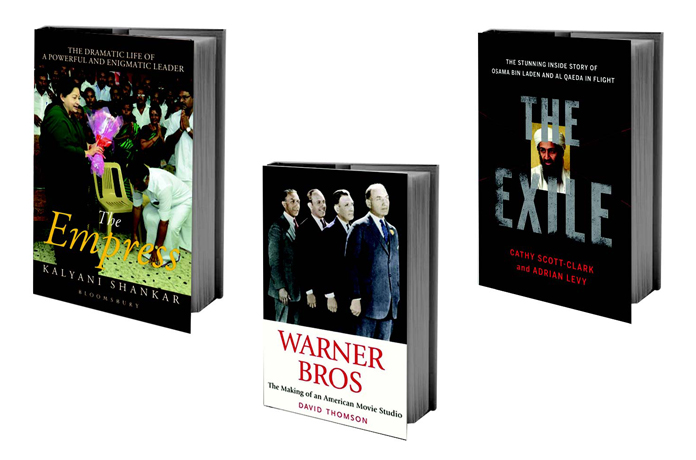
1. The Empress
Tamil Nadu has always hit the headlines for right reasons and wrong. For close to a year now, the news and views from this southern state have been revolving around the legacy of Chief Minister J Jayalalithaa, who was declared dead on December 5, after being admitted to Apollo Hospital on September 22. In her death, the state did not just lose a chief minister, but a figure who was revered as ‘Amma’, or mother, by 65 million residents of Tamil Nadu. Her death has created a vacuum in the ruling party and governance, which is hard to fill. Such was the cult status she enjoyed that no other politician could match in the recent past.
Her persona charmed the masses so much that despite allegations of corruption she returned to power four times. She was a crowd-puller and a vote catcher for her party–All India Anna Dravida Munnetra Kazhagam (AIADMK). Her charismatic appeal bowled over not only those who knew her well but even those who were complete strangers to Tamil Nadu or state politics.
Her fans held prayers in temples, churches and mosques when she fell ill or faced legal troubles. Some attempted self-immolation in front of the hospital or outside her house in a show of loyalty and devotion to their goddess.
Veteran journalist, Kalyani Shankar, in her latest book, The Empress, explores and explains the life of Jayalalithaa, the southern cine queen who held a firm position within the hearts of millions of her fans. Just as her life, her death too was an enigma.
Shankar tries to depict ‘Iron Lady’ as portrayed by people who were well acquainted with her and chose to speak out. Many who knew her refused to record their impressions and wanted to keep their memories private.
However, this is not the first time Shankar is writing about Jayalalithaa. The author has written about her extensively in her reportage and columns over the years. In 2013, in her work, Pandora’s Daughters, the author examined the personal and political lives of eight prominent contemporary women leaders who have achieved great power in the male-dominated world of Indian politics, by illuminating and interpreting their strengths and weaknesses.
They included the Sonia Gandhi, chairperson of the UPA and president of the Congress party. Others who found their way into her book were: symbol of Dalit strength Mayawati; Mamata Banerjee, who defeated Communists in West Bengal; “the next-door granny” Sheila Dikshit; the first woman president of India, Pratibha Patil; leader of the opposition in the Lok Sabha, Sushma Swaraj; and leader of the opposition in J&K, Mehbooba Mufti.
It also featured the film starturned-politician, Jayalalithaa, who was inducted into politics by her mentor, cine star and chief minister, MG Ramachandran.
Now, nearly a year after Jaya’s demise, we have a complete book chronicling her life and death.
Referred to as ‘Puratchi Thalaivi’, the book captures her elevation to the position of chief minister of Tamil Nadu in 1991, and how she steered her party to power three times more in 2001, 2011 and 2016. It also describes her dramas, tantrums and her politics of vengeance. There are many instances of her impulsive behaviour recorded in the book.
 One such instance is when she, as the Tamil Nadu chief minister, in 1993, decided to sit on a dharna at the MGR Samadhi off the Marina beach. She sat without her security demanding a monitoring committee to oversee the implementation of the Cauvery Tribunal’s interim award of 205 thousand million cubic feet volume of water by Karnataka to Tamil Nadu. Soon, AIADMK joined her to show their solidarity. Prime Minister Narasimha Rao sent Union water resources minister VC Shukla with an assurance that the committee would be set up. Jayalalithaa then sipped orange juice offered by Shukla, and the committee was set up within months.
According to the book, at one point, Jayalalithaa also nurtured the ambition of being India’s prime minister!
Shankar, who has been reporting on the political landscape for several decades now has also detailed controversies of political vendetta by Jayalalithaa, against her arch political rivals and octogenarian former chief minister M Karunanidhi, by arresting him in a post-midnight crackdown. Several honest bureaucrats who earned her wrath were not spared either, beginning with VS Chandralekha, the IAS officer who faced acid attack in 1992, to P Shankar, chief secretary who was ousted.
Given to slavish display of obedience Jayalalithaa “was unforgiving of anyone who deviated even slightly from her set prescriptions”, writes the author quoting former national security adviser, MK Narayanan.
Writing about her death, the veteran journalist says: “There was secrecy, mystery, rumours and lies about the six-time chief minister Jayalalithaa’s last days.”
The author has also recorded the tumultuous events post Jayalalithaa’s death by several players, including her friend, Sasikala Natarajan and her nephew TTV Dinakaran, plunging Tamil Nadu into a political morass.
a year after Jaya’s demise, we have a complete book chronicling her life and death
Nobel Prize winner Amartya Sen, and his co-author Jean Dreze, observe in their book–An Uncertain Glory–how Tamil Nadu is a paragon of administrative innovation. Leaving behind a rich legacy in political, administrative and economic areas, Jayalalithaa pioneered welfare schemes and portrayed herself as the champion of the poor by introducing schemes to provide cheap food, medicines, cement and even mineral water.
2. Warner Bros
David Thomson wants readers to have no illusions about the central figure of “Warner Bros: The Making of an American Movie Studio.” Jack Warner was “maybe the biggest scumbag ever to get into a Jewish Lives series.… But being less than Einstein, Proust, or even Barbra Streisand didn’t stop Jack and Warner Bros. from having an impact on our culture and dreams, on us, that is alarming because it’s enormous.”
Thomson is one of the greatest film historians, and at 191 pages of text, “Warner Bros” is a model of concision and precision. A departure from other books in Yale’s Jewish Lives series, it’s not a biography of a single man or even four brothers, but of a studio.
“They didn’t call themselves Paramount or Universal or Columbia, names from out of the clouds,” Thomson writes. “No, they said theirs was a family show, just the brothers. …”
The family Wonsal (or Wonskolaser) emigrated from an area of Poland under Russian control to Baltimore in the late 1880s and moved around, living in Canada (Jack, the youngest, was born in Ontario) and finally settling in Youngstown, Ohio. Harry, the oldest, “could read and write in Hebrew, while Jack struggled with English.” Jack, who would become the dominant force of the studio, “abandoned his own education for more pressing things before he was 12.”
One of those “pressing things” was movies. A founding myth of the family, propagated by all the Brothers Warner but particularly by Jack in his fanciful autobiography, “My First Hundred Years in Hollywood,” was how Sam bought a primitive movie projector and the entire family gathered to watch “The Great Train Robbery”—actually pieces of the film as the projector was not in perfect working order. They were enthralled by the artistry of the new medium and enticed by the business possibilities.
Though the four brothers— Harry, Abe, Sam and Jack— started the studio together, Jack, Thomson says, “was eager to be a show business person: this makes him awful in some ways, despised by many of his own employees. But he is irresistible, too, the showman in the family, the one who’s likely to tell the world, ‘You ain’t heard nothing yet!’”
Which, by the way, was the most enduring line in “The Jazz Singer,” the first feature-length sound picture and the first Warner Bros. blockbuster. The struggle to bring it to fruition was so great that, after Sam’s death, Jack “had no doubt—‘The Jazz Singer killed him,’ because of the way Sam had been in charge of that production and its struggle towards synchronized sound.” Sam died of complications from pneumonia the day before the film’s premiere in 1927.
 In an astonishing array of films that worked their way into America’s collective unconscious, the Warners’ stories “taught immigrants English—and a thought of being American.” To name just few of their most iconic films: “The Jazz Singer,” “The Public Enemy,” “Little Caesar,” “The Adventures of Robin Hood,” “Casablanca,” “Streetcar Named Desire,” and “The Searchers.”
Sift through that list and appreciate the amazing range of actors who starred in them: James Cagney, Edward G. Robinson, Barbara Stanwyck, Humphrey Bogart, Bette Davis, James Dean, Marlon Brando and many others.
Among them they represent the spectrum of American acting in those years. Thomson is also generous to the equally brilliant but under celebrated female stars such as Joan Blondell, Ruby Keeler, and Ida Lupino.
Jack Warner was domineering, ruthless even, to those he owed part of his success to, and an egomaniac, but he was instrumental in bringing sound to cinema, reviving Alfred Hitchcock’s career (with “Strangers on a Train,” made after a few financial flops), and whether he appreciated it or not, he helped usher in method acting. He let John Huston go to Mexico to “shoot a yarn about chasing gold,” and despite his personal politics, which were often reactionary, his studio was ”the most socially conscious or leftist studio outside the Soviet Union.”
It’s hard to think of any definition of hero, from the ancient Greeks’ to Hollywood’s, that fits Jack Warner, but surely, like David Copperfield, he was at least the hero of his own story. Cagney despised him, Bogart didn’t trust him, Bette Davis sued him, and his brothers were alienated by him. His first star, Rin Tin Tin, probably growled at him. But without him, perhaps half the classics of the first 40 years of American movies would never have been made, and archetypal American characters such as Rin Tin Tin, Sam Spade, Rick Blaine, Mildred Pierce, Stanley Kowalski and even Bugs Bunny might never have seen the silver light.
thomson is a great film historian, and warner bros is a model of concision and precision
After Jack sold the studio in 1966, Warren Beatty visited him to screen “Bonnie and Clyde,” which Beatty starred in and produced. It was one of the last projects Warner had a hand in, and its violence shocked audiences in 1967, just as “The Public Enemy” had 36 years earlier. “The old man,” Thomson writes, “was unimpressed by the movie. … Beatty told him, ‘It’s homage to Warners’ gangster films.’ And Jack fired back, ‘What the hell is homage’?”
If the old man had understood what homage was, he’d know that David Thomson’s “Warner Bros” is a fitting one.
3. The Exile
In literary terms, The Exile: The Stunning Inside Story of Osama Bin Laden And Al Qaeda in Flight by author duo Cathy Scott-Clark and Adrian Levy is a magnum opus. Running into 650 pages, the book is a fruit of several years of labour of research by the authors. However, has it managed to say anything new? Apparently, pretty much. How much of that pretty much is however independently verifiable is anyone’s guess.
Most of the book is centred on the flight of al-Qaeda’s leadership in general and Osama bin Laden and his family in particular. However, there are other aspects as well. They are like subplots. A lot has been written on whether the Pakistani Military and Intelligence leadership knew about Bin Laden’s whereabouts. Or whether or not they were complicit in it. Another subplot is related to the flight of al-Qaeda operatives to Iran, and Iran’s offer to the US to hand them over. All of these subplots are as interesting as the main plot if not more.
The research shows and how. While there are several sources that have been accessed, including Laden’s extended family, the primary – and possibly the most important– source for the author remains a senior cleric inside alQaeda leadership, who now stays in Mauritania. This informant gives a peek not merely inside the working of al-Qaeda, but also to the different ideological strains that existed– and most certainly still exist– inside the dreaded organisation.
 In a detailed account that deals with the terror group’s internal dynamic demonstrates that while the group continues to derive strength from its impressively large pool of fighters, who are ready to give their life at the mere suggestion; it is a small but committed leadership of individuals from varied backgrounds who decide the strategy. The book insists that while their ultimate goal might be same or at least similar, there was and is fierce tussle over what strategy to pursue. The authors, for example, insist that the majority of al-Qaeda figures did indeed opposed the 9/11 attacks. Many of the more rational ones were not even kept in the loop. For example, in 2002, an important top aide, Saif al-Adel, now number two in al-Qaeda, supposed to have targeted bin Laden with choicest of abuses as he thought Laden was losing control over his campaign of violence, and hence endangered the long-term goals.
On the question of Pakistan’s complicity, the book is extremely frank. Based on new evidences and leaks by their sources from inside American intelligence apparatus, the authors determine that neither the then Army Chief Kayani nor the then ISI top-man Pasha knew of Osama’s whereabouts leave alone assisting or helping him hide. Most of the investigations were either inconclusive or exonerated the duo. US spooks for example recorded that phone calls of both the Army Chief and the ISI DG – along with other top Pakistani officials – in hours and days following the Abbottabad raid, and concluded that the gentlemen were genuinely surprised at his presence in the garrison city.
Detailing one such conversation, the authors write, “General Javed Alam Khan, a barrel-chested spook in charge of analysis and foreign liaison at Pakistan’s Inter-Services Intelligence directorate (ISI), was at home following reports of a plane crashing into the Pentagon. He rang the Pakistani embassy in Washington, D.C., even though the line was not secure. “What the hell’s going on?” he asked the ISI station chief. “Where’s the DG?”
The Washington station chief sounded harried. The ISI director general was in the United States on an official visit, which was good or bad news – depending on whose office he was now in. It would fall to General Khan to brief him on how to handle the Americans.
Khan pulled out a Dunhill cigarette and pushed away his dinner. A pit bull with a locking jaw, he smoked more than he ate. His phone rang. “Sir.” The station chief’s tone said it all: “The DG’s attending a breakfast meeting on Capitol Hill discussing terrorism generated in Afghanistan!” Khan choked on a lungful of smoke.”
The book however concludes that ex-ISI chief Hamid Gul – the father of Taliban – most probably knew of Laden’s whereabouts, and so did a rouge section of ISI.
One of this book’s greatest achievements is the way it chronicles the life of bin Laden family from the days of 9/11 attacks to the days following his killing in Abbottabad. That it is so detailed and vivid indicated the hours that the author duo would have put interviewing these family members. These sections by far provide the freshest of information that is there in the public domain.
on the question of pakistan’s complicity, the book is extremely frank
However, the book has some clear weaknesses. Take for example Hamid Gul. One can say that the book conveniently named Gul as he’s dead, and hence unavailable to defend himself. This also made it easy for the authors to put those ISI officers off the hook who were still in the service. Some of authors’ allegations vis-à-vis General Qasem Solemani of IRGC’s is also poorly substantiated, and feel like it has been written to please the anti-Iran gallery. However, to be fair to the authors, they did give due credit to Iran by putting the blame squarely on Bush administration over the breakdown of negotiations between the Iranians and the Americans over intelligence cooperations following 9/11.