Without belittling the efforts of revolutionaries all over the world, one must admit that when it comes to giving it back to the US neo-imperialism, no one comes closer to what Latin America has achieved. And that is precisely why it boasts off revolutionaries of varied temperament from Che Guevara to Fidel Castro to Hugo Chavez.
But having said that, it is also true that most of them remained some sort of a divisive figure in their own country and outside. Also, before the new generation of leftist leaders started creating ripples by late 90s, the leftist leaders in Latin America did possess an unusually high disregard for the traditional democratic approach. But there was one who broke all these stereotypes—Salvador Guillermo Allende Gossens.
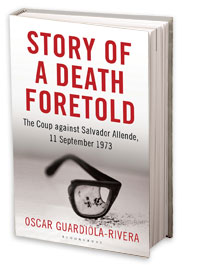
It’s been 40 years since Salvador Allende’s government was taken down in a coup, financed, sponsored and coordinated by the joint British-American clique. And the world is still trying to come to terms with it. There is no division of opinion now, as there was none then. After he committed suicide rather than surrendering to those who organised the coup d’état, President Richard Nixon, a grade one rascal who did not mind if the world considered him a grade one rascal, for once was trying to prove to the media that he was not a crook. In as many words. Such was the moral power of Salvador Allende. Oscar Guardiola-Rivera’s Story of a Death Foretold takes readers to that world of moral power.
The saga started much before Allende became a force to reckon with. After Fascism was defeated in the World War II, communists became the new bogeymen. A jittery and paranoid America was trying real hard not to let its backyard turn into a Commie nursery. It started with the hoisting of General Anastasio Somoza in Nicaragua and in the decades to come, popular, leftist, elected governments in Guatemala, Brazil, Honduras, El Salvador, Peru and Argentina were sabotaged and thrown out under one pretext or other, often followed by series of murders, disappearances and torture of intellectuals, artists and supporters of these leftist regimes.
Since popular leftist movements in these countries used violence as an instrument for resistance, US with its media onslaught was getting desired level of success in convincing the neutral world that it was a battle. After all, FDR himself had once said about Somoza that “He may be a son of a bitch, but he’s our son of a bitch.” If the moral compass of the world’s oldest democracy appeared uncalibrated, nobody gave a damn.
Along came Allende and suddenly that moral compass not merely appeared uncalibrated but deeply flawed too. Allende was a different breed of politician. He did not discard democracy as a valid tool. He was not a rabble-rouser.
“In the process, a new figure of hatred was invented: the silver-tongued intellectual turned enchanter of the masses, ready to unleash the destructive force of their resentment against the hard-working, law-abiding middle and propertied classes at home, while sowing chaos abroad in order to disrupt the natural order among nations. Nothing short of an exorcism, the unleashing of regenerative and purifying counter-revolutionary violence, could cast him out,” writes Guardiola-Rivera.
And yet, he was silently harming the interests of American corporations. When he started nationalizing mines, the corporations lined up outside the White House pleading Nixon to take “action.” And he did.
The book is probably one of the best, and dispassionate, accounts on the life of Allende ever written. It deals with several hitherto unknown aspects of Allende’s life including his love life and love life of his wife. It also gives some interesting anecdotes about Allende and people closer to him. The particular incident where Che Guevara gets a chance to listen to Allende’s speech during his “Motorcycle Diary” trip is particularly fascinating. And so is Allende’s meeting with a rather young Pinochet, when the latter was full of idealism.
What sets this book apart is Guardiola-Rivera’s almost frustrating political neutrality. In fact, he belongs to a generation of Latin American intellectuals who don’t wear their political leanings on their sleeves and try to analyze events on its merit.
But this does not mean that the author has not taken a stand. The US comes out as a criminal state whose involvement in the crime against humanity lays bare. The narrative is at times punctured by moral sermons, but it does not become a regular feature, ever.
Written lucidly, Story of a Death Foretold is one of the most important books to come out in this decade. The experience is bound to leave you stunned.
Author : Oscar Guardiola-Rivera
Publisher : Bloomsbury
EDITION: Hardcover
ISBN: 978-1-4088-3008-6
PAGES: 496
PRICE: Rs 699