The journey is the reward, whether you talk about life or the next weekend getaway you are headed to. And if you are among the aficionados of the 350cc Royal Enfield Bullet (and they have remained a sizeable lot over the past few decades), you may claim to be able to appreciate the sentiment behind this quotable quote more than anyone else.
It’s hardly surprising why, in an era wherein two-wheeler companies are trying hard to woo the fairer sex, the Royal Enfield has maintained a cult following among Indian males. For the uninitiated, the Royal Enfield has a rich history of deployment in military operations globally. The Enfield Cycle Company was, in fact, a weapon manufacturer and their tag line then read, “Made like a gun”. In World War 1, Royal Enfield supplied 6 HP sidecar Outfit motorcycles with Stretchers and a Vickers machine Gun sidecar attachment to the British and Russian monarchies. In 1955, the Indian government placed a huge initial order of 800 350cc motorcycles for police and army patrolling along the nation’s borders. In the more recent past, the brand has been earnestly endeavouring to supersede its old ‘sturdy’ image. However, the high prices of these bikes have kept them confined to a niche category for most of their history in the Indian biking market.
A look at the sales figures in the motorcycle/step-through category in India will illustrate the same. Royal Enfield sold 45,915 units in all for the April-August 2012 period, an impressive growth by 51.53% yoy. However, this pales in comparison to the likes of market leader Hero MotoCorp with sales of 23,12,551 units, Bajaj with sales of 10,14,117 units, Honda Motorcycle & Scooter India with sales of 4,59,882 units, TVS Motor Company with sales of 2,18,287 units and India Yamaha Motor with sales of 1,32,704 units. It is indeed not an apple to apple comparison, considering the price of a typical Royal Enfield product, but it’s quite clear that the bike has performed relatively below par as compared to the potential the brand holds. When they are operating in a two-wheeler dominated market like India, they certainly have struggled to account for a greater share and need to push the envelope; a view that even a company insider would willingly endorse, in all probability.
And this kind of a push cannot come at a better time. Off late, the leisure riding culture is quickly gathering pace in India, which has been epitomized by the changing attitudes of the working class, who have been largely confined to offices, malls, pubs and homes so far. Consequently, the premium two-wheeler segment is rapidly gathering steam. Highways in metropolises like New Delhi, Chandigarh, Chennai, Hyderabad, Mumbai and Bangalore are witnessing a steady growth in the number of professional and leisure bikers, frequently leaving behind their confined abodes and environs. Most professionals view it as a means to release themselves from day to day work pressures of the corporate world and revitalize their lives with leisure biking. A report by Hem Securities makes an interesting comparison in growth rates in various sub-segments of the motorcycle market in 2011 over 2010. While the economy segment (<125cc) registered a growth of 15% yoy, the executive segment (125cc to 249cc) registered a growth by 20% yoy. In contrast, the premium segment (>250cc) registered a phenomenal growth of 71% yoy, albeit from a lower base. With the visibly growing interest in this area, the marketing top brass at Royal Enfield senses an opportunity to take their products mainstream.
Campaigns like ‘The Himalayan Odyssey’, ‘Leave Home’, ‘Tour to Bhutan’, et al have been launched to enhance the brand’s recall and appeal in the minds of its target audience. It is trying to reach the youth, which was illustrated in the ‘Leave Home’ campaign. It encouraged youngsters to leave the comforting confines of their homes and embrace the spirit of adventure and also included a hero theme-based comic strip. The campaign reinforced the attributes of masculinity, thrill and adventure. In fact, these are the most common themes for the bike, which positions it as a bike for the highway and not for the busy city roads.
Other themes have also been explored in the brand communication. For instance, a series of ads emphasise on the legacy of the product, with the theme being, “Handcrafted in Chennai”. One ad talks about how the signature stripes on every Enfield bullet are handcrafted by two brothers Ashok and Jaya Kumar at the Thiruvottiyur workshop in Tamil Nadu. Another highlight how even the typical “dhuk, dhuk, dhuk” (engine sound) that Royal Enfield bikes make is a work of spectacular engineering and years of practice. “Without compromising on the unique characteristics of the brand, offering better performance, efficiency, reliability and easier maintenance for customers is always our focus,” elucidates Shaji Koshi, Senior VP, Sales & Marketing, Royal Enfield. Besides the print and media campaigns, the brand has been quite active on the racing circuit. The recently concluded Royal Enfield Rider Mania 2012 involved a wide range of events, including Slow Racing, Figure of 8, Assembly War, The Raghu Dixit project and Lemon & Spoon race.
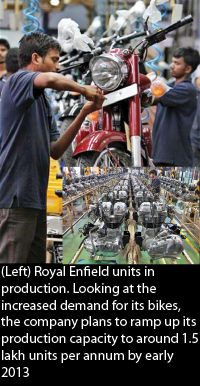
Company officials claim that thanks to the ramp up in new model launches and changing customer preferences, they are now facing a pent up demand that is getting harder to meet. The waiting period for a new Enfield bike currently is anywhere between five to fifteen months. Consequently, the production of this bike, which is also referred to as the “Indian sister of Harley Davidson”, has shot up by nearly 50% in recent years. Moving forward, Royal Enfield’s next milestone – producing 1.5 lakh units per annum – is on the cards. By March 2013, with its new manufacturing facility getting operational in Oragadam near Chennai, the brand plans to roll out 1.5 lakh units annually from its current capacity of 70,000 units per annum and the company plans to invest around Rs.3.5 billion in this facility over the years. The Oragadam facility has the capacity to bring out at least twice that number over time. Year 2013 will see Royal Enfield roll out new models, and Cafe Rider, which made its appearance in Auto Expo 2012, will be the first to be seen on the roads by early next year. Already, the company launched its highway cruiser – the Thunderbird 500 – this year, which is aimed at establishing an unassailable lead in the highway biking space.
While the demand spurt is definitely encouraging, there has to be a consistent effort from the Royal Enfield marketing team to engage the youth more deeply and make them passionate for the brand. Royal Enfield’s Facebook page currently has around 0.24 million likes compared to 4.3 million likes for a Harley Davidson. In fact, this is after branding experts label the Harley Davidson’s digital efforts as relatively mediocre! Moreover, the Royal Enfield page does not have a clear positioning statement. The Harley Davidson page, on the other hand, clearly communicates below the profile photo, “We fulfill dreams inspired by the many roads of the world by providing extraordinary motorcycles & customer experiences.”
The last major hurdle that the company will have to cross in order to have a sustained momentum in India will be towards a good bit of mass marketing. Company officials had mentioned during a previous interaction with 4Ps B&M that they would not embrace mass marketing channels readily and continue to promote their products through niche channels. Like Harley Davidson and the Volkswagen Beetle, Royal Enfield has also embraced content-based marketing, but the effort has to be more consistent and far reaching than it is today. This certainly requires the use of mass media channels and promotion strategies. For instance, Hero and Honda (before they split) got a massive leg up in their brand equity among the youth through their association with MTV Roadies. Today, leisure biking enthusiasts are extremely excited about owning a Royal Enfield. But if the brand does not employ such mass positioning strategies to consolidate its position, competitors (especially those doing an upmarket line stretch) may wrest it from its perch, sooner or later.