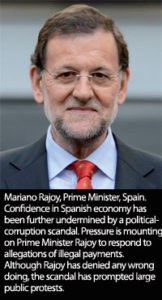
 In recent months, Spain, the largest of the four PIGS (an acronym used by international bond analysts that refers to the faltering economies of Portugal, Ireland, Greece and Spain; the other three have already faltered) has won praise from international financial institutions, including the International Monetary Fund (IMF), for its progress on critical and difficult reforms, particularly to its labour market and banking sector. In fact, according to an index compiled by the Organization for Economic Cooperation and Development (OECD), Spain’s unit labour costs fell below Germany’s last year for the first time since 2005 and are substantially below those in France and Italy. This has made Spanish goods more marketable and kept external demand solid despite a slower world economy.
No doubt, this seems to be a great achievement for the eurozone’s fourth-largest economy which is among the area’s laggards. Still, uncertainty continues to cloud the outlook for the Spanish economy. The reasons are simple. Elevated unemployment, weak business investment, and the government’s fiscal austerity measures continue to crimp domestic demand and in turn weaken the Spanish economy.
Spain’s public finances have been undermined by the deepening recession. Real Spanish GDP contracted 0.5% in Q1 2013 after falling 0.8% in the previous period. Although the pace of contraction eased, the annual decline steepened to 2% in Q1 2013 from 1.9% in the three months to December. In fact, the worsening outlook led the European Union to extend Spain’s deadline for lowering its budget deficit-to-GDP ratio below 3% from 2014 to 2016.
The country’s unemployment rate fell unexpectedly for the first time in two years to 26.3% in the second quarter of 2013, however, this still translates to almost than 6 million people out of work. More than half of all those under age 25 are jobless. In fact, more than two-thirds of the jobs lost in the euro area since 2008 have been in Spain. By comparison, the eurozone’s unemployment rate was 12.1% in May. What’s more? While Moody’s Analytics forecast the jobless rate to climb to 28% in the near future, the Bloomberg Consensus Survey predicts it to touch 27.2%. Even Spain’s public debt was 19% higher in the first quarter of 2013 than a year earlier, reaching 900 billion euro, equal to 88.2% of the country’s GDP (according to the Bank of Spain). At the end of 2012, the debt equaled 84% of GDP. Although Spain’s debt-to-GDP ratio is lower than the eurozone average of 95%, it is expected to reach worrisome levels in coming years.
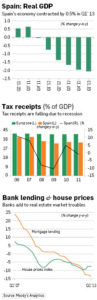 All this certainly calls for swifter implementation of even more comprehensive reforms. Both the IMF and the European Commission also agree that “Spain needs to do much more to overhaul its inefficient tax system and problem-plagued banking sector.” In fact, since May, the European Commission has intensified its monitoring of Spain’s economic policies, calling the government’s pension and tax reforms insufficient. Agrees Anna Zabrodzka, the Prague based Economist at Moody’s Analytics, as she tells B&E, “The Spanish tax system needs deep structural changes to make it more efficient. The main problem is the high government dependence on property-related taxes, which dropped by more than 50 billion euro per year after the housing market bubble burst in 2007. Collections equaled 32.4% of GDP in 2011, down from 38% in 2007 (the eurozone average is 40.8%).” Hence, Spain certainly needs to broaden its tax base, for example by extending its full value-added tax rate to a larger share of goods. Currently the 21% VAT covers only 42% of all goods sold in Spain, compared with 82% in Germany.
Although in June, the Rajoy government had introduced some changes to the tax system, but they fell short of EU recommendations. Taxes on alcohol and tobacco have been increased, but a reduction in property tax rates that was to take place by the end of 2013 was postponed for two years. The government’s plan to increase spending on pro-growth measures starting next year compelled it to raise the ceiling on public expenditure by 2.7% for 2014 to 133 billion euro, which will push the fiscal deficit from 5.5% to 5.8% of GDP. Spanish officials estimate that the plan will accelerate GDP growth by 100 basis points in 2015 and 2016. However, funding additional spending through tax hikes could discourage activity, lowering tax revenues even further despite the higher rates.
A banking sector with pockets of weakness also raises concerns, and the Rajoy government will definitely have to pump more money into the sector to restructure it. In fact, the nation’s financial institutions, as a group, were among the worst performers in the EU’s bank stress tests in 2010 and 2011 (the block’s next round of stress tests has been delayed until 2014). Moreover, as per IMF, by July 15, 2013 Spanish banks had used 41.4 billion euro of the allocated 100 billion euro in bailout funds as of December 2012. The IMF credited Spain’s banks with structural changes and improved solvency, noting that banks must now have up to 10 billion euro in reserves to cover bad loans. Bank of Spain Governor Luis Maria Linde believes Spanish banks have enough resources and do not require further capital injections from the European banking bailout fund.