 These are six legends in the world of entrepreneurship. Muhammad Yunus, Steve Wozniak, Bill Gates, N. R. Narayana Murthy, Jimmy Wales & Richard Branson. For an ordinary investor, buyer or banker living in the Internet age, none of these names require an introduction. Each of their entrepreneurial ventures that began on a rather modest note has today touched lives of millions around the world – whether they be intra-day fanatics, underprivileged farmers, knowledge seekers or buyers of pure technology. These half-a-dozen names have over time, discovered and perfected a formula to play the market. Hyperbole? Perhaps.
But how they have managed – or did so before they passed on the baton to their successors – to master tactical business strategy over the years is a fact that even the market-driven science of momentum investing fails to explain. Here’s the truth – it is often data and not logic that explains their success. For them, lounging on a sofa in their corner office and calling the shots based on popular appeal – amongst those strategy wizards present in the room – is far less important than walking about loudly and shamelessly, rehearsing active leadership traits that they have popularised [especially those that are as irresistible as they are common in the rulebook of leadership!]. And in the ambition to grow their businesses, they have become famous for leadership qualities that reach beyond just their outstanding abilities to charm and win over followers. And it’s not that they haven’t been through horrible periods. How they encountered rocky patches before or when their ventures were in diapers or even when they had grown into decade-plus-old undertakings are interesting tales. What is however most compelling in the entrepreneurial chronicles of these characters – all thanks to their leadership attributes – is how they managed to convert their many or one [destined to fail or failed] schemes into long-term winners.
Some of these hero-worshipped entrepreneurs move with caution and a heavy dose of humility. Others are rambunctious, uncompromising and unapologetic. Some believe in mastering a particular business – a core bread-winning concept. Others invest wherever they sense an idea can bloom. Services industry is what some of them bet on. Products is what others swear by. For some, a publicly-listed entity is the epitome of capitalism. Others hate being tied to the cyclical bourses. A handful of these are big risk takers. Others prefer not to invest in moonshine. Some of them don’t care about appearances – whether it be their necktie-knots or the way their office space appears. Others are careful about ergonomics – even about how insiders react to colours and outsiders to strange shapes that welcomes them on campus. Some think the better market is still America and the slowdown marred eurozone. Others find the oft-hyped Asian markets worth the change in their marketing communication line. Some will haggle over acquisition targets for months and back out at the last second because they just don’t believe that anything other than natural, internal growth is, well, growth. [Of course, their excuse is more media-friendly than their approach to M&As – that the opposite board Chairman welcomed them on a dirty table or sneezed at the wrong moment; anything!] Others will jump at the thought of proving their primary school mathematics teacher wrong [recall the charming ‘1+1=3’ promise of M&As?]. These and many more.
 There are differences in ideologies that drive these celebrated entrepreneurs. Loud and clear. And that is precisely what makes the whole business of creating businesses interesting. There is not one philosophy carved in stone [not yet!] that guarantees success in the game of creating a for-profit (or social) business and generating employment. There is not one strategy that makes any start-up the business of the future. Strategies differ. They should. Remarkably though, there are leadership traits that the world’s finest founders of businesses in the 21st century share. Call it a conservative thought, but the prime characteristics that make these mortals geniuses in this respect, are common amongst their ranks.
Trademark lists are peppered on readers around the world – regularly. Some have companies ranked on a standalone parameter like revenue or net profit, while others rank leaders on the basis of their influence based on media appearances. No list is ideally comprehensive in the complete sense though. We agree. To add, this list of six entrepreneurs (namely, Muhammad Yunus, Steve Wozniak, Bill Gates, N. R. Narayana Murthy, Jimmy Wales & Richard Branson) that we put before you in discussion isn’t complete to represent the league of Cult Entrepreneurs of the 21st century. This list is indicative – of the bigger list to come and the breed of those who will follow, especially when it comes to leadership skills. And in this respect, it is binding on us to mention that though all Cult Entrepreneurs (and leaders) do possess unique ‘strategic leadership’ trump cards, our experience – with CEOs and the various training sessions at leading companies around the world – make it not so difficult for us to list down the superset of ‘common textbook’ leadership characteristics that most successful entrepreneurs around the world possess.
We discuss seven such leadership traits that are found in most entrepreneurs who can be tagged ‘Cult’ and ‘Successful’. [Editor’s note: Most of these seven traits are highly pronounced in all of the six Cult entrepreneurs that are discussed by the co-authors. Due to limitations on the word count front however, it was not possible to discuss all six aforementioned Cult entrepreneurs under each trait.]
 1. Vision In our previous book ‘CULT: Leadership & Business Strategy, Ruthlessly Redefined. The Classic CEO Guide to calling the shots without getting shot (Vikas Publishing, 2011)’, we called Vision “the necessary, obsessive compulsion”. Why? We actually couldn’t think of starting the book with anything that is more important to business. The biggest problem we see today with wannabe entrepreneurs who fall by the wayside once the flame is out, is their lack of vision. Neither have they identified one, nor have they thought of a way to chase that dream. Numbers make our case stronger. Through extensive research, Jim Collins and his research team proved in their book ‘Built to Last’ how “Visionary companies’ gave stock returns that were almost 700% more than companies that couldn’t be called visionary”. But entrepreneurs today are busy framing strategy and forgetting to declare a path that their companies must follow.
Prof. Robert Kaplan of HBS in his July 2011 paper, ‘Looking in the Mirror’, concludes, “When I see a problem with a business or non-profit, it often starts with a lack of clarity about the organisation’s aspirations. When there is not a clearly articulated vision along with a manageable set of key priorities, you may see an organisation where employees are expending their energies in a number of uncoordinated directions.” Another expert on leadership, Prof. Modesto Maidique of HBS writes (in an October 2011 article) how “Builders are legendary leaders who have a grand vision for the future of their organisations.” Many works have proved over the years how vision (a detailed one at that – number-driven and time-oriented) that is spread throughout the organisation, makes a positive difference to any institution and that such a quality is a must for every entrepreneur to have. In his 2013 book ‘Creating an entrepreneurial mindset’, Roger Cowdrey (a famed international business consultant and motivational speaker) writes that of the four most important elements of an entrepreneur’s mindset, the first is ‘Vision’. “For an entrepreneur to be optimistic they need to have a belief in what they wish to achieve and that in turn requires a vision. That vision is one that may well need to be articulated because often entrepreneurs cannot work alone and need support of various kinds,” he documents.
Take the example of Adam Osborne. In all probability, you wouldn’t have even heard his name. Actually, he was an entrepreneur – nothing short of a Silicon Valley legend when he launched the world’s first portable personal computer in 1981. But instead of becoming the Apple or Google of the 1980s, his lack of ‘the right’ vision killed his game. Why? Before having sold a threshold count, he announced a next generation version of the personal computer. That in turn killed his cash cow. What was his faulty vision? To provide upgraded versions of PCs before the logistics company delivered the previous models at the doorsteps of buyers? His venture was dead in less than three years! Brad Keywell, Co-founder of Groupon, in one of his recent articles notes, “Sell your vision, not valuation. Put your idea under a microscope and explain every cell structure. Make people believe in you first, and a fair valuation will follow.
 Vision guides entrepreneurs’ journeys to establishing new ventures (Baum, J. R., & Locke, E. A., 2004. The relationship of entrepreneurial traits, skill, and motivation to subsequent venture growth. Journal of Applied Psychology, 89, pp. 587-598). Given the importance of vision to entrepreneurs, Gupta, MacMillan, and Surie (2004) defined entrepreneurial leadership as “Leadership that creates visionary scenarios that are used to assemble and mobilise a supporting cast of participants who become committed by the vision to the discovery and exploitation of strategic value creation” (Gupta, V., MacMillan, I., & Surie, G., 2004. Entrepreneurial leadership: Developing a cross-cultural construct. Journal of Business Venturing, 19, 241-260).
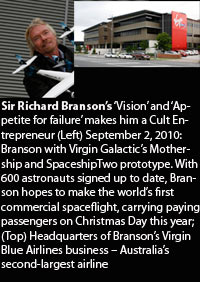
Vision is what got a near-sighted dyslexic, from a (third party) petty initial investment of four pounds to becoming an owner of nearly 450 companies that collectively generated $29 billion in annual revenues last year. He has amassed great wealth ($4.6 billion as of 2012) and now wants to change the future of space travel. Though he was conscious of the fact that he wanted to create the largest business powerhouse in UK to begin with, his vision was to create businesses in every sphere possible – from music to airlines, from healthcare to colas – and make the world feel the power of a diversified brand called ‘Virgin’ whose identity wasn’t limited to one product or service category like a Coke or a Nike! Sir Richard Branson – though he confesses (to B&E) that he still doesn’t know the difference between gross profit and net profits did not let numbers trick him. Secret: his unbelievable appetite to dream real and live his vision!
 While speaking to B&E last, this is what Branson had to say about how critical vision is to an entrepreneur, “It’s important to think about what business really is. People think it’s about balance sheets, profit and loss. But really it’s about creating things – having a vision, creating something extremely special, then getting all the little details right – something that you can be really proud of, and others can be too. The actual business and its financial aspects are something to mop up at the end. If you’ve created something really special then people will come to it, pay for it. If you just call in the accountants, you’ll get one company who predict you’ll make lots of money, and another who say its a ghastly idea. Basically they have no idea. Business cases for new ventures are really not worth the paper they’re written on. It depends on your vision. It’s up to you and your team to create something really special, that people will really want.”
2. Authoritarian leadership Try this – ask a passerby to connect the words ‘Germany’, ‘Powerful’ and ‘Leader’ with a proper noun. You’d get one name – Adolf Hitler, the authoritarian leader, who the world hates (still!; in public) but secretly admires (still, for how he would wield great power; serious!!!). A world where organisational sincerity amongst employees has reached its lowest lows and where there is hardly a mature person in any organisation’s professional ranks who can be given more than an inch of liberty in terms of trust, dictatorial entrepreneurs are the ones who continue to experience maximum success. Supporting this fact with observation and a logic for the need to use the whiplash, Dr Bruce Johnstone of the Cranfield School of Management notes in a March 2012 article titled, ‘Why Are Entrepreneurs Such Authoritarian Leaders?’, “Successful entrepreneurs seem to practice a tough, authoritarian style of leadership, and have unreasonably high expectations of other people. Entrepreneurs need quite different leadership styles. Entrepreneurs are the tough infantry sergeants of the business world, who must lead a small platoon of supporters into dangerous unknown territory. As leaders they need to inspire and persuade other people to support them while they take on these unreasonable risks and challenges. So it is perhaps not surprising that entrepreneurs tend to be rather autocratic leaders.”
 There is no shortage of examples of entrepreneurs who have decided on their “own” and made prosperity the staple term in their companies. Despite more than a year and a half since he left the world, Steve Jobs is still the example to swear by when it comes to an entrepreneur’s totalitarian will! His authoritarian style of leadership and a focus on innovation has kept the clock ticking for Apple Inc. which was until the beginning of this year the most valuable company in the world. Under Jobs, the company’s m-cap grew by more than 11,000% (to touch $342.96 billion; on October 1, 2011) – one of the highest ever recorded under a founder! Many do debate about whether Jobs was really an innovator or whether he really cared about what consumers really wanted. But no one – not even his former employees – argue that he used a tyrannical leadership style to the hilt and forced his employees to deliver what he demanded (and not what market research claimed was the want amongst consumers; according to him, “A lot of times, people [buyers] don’t know what they want until you show it to them!”). During Job’s reign at Apple, American author Andrew Keen wrote in his best-seller titled, ‘The Cult of the Amateur’, “There’s not an ounce of democracy at Apple. That’s what makes it a paragon of such traditional corporate values as top-down leadership, sharply hierarchical organisation and centralised control. It’s Steve’s company – pursuing his vision, at his pace, with his team, making his products. Without Steve Jobs’ authoritarian leadership, Apple would be just another Silicon Valley outfit.”
From Oracle founder Larry Ellison, who has been described as being an autocratic indomitable leader (in one such book titled, ‘The Oracle of Oracles’, by Florence Stone, he has been described as “Ruthless, volatile, arrogant, impatient and autocratic”) to the ultra-modern day entrepreneur Facebook creator Mark Zuckerberg whose iron-clad control over its business has been discussed at large in recent years (one such criticism came from Institutional Shareholder Services, I.S.S., a proxy firm that advises large shareholders of public companies, and California pension fund, California State Teachers’ Retirement System, which has a $145 billion portfolio and owns Facebook shares in 2012 – they called Zuckerberg’s leadership style “autocratic,” and said that such a culture made both shareholder rights and the board powerless!) to the poster boy of Private Equity Steve Schwarzman (he is known for his intolerance for error, impatient behavior, a large ego, and a leader who would treat his employees “like they were deals” changing whatever went wrong almost instantly!) – authoritarian style of leadership is what makes an entrepreneur a box-office hit.
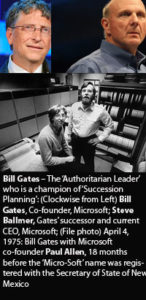
Little it is known but the friendly-faced, burly-yet-gentle-voiced co-founder of Microsoft Bill Gates, is one who also adopted the ‘I-Am-Right’ style of leadership to lead Microsoft to great success. In his own words, he used this style because of the very industry in which he operated where “urgent action” was a daily demand and participative leadership style would only make decision-making slower than needed. Of course, he didn’t rush foolhardily into trying to achieve the impossible. He had a well-crafted and possible-to-achieve vision (“A computer on every desk and Microsoft software on every computer”), and to get errors (that are expected in the business of technology like Microsoft’s) rectified and get the best people on the job to work out of their skins, he needed to use the “Shoot-when-I-command” policy during a large proportion of his hours at office. Studies done by Ohio State and University of Michigan – under the two theories of Initiating Structure/Production Oriented and Consideration/Relationship Oriented styles of leadership – prove that Gates was extremely task-oriented. What is most interesting, Gates applied the autocratic style to people who were higher up in the ranks at Microsoft. Why? Because that way he could minimise the losses and time wasted, and maximise profits, growth and time saved. Moreover, he wanted his upper-level employees to represent his strong and distinct leadership. One expression of Gates’ autocratic leadership style that became obvious even outside Microsoft was his frequent meetings with his researchers that very often led to him altering their teams and regrouping them to sqeeze more out of them (as per a 2012 article, ‘Entrepreneurial Leadership’ by Dr. John Kitoko, Chairman of the USA Africa Chamber of Commerce). So don’t go by his face when you see him all soft and smiling at one of Bill and Melinda Gates Foundation events. He is ‘authoritarianly’ tough from within and while he was at Microsoft, he wasn’t one known to tolerate those with weak backbones!
3. One company, one face Wall Street, Dalal Street and all the money-spinning ‘Streets’ that you can recall are deeply different places from what they were a decade ago. New rules are in, new companies are in. But because investor environment is fast growing less trustworthy, the whole ecosystem has become far less fair and adventurous. As such, the terrible business climate that has become reality after the 2008 meltdown has made equity the more-despised-less-loved instrument. And while you can say that you still like the private sector, the most important question is no longer: “Where do I put my money on?” It is: “Whom do I…?”
Markets up. Markets down. Days when you can trust less a company’s stock or lesser its earnings stability, entrepreneurs and company CEOs should get their face on the cover page of their company promotion! Reason: There are fewer things in the world you trust more than a human. Now more than ever.
Academic research supports this argument. In a year 2008 report titled, ‘The Face of Success…’, Profs. Nicholas O. Rule and Nalini Ambady of Tufts University, conclude after examining the public presence of CEOs of 50 Fortune 1000 companies (top 25 and bottom 25) that, “Participants’ naive perceptions of leadership ability from CEOs’ faces are significantly related to how much profit those CEOs’ companies make. Moreover, these judgments of leadership are not related to judgments of perceived power. CEOs from more versus less successful companies could be distinguished via naive judgments based solely on perceptions of the CEOs’ facial appearance.” Translation: The more an entrepreneur-leader projects himself strongly in public appearances of the corporate brand in question, more will his company earn. Think of the world’s strongest brands, highest topline and bottomline earning corporations… Most of them will have a face to tell a tale. A face that oozes confidence, irrespective of what analysts may forecast for the company.
When you think of Google, you think a Larry Page. When you think of Facebook, a young Zuckerberg comes to mind. Similarly, when you think of a PepsiCo, Apple, Microsoft, Exxon, Dell, Berkshire Hathaway, General Electric, Ford and many other top companies in the world, you get reminded of a glowing face that stands for trust on behalf of the company.
What promted the P&G board to bring back its former CEO A. G. Lafely to replace outgoing CEO Bob McDonald in June this year? The world knows Lafely by face and trusts him that he can save a stagnating stock and topline at the world’s largest consumer goods company.
Why is it that GE under Jack Welch was considered a safer investment option as compared to one under current CEO Jeff Immelt? Even a dozen years after his exit, Welch is a face remembered more than his successor Immelt [Can you clearly recall Immelt’s face without challenging your memory to the slighest extent?].
Why are Apple shareholders getting impatient, selling stocks in panic during regular intervals despite the first dividend in years, thereby causing the Apple stock to dip since 2013 began? Most people still associate Apple products with Jobs and not with Tim Cook. [Repeat the Immelt exercise with Cook.] So the iPhone sold because Jobs said it was good. So did the iPad!
Why was Sony regarded as a technology powerhouse until the early 1990s? Because entrepreneur and co-founder of Sony, Akio Morita was for Sony what Steve Jobs was for Apple! After Morita, there is not one CEO that an ordinary Indian or an American investor would remember as having led Sony! Today, the once-powerhouse of Japan is oft-written as a company in trouble. Not surprising. Is it?
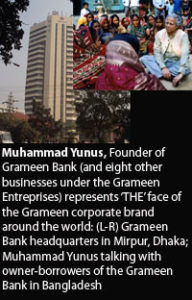
Today, Muhammad Yunus continues to remain the face of Grameen Bank (and most forget that he is no longer the Chairman of the Foundation!). Imagine – in 2006, the Nobel Peace Prize was given to Yunus and Grameen Bank together “for their efforts through microcredit to create economic and social development from below”. Such strong was the association of Yunus with Grameen Bank that even the Nobel Peace Prize Committee (The Norwegian Nobel Committee) had no choice but to bestow honour upon the two inseparable brands – Grameen Bank and Muhammad Yunus.
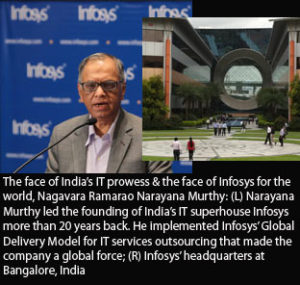
Such is the story of another Cult entrepreneur Nagavara Ramarao Narayana Murthy. Narayana Murthy was one of the seven co-founders of Infosys Limited and served as its CEO from 1981 to 2002 – for 21 years since the company was started. The ‘Global Delivery Model for IT services outsourcing’ that he conceptualised and implemented at Infosys made the company (and India) a force to reckon with in the world of IT services, globally! Today, whenever you think of Infosys, you think of Narayana Murthy’s face – that humble look with a mind of its own – whether it be to honour someone in the IT industry (Murthy was awared the Padma Vibhushan – India’s second highest civilian award – and Padma Shri -India’s fourth highest civilian award – and features in Fortune’s list of 12 greatest entrepreneurs of our time alongside Steve Jobs and Bill Gates) or in times when Infosys needs a revival act after dipping sales and a stagnant stock have seen it fall from glory in the past three years! We end our argument with a question. Why was Murthy brought back as the Executive Chairman of Infosys, more than ten years of having quit the corner office (and two years after he had given up that precise position)? For the same reason why Apple shareholders cheered Jobs’ homecoming in 1996, and why Lafely was given a welcome back hug at P&G last month. Apple minus Jobs, P&G minus Lafely, and Infosys minus Murthy are corporate brands that do possess a portfolio and a name to go with it, but lack a strong identity. Think ‘The Godfather’ minus Marlon Brando!
4. A balanced risk-taking appetite and a believer in gut-feel In a world where patience has become a lost virtue, entrepreneurs have little time to decide before they choose to get the bullet off the gun. CEOs of established businesses can use charts to drive home the message that strategy A is better than B. What about entrepreneurs who don’t have such a liberty? They ought to take bigger risks and go by gut feel. Yet these risks are well-measured. But what’s the measuring rod? We come back to our previous statement. Gut feel!
Whoever says that intuitions [in the world of entrepreneurship] are pure figments of irrational imaginations cannot be farther from the truth. Intuitive decisions have been explained by researchers as an “expertise that has been built up… and influences conscious thought and behaviour” (Sadler-Smith, Eugen and Shefy, Erella, 2004. Academy of Management Executive, Vol. 18 Issue 4, pp.76). The Burson Marsteller CEO Survey, 2006, shows how “no effective CEO is driven solely by numbers.” The survey further proves that 71.4% of high-revenue-company CEOs believe that “intuition and gut feeling” are very influential in guiding their decision making [compared to 54.8% who depend on “analyst reports”]. The PwC Global Data Management Survey 2004 also shows that globally, companies in fact feel low level of confidence in their own data, and “an even greater degree of scepticism over outside data.”
Consider entrepreneurs like Sam Walton, Henry Ford and Bill Gates. What they saw was just a window of an opportunity. They allowed their gut to take control and took that amount of calculated risk.
No one would have trusted Sam Walton’s belief in the 1950s that people would leave the “mom and pop” stores for massive hypermarkets that offered production line items at lower prices. He trusted his gut and started Walmart. [Walton, who later became the world’s richest man, left an estimated $100 billion fortune to his wife and four children when he died.] Gates’ belief that commoners would need access to computers that were simple to use or Ford’s faith in the power of fuel-powered engines would have been disregarded initially. But each of them held on to his intuition. Their ability to trust their gut and follow their intuition led the way for success. HBS Dean Nitin Nohria calls such a “contextual intelligence”. After studying characteristics of 1,000 successful founders and leaders of America Inc., he concluded that such entrepreneurs and leaders are “not super-smart” but “what they had was a deep sense of the context in which they lived.” And “they had a second sense of the future.”
When Muhammad Yunus started out with his idea of a Grameen Bank to lend to the poor [women], he had no proof to show that they had a very low default rate. Even when he later collected proof to back his claim [after his pilot projects in Jabra and Tangali villages worked], bankers in Bangladesh disbelieved him. He asked them to choose five different districts, trusting his gut that his idea of microcredit would work in each district. When the banks still did not believe him, he chose to take another gut-decided plunge – he started his own bank. Today, the risk has paid off. Besides the bank, the Grameen group of enterprises has nine businesses – all of which are not-for-profit, and whose working models are replicated across 100 nations. So trusted has his model of social entrepreneurship become that he has succeeded to attract even private capital to fund his social dreams
5. Succession planning and a belief in Inside-O-Mania! In the Cornell-IIPM Think Tank-B&E joint study on ‘Succession Planning’ (B&E, Issue May 2013), we wrote on how succession planning is a must for every organisation to thrive and on how all-work-play-hardly-ever type, competent Insiders should be preferred over Outsiders to make this HR strategy work. The same applies in the case of every successful entrepreneur, who must like being surrounded by smarter juniors and should fall in complete love with the idea that in time, one of these juniors will replace him/her (instead of falling in love with the idea of holding on to the corner office chair forever, to create a record on someone else’s calendar). Entrepreneurs today should realise that in a world where volatility is the new norm, and China seems to be easing, failing to plan [a successor] is planning to fail [with or without one!]. Think of it – what makes companies like GE, PepsiCo, DuPont, IBM, P&G, Apple, Tata Group, Southwest Airlines, Intel and others of their clan safe investments for the future? Read into their performances during the last downturn and you’d realise that all of them did lose value when markets around the world collapsed. So it isn’t a case of being hugely lucky all the time. Yet investors realise that these companies’ founders, if alive [and founder families] and Boards ensure that arrangements are made not to render the organisations “headless chickens” when it comes to deciding on leadership succession. Forget optimism. This one is a trait found amongst only the breed of steel-hearted entrepreneurs who don’t fear being replaced by an able Insider when the rule of no-nonsense and dead-weight gets applied on them.
A warning here as outlined by a 2011 E&Y report titled, ‘Next Generation Planning’: “Despite succession planning being acknowledged as a high priority issue, many family businesses admit that they have no detailed handover plan in place to maintain the business, find the right person to take the lead.” The work further states that, “For the owner of the company, succession planning is a unique and once-in-a-lifetime process; a suitable plan must be developed and established at an early stage. Various alternatives for leadership need to be considered; including searching within the family circle, amongst existing managers in the company and possibly external candidates.” In short – the world should know the no.2 in your company. Allow us to pass two quick references here. Why does Apple continue to excite buyers of consumer technology around the world? Its late founder Steve Jobs – however hated he might have been for not treating Insiders with respect – was always one who believed that exit he would have to one day and trust he would have to an Insider who understands the Jobs-style of running Apple. His successor Tim Cook (who has been the CEO for over a year-and-a-half now) was groomed under Jobs for over 14 years. Cook joined Apple in 1998 and earned a reputation for living up to Jobs’ demanding, shout-at-will style. The 21 other SVPs at Apple knew that Cook was on the cards for filling Jobs’ shoes since 2008 – 3 years before the world officially saw Cook launch the first product sans Jobs on October 4, 2011 – the iPhone 4S. “I love Apple. And I consider it the privilege of a lifetime to have worked here almost 14 years,” is how Cook opened the launch session. Now isn’t that what all entrepreneurs would like to hear their successors speak on the world stage!
Another example – In P&G’s 180-year old history, the company has had only 12 CEOs – all of them Insiders. This is some sign as to how seriously the company takes Insider succession planning. Right from appointing the first non-family CEO (Richard R. Deupree, who was made the CEO in 1930 by the outgoing President and CEO William Copper Procter, grandson of co-founder William Procter) to the fact that even today, less than 5% of the company’s senior managers are Outsiders (a concept called ‘Proctoid’ at P&G), the culture of succession planning (coupled with the faith in Insiders) that the co-founders had instilled in P&G’s fabric, continues to keep this consumer goods company afloat. Even today, every February there is a board meeting and three candidates are handpicked for each of the top 50 jobs across the company (including that of the CEO and Chairman). This way, at any instance, there are 150 candidates who have either begun training or are almost ready to replace the CEO himself at P&G. And who oversees their training? The CEO, at a training centre less than 100 feet away from his office. This is what A. G. Lafely – the newly re-appointed CEO & Chairman of P&G – had to say when asked about his company’s unbeatable leadership development programme, “If I get on a plane next week and it goes down, there will be somebody in this seat the next morning.”
One of the smoothest transitions in recent history was that of an entrepreneur giving way to an Insider. At Microsoft. Bill Gates engineered his own departure from the company he started at an age (45 years) when most would think of never doing so! Few would dispute Microsoft’s persistent and evolving success. He killed the company’s dependence on him so peacefully (from CEO to Chairman in 2000 and from Chairman and Chief Software Architect to a Non-Executive Chairman in 2008 – his last full-time day at Microsoft was June 27, 2008), that few inside or outside Microsoft miss him. We wouldn’t wish to comment on the quality of the successor he chose, but today the company CEO Steve Ballmer, COO Kevin Turner, Chief Software Architect Ray Ozzie and Chief of Research and Strategy Craig Mundie, more than make up for the absence of the Non-Executive Chairman
6. A winning loser Failure is a known occurrence amongst successful entrepreneurs. That is a bland observation – but a popular one.
Conventional knowledge is that failures happen before success. Milton Hershey, founder of Hershey Chocolate Company, saw his previous businesses go bankrupt thrice before he finally made it big. Henry Ford’s first five start-ups were failures – including The Detroit Automobile Co., that he started in 1899 – before the Ford Motor Company was born in 1904. Walt Disney’s first animation business called Laugh-O-Gram went bankrupt a year after it started and he not only suffered many major financial setbacks in the 1920s and 1930s, but was neck deep in debt before he made it big with ‘Snow White and the Seven Dwarfs’! Coloner Sanders of KFC fame actually had a hard time selling his chicken recipe in the first 20 years – it was rejected 1,009 times before a restaurant accepted it. Most people are familiar with Macy’s department store chain, but few know that its founder H. C. Macy actually had seven failed businesses before his New York City store changed his fortune. Sony’s late founder Akio Morita’s first product – a rice cooker – was a big flop. But he made Sony a household name with his ability to digest failure. And how about Bill Gates (the richest man in the world today)? His first venture with Microsoft co-founder Paul Allen was a failure called Traf-O-Data, a machine that could be used by the State traffic police to keep a record of traffic data! The idea became obsolete when the state of Washington offered to tabulate the tapes for cities for free.
Then there are also examples that teach us why successful entrepreneurs should inculcate a big appetite for failure – for failure can come knocking even after they’ve tasted millions and billions of dollars in success! Take the example of Frederick Smith who revolutionised overnight delivery in the 1970s, His electronic delivery service, Zapmail, that he started in 1984 to compete with fax machines failed and cost him nearly $350 million over two years. And how about Steve Jobs. We mostly remember how Apple’s purchase of NeXT – his second brainchild got him back on board the Cupertino giant. Actually, NeXT, a computer workstation for educators, was a big failure that cost its investors hundreds of millions of dollars and its high pricing and systems bugs never got its sales rolling.
In the past four decades, Richard Branson has started more than 600 standalone companies under the Virgin Group (excluding joint ventures). Of them, only 100 of them are active today. While some people see this as 500-plus failures, for Branson, it is an ongoing challenge to improve his chances of success. This is how he describes his failures: “Some things just don’t work out, but I don’t dwell on them. We probably lost the most money on Virgin Cola. You won’t know what will work ahead of time, you just have to know that as long as you keep challenging yourself, you’ll be at your best. I will work day and night to avoid failure, but if I can’t, I’ll pick myself up the next day. The most important thing for entrepreneurs is not to be put off by failure.” In fact Branson belongs to the latter category of failed-successful-habitual-entrepreneurs. He has seen successes, and failures have followed. And yet, he keeps on trying newer businesses. Virgin Cola, that he introduced in 1994 as Coca-Cola’s rival is practically extinct. Virgin Clothes, that promised new trends in clothing for youngsters, a company that went public in 1996 was shut down when it shareholders could not take more losses. And there are a host of other ventures that only saw his appetite for failure rise – Virgin Money, Virgin Vision, Virgin Vodka, Virgin Wine, Virgin Jeans, Virgin Brides, Virgin Cosmetics and Virgin Cars and many more are some ventures from the Virgin stable that didn’t live long enough. Yet, Branson remains one of the most successful entrepreneur of our times.
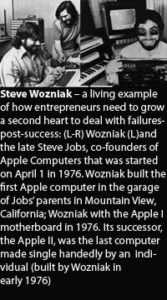
Apple co-founder Steve Wozniak who masterminded the birth of one of the most revolutionary and valuable companies of our times, is someone who you’d associate more with success. But he’s had his good share of failures too. First was his failure to live with outside talent that he and the other Steve had hired at Apple to work on the Macintosh project. He left Apple in 1985 – partly because he despised wealth, more because he didn’t want his invention skills to die. He was truly a wizard in this sense – a habitual entrepreneur who had most respect for innovation and least for what business worked from that invention. [Of course, he had Jobs to worry about the latter part.] But like most habitual entrepreneurs, he wasn’t one to stop facing failures. His immediate venture that followed his Apple exit – Cloud Nine – was a failure. Cloud Nine was into manufacturing programmable remote controls that were designed to work with most devices in the household. But because it didn’t work the way it was supposed to, manufacturers and buyers let the idea remain on paper. The failure was on such a scale that he felt devastated. He wanted to give up on programming. “His failure was so complete that he felt as if his artist-like ability to connect different ideas in his head was gone. He felt that he couldn’t program software anymore,” writes Evan I. Schwartz, in her 2004 book, ‘Juice: The Creative Fuel that Drives World-Class Investors’. For the next fifteen years, Woz imparted lessons on computer graphics to elementary school kids. During this time Woz lost much of the fortune that he had made at Apple. Finally In January 2001, Woz gathered his guts and all that he had learnt over time got back into the game of invention. He started a company called WOZ (Wheels of Zeus) that is into the business of building new wireless products for consumers, corporations and institutions around the world. Started with $6 million in VC funding – today, the company is an example of how a failure-struck Wozniak has risen from dormancy. WOZ is a sign of this habitual entrepreneur capitalizing on all his past failures. But mind you – knowing Wozniak, he will not stop making new mistakes. He doesn’t mind that.
7. Passion We come to the last trait that entrepreneurs are most talked about for – Passion. In a May 2007 official Microsoft research release (‘The Rich Have Money – And Passion’), the Harrison Group, a leading international research firm, showed how 70% of America’s big family fortunes are less than 13 years old (that is, they’re not ‘inherited’) and more importantly that “the people who amassed those fortunes are primarily entrepreneurs – risk takers for whom wealth is a byproduct of pursuing their passion!” In a 2005 HBS paper, Dr. Jonanthan Byrnes (of MIT), after an exhaustive international research, identified “eight essential characteristics” of transformational leaders. The top one was “capacity for passion!” Larry Ellison, founder-owner of Oracle, has always been “putting his money where his passion is.” (as per a BusinessWeek cover story). When once asked about his secret of success, Bill Gates replied, “The five-point master formula of success is: 1. Passion, 2. Intelligence, 3. Integrity, 4. A Good Team, and 5. Leadership.” Entrepreneur Warren Buffet once said, “When you have able managers of high character running businesses about which they are passionate, you can have a dozen reporting to you and still have time for an afternoon nap…” Another success in the field of entrepreneurship Michael Dell says, “Passion should be the fire that drives your life’s work.”
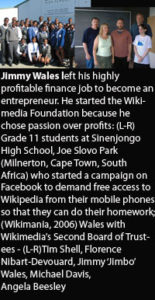
Florida-born Jimmy Wales, founder of Wikimedia Foundation is one individual who you can claim is an entrepreneur who does it for the sake of passion than for the money he can generate from his work. Many say that his work (Wikipedia) isn’t accurate. But such claims only go to show his vast influence. [You have a problem because you read on Wikipedia and think others will read it too!] While talking about his project, Wales tells B&E, “The original vision statement for Wikipedia still sustains me: Imagine a world in which every single person on the planet is given free access to the sum of all human knowledge. I always do the most interesting thing I can find to do.” Many critics have even questioned the sustainability of Wales’ project – but he doesn’t think there is much of a problem there and that his advertising free site can remain that way with donations covering up for the cost. “I see no problems with our revenue model. People have been asking that question for years, and we continue to be more and more successful with it,” he says. It is pure passion that got Wales from making money at speculations on forex and interest rate fluctuations to distributing free knowledge to the world in the form of Nupedia (his former project which is closed now) and Wikipedia (that today has over 100,000 active editors globally, as reported in the FY2010-11 annual report, and received funding of around $23 million that year). It’s pure passion that makes this founder of the world’s 7th largest website (as per Alexa.com; with 30% of its global visitors in US and India combined) bold enough to say “No” to space hungry advertisers. And that is despite being in the business of non-profit for 12 long years! His next passion point is Wikiversity, a project similar to Wikipedia set up by the Wikimedia Foundation. Wikiversity offers structured teaching in various subjects and topics “to foster learning”. With word about this project set to grow, Wales for now is happy about being in the social business of influencing behavioural change than making profits. And if the need arises, he could see a good stake in his Wikipedia website to a willing investor. Wealth follows passion they say. Wales knows it. For those who desire to make a mark in the world of entrepreneurship, it is important to learn that strategies apart, it is the approach to the game of start-ups that makes all Cult entrepreneurs different.
Rolling the dice is not the difficult job – it’s knowing how much money you can afford to lose, when to panic and what attitude suits which moment best that makes a company founder remembered. And most critical is to realise that all contracts that are signed in the spirit of entrepreneurship will not turn high-octane investments in quick time.
Here’s the secret recipe to make a Cult Entrepreneur: Don’t be afraid of avalanches, have the vision and passion to succeed, be an iron-handed leader, measure your risks, follow your gut, and most importantly know when to overcome emotions and embrace retirement or a new ad’venture’ that excites your failure buds.