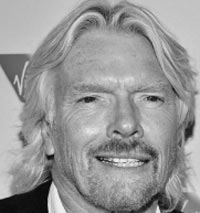
 B&E: You are a celebrated entrepreneur, having been knighted in the year 2000 for your services to entrepreneurship. What prime qualities do you do think an entrepreneur should possess?
Richard Branson (RB): Every entrepreneur, should possess the quality of having a positive attitude in terms of understanding and solving employees problems, meeting their evolving needs on the professional front by communicating with them very often, and being very transparent in terms of explaining them the company’s new ideas of business and policies. It is important to seek their opinion and tell them as to what is expected from them professionally in order to gain a competitive edge. Only then, will an entrepreneur be able to retain employees. It is important to nurture their talent and believe in them. Employees should be considered by any entrepreneur as an asset, and not as a liability. Only then, will a company achieve success and become a leading force in the world of business.
B&E: And how about the focus on employee productivity?
RB: Very important. An entrepreneur should also be able to ensure that employees are able to execute work on time. His should not frantically employ people in bulk and make false promises. Those are wrong moves.
B&E: How do you describe “Sir Branson – the Leader”?
RB: I am a leader who has confidence in himself and passes on that confidence to his employees. A leader should be able to execute future course of action without regretting over what happened in the past. I am a leader who believes in moving in the right direction professionally. And one who is ethical and ready to face competition with integrity. As you would know, I started my first business venture at the age of 16 with a school magazine, and now own nearly 450 companies under the brand name Virgin. From start to end, I have believed in myself as a leader and have ensured that my employees believe in me as a good leader. That is what a entrepreneur-leader should aspire for.
B&E: What lessons have failures taught you as an entrepreneur?
RB: Let me answer that as someone who has a business running in the aviation industry. Being in this industry where everybody is bleeding, one of the biggest lessons I have learned is that one will fail if one doesn’t keep his eyes open to what is happening in the market and if one doesn’t conduct market researches at regular intervals. It is important to know both what consumers want and what the environment is. My failures have taught me to act as per what the environment allows. For instance, owing to the economic slowdown, Virgin Atlantic had withdrawn services from Mumbai in 2009. Owing to many environmental issues like the lack of parking slots in Heathrow etc., other than just the overall economic scenario, then, Virgin Atlantic was in turmoil. But once the environment improved we decided to get back.
B&E: Should every entrepreneur have a high appetite for risk?
RB: An entrepreneur will never be considered one if he has not displayed an appetite for risk-taking. Why? Because then, he will not learn from failures and will fail to experience many-a-challenge and will therefore miss out on gaining true knowledge about how to combat failures and even risks for that matter. At the same time, an entrepreneur is expected to keep tabs on the daily occurrences and changes in the industry where he functions. This is, so that it allows him to minimize risks involved in a future course of action, make higher profits than otherwise and make his company a tough competitor to beat.