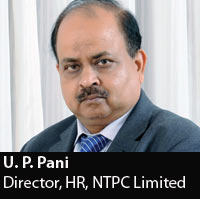
 B&E: Tell us about NTPC’s R&R mechanism?
U. P. Pani (UPP): NTPC, since its inception, has created a culture of reward and recognition by celebrating various achievements and recognising the contributions of employees and teams behind its success. There are reward schemes for individuals and teams excelling in their work right from the stage of project construction to the running of the power station, and at competitions employees can demonstrate their competence and skills. We recognise the contribution of employees’ families by involving them in various events. Employees’ work is appreciated through commendation letters from business unit head, executive directors, or CMD. On occasions, like Republic Day and Independence Day, employees are publicly rewarded for their significant contribution by walking an extra mile in their respective area of operations. The efforts of these special achievers are publicised through newsletters, video magazines, and intranet. The rewards comprise trophy, cash prizes and training programmes of their choice in India and abroad.
B&E: What factors drive your rewards and recognition programme? What is the DNA of your R&R structure?
UPP: We believe in the power of people. It is the professional philosophy of the management to create an enabling organisational culture for people to demonstrate their creativity, initiatives and increase involvement in the company’s holistic development through recognition and celebration of their achievements. Keeping this in mind, a bouquet of special R&R scheme was evolved with the following objectives:
• To recognise and reward employees for enhanced motivation.
• To create a culture of excellence through value actualisation and demonstration of leadership.
• To foster and nurture a culture of celebration and recognition.
• To encourage the overall development of employees.
• To encourage involvement in CSR.
• To promote exhibition of values.
B&E: What factors do you keep in mind while rewarding a leader?
UPP: A leader is the one who has vision and ability and is able to inspire others to articulate the vision by achieving the goals through execution of plans. Factors, like strategic leadership, excellence in innovation and creativity, demonstration of core values, new initiatives taken and being a cultural leader, should be kept in mind while rewarding a leader.
B&E: How important are non-monetary rewards in motivating today’s workforce?
UPP: Money has long been viewed as a reward and motivator. But, research has proved that non-monetary rewards can have more substantial impact on employee satisfaction and motivation than traditional financial rewards. Even well-compensated employees may leave a company if dissatisfied with aspects like work climate, career development and recognition. Companies with excellent non-financial incentive plans can attract, motivate and retain talented people. Companies tend to rely on non-financial rewards when budgetary constraints make it difficult to offer appraisals or other monetary incentives. However, non-financial rewards should be a part of any company’s plan regardless of the economic situation.