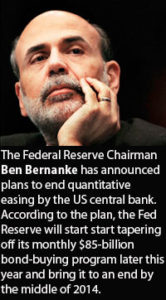
 The suggestion by the Federal Reserve Chairman Ben Bernanke on June 19 that the US central bank will start tapering off its bond-buying programme and bring it to an end by the middle of 2014 sent equity and bond markets roiling around the world and sparking the largest drop for the S&P 500 index since 2011. The Dow shed more than 500 points and bond markets fared no better as the yield on the US benchmark 10-year bond climbed 25 basis points to 2.5% by week’s end. All over the world, investors and money managers went into a collective shock, lamenting they’d been somehow blindsided by the Fed.
However, it would be wrong to blame Bernanke for inappropriately timing the Fed’s decision to turn off the taps. Since cutting interest rates to near zero in late 2008, the central bank has more than tripled its balance sheet to about $3.3 trillion to drive borrowing costs down and spur hiring. These initiatives have paid off with the American economy showing decent signs of recovering: Growth has revived, economic growth has been steady for at least 12 straight quarters, personal debts are coming down, unemployment is 7.6%, down from double digits, inflation is below the Fed target of 2%, even the decimated housing market is on the road to recovery, and the banks are in reasonably strong shape.
But investors fear whether the US economy can continue growing without the central bank’s monthly $85-billion bond-buying program at its back. Also, any rise in US bond yields will inevitably trigger a spike in yields on European bonds. The rise in US bond yields may well plunge both Italy and Spain right back into a full-blown crisis. Even the emerging markets of Asia, Africa, South America and Eastern Europe will see the flight of dollars to the US in search of higher yields. Faced with such challenges the Fed could well find itself on the horns of a dilemma. The US may well be strong enough now for tapering but the rest of the world isn’t.