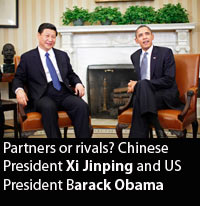
 When two global giants meet to discuss weighty matters and affairs of the world, there is an air of expectation all around. So it was when Chinese President Xi Jinping met US President Barack Obama in the second week of June. It was interesting to see the interactions between China, which is on course to becoming a superpower, and the United States, which has been a superpower for the past 70 years or so.
Many political scientists put a special wager on Sino-American relationship, describing it as the most important political milestone that will shape the trajectory and direction of global politics in the years to come. Many feel that it’s only a matter of time before China pulls up ahead of the US, the same way that Rome and Britain were once eclipsed by Carthage and Germany respectively. With China’s clout growing thick and fast, many are betting that history will once again repeat itself and just like Rome and Britain in the past, the US will give way to a new world order dominated by China.
In the first half of 2011, the Organisation for Economic Co-operation and Development (OECD) projected that the Chinese economy will overtake the US to become the biggest economy in the world by the end of 2016. What was America’s reaction? It accepted the prediction graciously. Even Obama said in a conference that “It is in the United States’ interest that China continues on the path of success, because we believe that a peaceful, stable and prosperous China is not only good for the Chinese but also good for the world and for the United States.”
But despite such sentiments, the ever increasing tensions between the two countries suggest that the reality is far more knotty for the rhetoric to untangle. China’s ever increasing military expenditure remains a key worry for the US. A 2011 report prepared by the International Institute for Strategic Studies anticipated that “if spending trends continue, China will achieve military equality with the United States in 15–20 years.”
The two countries are also locked in a blame game and geo-political friction from time to time. On the one hand, being the largest foreign holder of US public debt, China has voiced its concern on US deficits and fiscal policy. On other hand, the US keeps castigating China continuously by saying that “Beijing cannot continue to shock the conscience of humanity with its violations of fundamental human rights and its policies toward Tibetans and other minority ethnic groups.” The status of the Republic of China (Taiwan) is also a major bone of contention between the two counries and has led to the fraying of relations between them over time.
While the People’s Republic of China (PRC) has continuously threatened to take over Taiwan by force, the US has shown its support to the tiny nation and has exported large amounts of weaponry to Taiwan. There are other differences too. China indirectly blames the US for creating tension in the Asia-Pacific region. A national defence paper brought out by China’s government alluded to the US role in the region by observing that “Some country has strengthened its Asia-Pacific military alliances, expanded its military presence in the region, and frequently makes the situation tenser.”
It was in the backdrop of these long simmering and mounting tensions between the two countries that the meeting between Barack Obama and Xi Jinping was rife with anticipation and expectation. While the world continues to guess on the outcome, Obama reaffirmed after the meeting that “Beijing has understood his ‘blunt’ message that his administration would not tolerate this kind of behaviour.” But if China really becomes a super power and desires to play the role of a “responsible stakeholder” in the international system, will the US make place for China and allow it to become the primary guarantor of peace and stability in the world – a role that the US has been performing for the last seven decades.