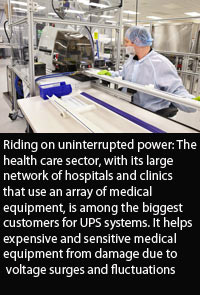
 A well designed power supply system can ensure a high level of reliability for meeting the growing needs of e-commerce, data centres and the ever increasing number of servers, electronic and medical equipment. All of these need a highly reliable power supply, which only a power continuity system can address. But in India, where electric power generation is woefully short of the requirement, and the quality of power leaves much to be desired, the need for a suitable power conditioning system to buffer the equipment from electric utility supply variations and fluctuations is all the more imperative. UPS (Uninterrupted Power Supply) is a power conditioning equipment that allows for a smooth changeover to mains operation on resumption of power. It also takes care of the problems such as brownouts and voltage sags and surges.
Over the years, India has been constantly facing power deficit. According to the statistics of the Central Electricity Authority, power shortfall during 2011-12 was 8.5% with the demand touching 9,37,199 million units and generation lagging at 8,57,886 million units. The country faced a huge power deficit of over 12,000 MW during the peak hours in the last financial year, according to a report by the CEA. Against the peak demand of 1,35,453 MW, total power availability was 1,23,294 MW in the last fiscal, the data showed.
In order to support economic growth and meet the ever growing demand, there is a need to increase primary power supply by 1-4 times, and power generation capacity by 5-6 times. Though the government is taking action to bridge the gap between demand and supply, the demand for power is growing much faster than the government’s ability to increase capacity. As a result of the power deficit, there is a growing demand for alternate or backup power sources, which has created a thriving market for the UPS business in India. According to market intelligence and consultancy firm Frost & Sullivan, the power backup market in India is addressing a 17% power deficit. The cumulative cost of nationwide power outages is a staggering Rs.1,300 billion.
Industry experts broadly classify the UPS market into three segments: Micro UPS segment (up to 3 KVA) largely caters to the SOHO, SME, and corporate sectors for stand-alone PCs, small network stations. The government is also a big customer of this segment. Small-medium UPS segment (3-20 KVA) caters to corporates, institutions, retail outlets, and hypercritical applications such as ISPs, ERP implementers, VSAT, email servers. At the top end, high-end UPS or enterprise segment (20 KVA and above) caters to segments such as Infotech, telecom, datacenters, BPOs, and industrial entities. The smaller systems are sold primarily through channel partners, while large systems are supplied directly to end-users. The small-UPS market (up to 5 KVA) is about 50% of the total market at Rs.9 billion. The medium and large categories are Rs.4.5 billion each in terms of market size. Demand from the information technology & enabled services (ITES) sector – which is growing by 25-30 % year on year – is one of the major drivers of growth for the UPS market, especially in more than 20KVA power range. IT & ITES sector covers 87.4% of the total market share. The non IT segments like manufacturing, electro-medical, banking, telecom, transportation & logistics, security and others cover the rest 12.6% of the market share.
There are close to 350 organised suppliers of UPS systems in India. According to Frost & Sullivan, the top brands hold a 60% share of the market, while the local brands have a 40% share. American Power Conversion, Emerson Network Power, WeP Peripherals and TVS-E are the leading UPS vendors in India. TVS-E, WeP Peripherals and APC have maintained a leading position in the low-end UPS segment whereas it is APC and Emerson Network Power who are the leading players in the high-end UPS market. Emerson, Numeric and APC are the top three players in terms of units sold of high-end UPS whereas APC, Intex and Microtek are the top three players in lower-end UPS. The low-end of the UPS space has a lot of regional and unorganized players catering to a loyal client base consisting mostly of SOHO and SMBs while organized players contribute to the higher end of the segment. In the sub-1 KVA power range, the competition is very severe due to low entry barriers for new suppliers.
The entry of a large number of smaller suppliers in the sub-1 KVA and 1-5 KVA ranges has resulted in increased competition and superior product quality. The top suppliers in this market segment are offering superior products, possess wide sales channels, and offer prompt after sales support. The 5-20 KVA range segment is highly competitive with both Indian as well as MNCs operating in this space. MNCs dominate the ‘more than 50 KVA’ market, where product quality and technology is very important. In India, the UPS market has experienced considerable growth in recent years, owing to a substantial growth in IT infrastructure across different business verticals. Since UPS is a derived market, buying behaviours closely follows the IT buying pattern. The growth is largely being driven by increased IT spends by small and medium businesses, home & SOHO and key industry segments like BFSI, IT services, government and education. With SMBs growing rapidly, a large number of small business units and shops are looking at adopting IT to simplify their day to day functioning, reduce dependence on manual database management, and streamline their accounting processes. The BPO sector, which is now spread across B and C class cities in the country, is also creating a major demand for enterprise-scale UPS systems.
India has a good potential for growth in high-end UPS models. This is due to the fact that Indian enterprises tend to have large single locations for business. Large enterprise customers such as ITeS players want high levels of uptime. The IT infrastructure in these cases is well integrated with UPS and precision air conditioning systems. ITeS players are also ramping up and continuously increasing their head count. Similarly, corporate data centres that are used to house servers from different countries can’t afford even a single minute of downtime. ITeS and corporate data centres are going in for high-end UPS models. Sectors like manufacturing, telecom and the energy sector are also expected to go in for high-end UPS purchases in a big way. Banking and finance is expected to go in for a mix of high- and low-end UPS systems. Indian banks have a large number of branches and ATMs spread across the country. Banks tend to have a large central data centre that requires a high-end UPS model of around 40 KVA capacity. An ATM, on the other hand, can get by with a 2 to 3 KVA UPS system. Since low and medium range UPS systems are used in bulk by the banking, financial services and insurance (BFSI) segment, this will drive both the high- and the low-end UPS market in India.
“With banks focusing on expanding their retail presence and ATM networks, and asset management companies planning to open thousands of franchisees, this market would explode,” says Mark Werle, CEO, Numeric India, who is counting on high growth opportunities in the BFSI segment. Organised retail and retail financing are other areas likely to boost UPS sales going forward. As large retail players like Reliance and Bharti roll out their outlets, there will be a huge demand from this segment. Retailers will need uptime solutions at every point of their value chain such as stores, warehouses, sourcing points etc, which will create a large demand for centralised and branch solutions to emanate from organised retail.
Driven by steady demand from various sectors, the Indian UPS market is expected to witness a CAGR of 13.4% up to 2014. As this sector is crucial for business continuity of the corporate sector, it indicates the tremendous opportunity, the market offers for UPS manufacturers to expand, particularly those who address the commercial and industrial segments. In order to cater to the commercial and industrial applications, price, after sales service, and timely delivery and customisation are the key differentiating factors in the UPS market. With customers’ focus shifting rapidly to end-to-end solutions encompassing power backup solutions, top UPS players are repositioning themselves as complete power backup solutions providers. Vendors are consolidating their offerings and including DC management software, KVM, infrastructure management appliances and power distribution units in a single package. “Green UPS solutions are becoming popular, also because of infrastructure challenges and efficiency is particularly prized in power-starved India,” says Sunil Khanna, President & Managing Director, Emerson Network Power (I) Pvt. Ltd. Most innovations, such as green UPS solutions, are focused on increasing efficiency and saving power and the environment as well. Conventionally, UPS in small offices offer efficiency up to 85%. UPS systems that offer green UPS technology are more sophisticated, come with LCD display and clean sine wave output, and offer efficiency as high as 94% in the sub 10 KVA range. Today, energy efficient UPS systems have become the new industrial mantra. Energy efficiency can be considerably maximised by using modular and scalable UPS systems. As a result, UPS manufacturers are constantly doing R&D work to make the design, software, components and energy storage solutions compatible in such a way as to minimise energy losses. The UPS industry is also advancing toward power quality audits and thermograph surveys. In order to meet end-user preferences on reducing downtime, increasing energy savings and systems efficiency, suppliers are making an effort to incorporate these concerns in their products.
But even though the UPS market is growing at a fast rate, the level of indigenisation of the industry has been slow. The basic technology for manufacture of UPS is available in the country though it is at a medium level. The peculiarity of this industry is that despite availability of technology it is not put to use, because of the lack of an adequate component base. As the component base is almost nonexistent, the industry is heavily dependent on imports for critical electronic components. While Indian manufacturers have the capability to manufacture high frequency UPS, they are constrained due to non-availability of components like power semiconductors and magnetic devices. “The production of such components in India, to international standards should increase, and the government should bring policies that incentivise local production of these components,” says Khanna. In the case of electro mechanical and mechanical components, the gaps in the technical know-how and production expertise in the areas of lower micron engineering and precision toolings, there is lack of standardization, making it difficult to cater to the large variety and small quantity requirements. In recent years, however, large manufacturers such as Emerson have taken to extensive R&D work of their own, and have been able to develop UPS working on low cost indigenous semiconductors, instead of high cost imported components.
However, with customers increasingly seeking a single-point solution for their total power protection needs, UPS suppliers are upgrading themselves to become total power solutions providers. “The UPS industry is advancing towards providing various value-added services such as power quality audit, thermograph survey and remote monitoring services due to the increasing demand from IT/ITeS, manufacturing as well as government and infrastructure end users,” says the Frost & Sullivan report. Going forward, the UPS market will get hotter, with vendors offering a slew of offerings cutting across all segments. While big players will gun for the big enterprise mandates, the entry level will see volumes growth. As far as technology goes, modular and scalable UPS that best address the challenges and demands of flexible capacity enhancements and lowest MTTR (mean time to recovery) will come to dominate the market.
Already, the trend is moving more and more towards compact systems and rack based solutions to minimise the space required. As networks are becoming more complex, far flung and being managed from remote control sites, UPS needs to be equipped with multiple network management protocols and flexible enough to incorporate diagnostics and predictive failure analysis. In the years to come, the UPS market is expected to get more organized, achieve greater standardization of products, and enjoy higher consumer awareness. “The market is being consolidated globally and this is impacting India as well,” says Werle. Indian suppliers will continue to explore for opportunities for collaboration with MNCs by forming joint ventures, and technical or distribution tie-ups to stay ahead in the market. If such a development comes to pass, it would spell a win-win situation for both Indian companies as well as MNCs.