RBI, in its last monetary policy review, had delivered on expected lines and reduced the repo rate by 25 bpS from 7.50% to 7.25%. There were two main considerations behind the stance. First being the recent deceleration in economic activity along with the expectations of gradual and modest economic recovery from here on and the second being the recent moderation in WPI inflation. ICMR, in association with B&E, attempts to find out from industry professionals How successful has the RBI been in striking a balance between inflation control and achieving sustainable growth
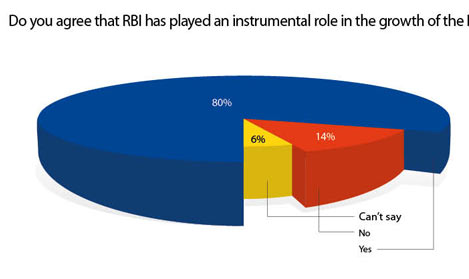
Reserve Bank of India, India’s central banking institution, as per 80% respondents, has succeeded in framing effective policies that have been conducive to growth of the Indian economy, preventing it from slipping into deep slumber – especially during the periods of recession when even the developed economies were gasping for air.
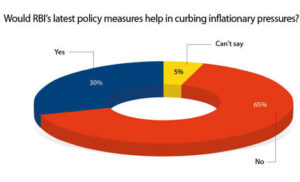 Striking a good balance between the fight against inflation and achieving sustainable growth is a challenge. And India’a apex bank seems to have failed in attaining that balance. 65% respondents feel that RBI’s recent move to reduce the indicative policy rate (repo rate) by 25 basis points from 7.75 to 7.50% will be of little help in curbing the inflationary pressure.
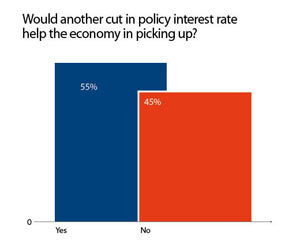 Although experts believe that the RBI would continue with its moderate pace of 25 bps of repo rate cuts at its next policy meeting date on June 17, 2013, common man is still sceptical about its effectiveness. While 55% respondents believe that the RBI should go ahead with another rate cut, 45% respondents feel it will be of no help to the economy.
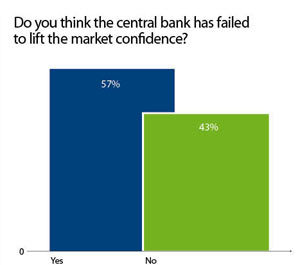 57% respondents feel that the central bank has failed to lift the market confidence. Investors feel the RBI has put the ball in the government’s court to boost growth. Reason: The recent monetary policy action, by itself, cannot revive growth. It needs to be supplemented by efforts towards easing supply-side bottlenecks, and continuing commitment to fiscal consolidation.
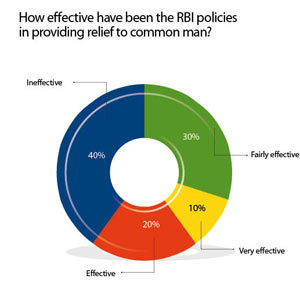 40% respondents feel that the RBI policies have been of no help to the common man. Reason: Inflation has proved too hard to crack. Although the wholesale price index has slightly fallen, the consumer price index is still high, which means the food price pressure is still there.
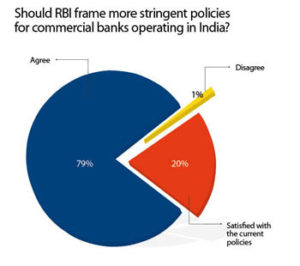 79% respondents feel that the RBI should frame more stringent policies for commercial banks operating in India. Respondents’ belief clearly reflects the concern over debt recasts, already at Rs.2.29 trillion in March and likely to surge further in the context of a sluggish economy.