 It was the third Monday of June last year. For Marissa Mayer – a 13-year veteran at Google – it was a typical day at office. Except that she got a call that afternoon from Spencer Stuart recruiter Jim Citrin. Citrin, who had been asked by the Yahoo! CEO search committee to get them a suitable CEO candidate spoke briefly. “I’m doing a CEO search. It’s a Fortune 500 company. It’s in the consumer Internet space. It’s in Silicon Valley – you wouldn’t even have to move. It’s the perfect job for you. The board is asking for you by name. Are you interested? It’s Yahoo.” The offer got Mayer excited. In part because since Larry Page’s ascent at Google in early 2011, she was missing the position she enjoyed under former CEO Eric Schmidt. After heading the search business at Google for five years as VP of Search Products and User Experience (during which she was credited for not keeping the UI of Google’s homepage so peacefully comforting for users) she was literally demoted and put in charge of its local services, maps, and location services – a move that got her away from the company’s breadwinner-of-a-search business. She was also axed from Google’s operating committee – the CEO’s inner circle – since Page assumed charge as CEO. [Perhaps the fact that during her early days at Google, the two had been dating for three years had Page uncomfortable about Mayer being in the power circle at Google Inc.]
During the call with Citrin, Mayer agreed to meet Yahoo!’s CEO search committee. Three weeks following that meeting, she was interviewed by the board of the company. When asked what she would like to do if she was appointed CEO, she mildly criticised Yahoo!’s products and said she would like to see them become more “innovative and delightful”. That was the 15th day of July last. The following day, she was Yahoo!’s new chief.
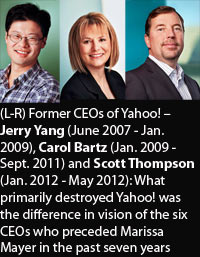
 Mayer, who has followed Yahoo! before it was named so, more than understands the highs and lows that the online company has seen in the past ten years. And she got down to altering the fabric of the organisation as soon as the corner office was given to her. Be it the initiation of streamlining processes and removal of bureaucracy at the company or provision of free food in the cafeteria and smartphones for all employees (strictly, no BlackBerrys!), Mayer is well known for her not-so-rare announcements of trying to make Yahoo! “the absolute best place to work”. But what has mostly caught public eye is the string of acquisitions that this 37 year-old has made. She is impatient about making Yahoo! a pureplay online technology company, a far cry from what former CEOs had turned Yahoo into, with their two decade-long efforts to make the company a confused conglomerate. In the past seven years, the company has seen as many people in charge – Terry Semel, Jerry Yang, Carol Bartz, Tim Morse, Scott Thompson, Ross Levinsohn, and now Marissa Mayer. That obviously did not work well for its shareholders (Yahoo lost 68.1% of its m-cap in the six years that led to Mayer’s hiring), making it a typical proof of “Too many cooks…” Semel focused on media and creating and distributing content. Yang invested in technology centered on users and advertisers. Bartz was a stickler for finance and her strategies were always focused on enhancing profits. While Morse played filler, his successor, Thompson worked to make Yahoo! both a media and a technology company and executed a plan to streamline operations. Levinsohn again, was a temporary officer at the post and in the couple of months at the game, focused on content partnerships. And Mayer? The dozen acquisitions that she has made in the past ten months makes us believe that she is here to emphasise on technology, innovation and product quality. The right thought. Finally
 But despite all the talk of praise about Mayer – the youngest of all Fortune 500 CEOs today – the dream to bring back glory days at the Sunnyvale giant is many-a-boulder-throw away. Yahoo! is valued at just about a quarter of what it was during the summer of 2000 ($95.84 billion). It has lost much goodwill amongst stakeholders. And under such a circumstance, it is not difficult to perceive her impatience as mostly unwanted and her struggle as very ambitious. Take the most expensive deal that Yahoo! made under her in May this year. Tumblr, acquired for a precious $1.1 billion. Let us not judge this deal by the fact that Mayer only “just” got interested in the social blogging site. [She has two posts on her newly created blog site on Tumblr.com.] Or that the all-cash deal only “just” reduced Yahoo!’s cash reserve fuel tank to ‘E’ (the company had ‘Cash and equivalent’ of $1.17 billion as on March 31, 2013). With no monetisation strategy in place (Mayer publicly stated, “We promise not to screw it up.”) and with Yahoo! planning to not change the way Tumblr works or make it a repeat of its GeoCities disaster by integrating ads on Yahoo! pages with that of Tumblr’s blogs, questions are being asked about whether the deal makes sense. Undoubtedly, Tumblr could be a strong strategic fit for Yahoo! if it has to create any impact amongst bloggers in the world. At present, the platform has a unique psychographic insight of its audience. Each member of Tumblr’s audience is active on blogs and expectedly socially networked (therefore providing much room for automatic cross-linkages with platforms that even Yahoo! doesn’t own – how about a blogger posting the link of his Tumblr account on FB?). Because the platform provides for sharing of content on a wide variety of interests and subjects through a dashboard, it makes Tumblr attractive for advertisers who are on the lookout for not just a young audience but groups based on interests.
But here’s the question – is an expensive purchase of a blogging website really an answer to a Facebook or a Twitter? A mobile generation means greater emphasis on shorter blogs. It also means the beginning of the end for blogging sites like Slashdot, Blogger, Digg, TypePad, WordPress, LiveJournal and Tumblr.
The first problem with this buy is therefore the very target. Mayer could have saved some hundreds of millions by investing in revival of its popular but ignored photo site Flickr, in trying to make it more Facebook-like. Or if she wanted to continue ignoring Flickr, she could have chanced her arm at a pre-established social web name like a MySpace or an Orkut. [How Tumblr and Flickr are spelt is startlingly similar! Let’s hope their fates go different ways and the excitement with Tumblr isn’t lost as quickly.] The second problem with Tumblr – payback. At present, Tumblr barely manages some few millions in revenues globally. As per a report by Jefferies LLC, Tumblr generated only $13 millon during FY2012. The valuation is therefore 85x of annual revenues of a loss-making, volatile web property. Over-valued. But there is a solution to making this work, however annoyed Tumblr users get. Tumblr could upload its soon to be created ad inventory onto Yahoo!’s Right Media Exchange (its display advertising marketplace that has more than 300,000 active buyers and sellers, including Yahoo!) and that could be the right start to making money with Tumblr. “Advertising on Tumblr will be akin to what Yahoo has recently introduced for in-stream so as to not affect the user experience. And in specific instances, Yahoo will help to sell ad inventory for content curators/bloggers opting to do so,” says NY-based Credit Suisse Analyst Genna Sankin to B&E.
To be fair, this acquisition does serve a reminder that CEO Marissa Mayer’s goal with Yahoo is to position the company for growth as opposed to just shepherding along the capital markets activities to returning cash to shareholders via repurchases. With Tumblr, Yahoo gains the following: a younger user base to reach about 100 million users, a re-entry into social/content sharing, a bi-lateral distribution with Tumblr adding longer tail content for consumption on Yahoo, and the inverse for Yahoo and its existing partners’ content to Tumblr users, and a greater emphasis on mobile engagement. The larger problem (which outsizes all opportunities however is that) Tumblr’s current business model does not support any big financial goal. And Mayer’s promise that Yahoo! will run Tumblr autonomously in the near-term, makes the question of payback with the asset a tough question to answer. The only outcome guaranteed here is that someone will get hurt. Whether it is the bloggers on Tumblr or Yahoo! itself – time will tell
In order to justify the expensive purchase price (of $1.10 per Yahoo! share), using a 11.5% hurdle rate (an estimate of Yahoo!’s WACC by Jefferies LLC), Yahoo! would need to report an additional PAT of $127 million. Applying Yahoo!’s average net profit margin of 13% (that excludes income from its stakes in the Asian assets), implies that Yahoo! should, at a minimum, generate an additional $976.92 million in advertising revenue annually in order to make this acquisition worthwhile (assuming no additional change in cost base, which is bound to increase with the renewed focus on hiring new talent). Going by revenue estimates, this increased ad revenue does not seem becoming reality with only $198.7 million in additional revenues being forecasted by Credit Suisse between FY2012 and FY2015. To put things straight – with costs increasing, generating an extra EPS of $1.1 appears difficult even in three years from now, as the EPS is only expected to fall from $3.46 in FY2012 to $1.44, $1.55 and $1.71 in FYs 2013-2015. Here is what NY-based Brian Pitz, Managing Director, Equity Research – Internet and Interactive Entertainment, Jefferies LLC, tells B&E, “While the acquisition could be a nice strategic fit for Yahoo!, we are much more concerned about the reported valuation, and believe that a pure content/advertising monetisation model for Tumblr may end up proving hard to justify at the reported price.”
Ten months into her regime, Yahoo! is growing into an image of Mayer – energetic, young and more appealing to consumers. Finally there is juice in the making to be absorbed for investors and users alike. And Mayer is every bit a teenager that she was. In high school, Marissa was an all-rounder. Besides being the first-bencher in class whose hands punched the air every time a question was shot across from the teacher’s table, she was also the captain of the debate team and the pom-pom squad. When she was made the captain of the pom-pom team, other girls (who obviously were of a different nature) could not adjust with her ways. It took Mayer just a week to win them over with her talent, hard work and fairplay. Even today, you see this glimpse of fairness in her work at Yahoo! “Radically transparent” is how she describes her moves at the company – be it ensuring talented people are hired, be it forcing employees to work (which could even mean dragging telecommuters to work each day of the week) or even getting the right person the promotion that he or she deserves. Of course, her HR policies have been criticised by many like Sir Richard Branson and former chief of Yahoo! Carol Bartz, but Mayer does it because she wants to. There are negative implications of her recent HR decisions as Prof. Lakshmi Ramarajan of Harvard Business School, describes, “Mayer’s decision to ask Yahoo! employees to work from offices rather than at home has at least two potentially negative consequences, one for her and one for her employees. Mayer should begin thinking about the organisational fallout from her decision.” [Read the column by Prof. Ramarajan of HBS on page. 46, titled, Marissa Mayer’s ‘Bridge-the-Gap-with-workers’ challenge.] There may be fallouts aplenty of attempting to alter the cultural fabric of a corporation that is largely regarding as one rolling downhill, but if Mayer can force work out of her subordinates and get the acquisitions working for the better of the company, she will quickly find replacements for complaining employees
That Mayer has succeeded in stemming some rot is a fact hardly to ignore. Recently, the company reported good fourth quarter results that ended a good year for the company. Revenues steadied in 2012, following three years of decline. This became possible because the search business, which has been weighing on results in the preceding few years, recorded a small increase in 2012. Improved pricing on the Display side also contributed, although Yahoo still has to work on engagement on its key properties. Yahoo!’s increasing share in the mobile business is an encouraging sign too. And that is despite the company lacking any concrete mobile advertising revenue plan yet. Under Mayer, Yahoo also redesigned its mobile search page across 23 countries resulting in increased usage. The company also launched IntoNow 3.0, a fun way to connect with friends and get more out of TV viewing. In the last few months, the company has made many tuck-in acquisitions in the space with the intention of beefing up its engineering talent.
After years of being a confused media giant, Yahoo! is finally focusing on the basics – as a technology company should. Mayer seems focused on the mail, search and social networking businesses, that have traditionally been Yahoo s strengths. She has been disposing its non-core assets. To this end, Yahoo HotJobs was sold to Monster.com and the Zimbra e-mail service to VMWare. It should also try and get a suitable offer for the Small Business assets. Mayer, besides the expenditures she has incurred for Yahoo! has realigned the firm’s focus on core areas and profit maximisation. Encouragingly, Yahoo’s Asian assets are also now generating some cash. Yahoo recently sold off half its 43% stake in Alibaba for $7.1 billion and if Alibaba goes for an IPO in 2015 as expected, this would be another opportunity for Yahoo to generate some cash. “Yahoo’s divestiture of half its stake in Alibaba has reinstated investor confidence in the new management’s ability to execute its long-term strategy, which remains focused on improving the core business,” says Terry Ruffolo, Director Media Relations/Multimedia Production at Zacks Investment Research to B&E.
There are two areas that Mayer has to focus on. Starting now. Yahoo’s stand in the display ad market is weakening. IDC estimates that Google has already overtaken Yahoo! to take the number one position. Even Facebook has emerged as a strongest player in this format. A threat for Mayer. Especially considering that this format is expected to be the primary driver of online ad spending in the years to come.
Competition in the online advertising segment is also severe. It is obvious that over the years, Google has seen phenomenal growth at the cost of no one but Yahoo!. The Microsoft-Yahoo deal appears to be challenging Google’s domination, as S&P Equity Analyst Scott Kessler tells B&E, “Microsoft powers Yahoo!’s search results and non-premium-related advertising. We think this deal has enabled Yahoo! to focus on and invest in core operations. We also see financial benefits.” But Google’s customer loyalty is strong and the Microsoft-Yahoo combination is not yet bringing desired results.
Yahoo’s video business also needs some push. The video market is growing in leaps and bounds, but Yahoo s efforts appear inadequate, given the limited number of sponsored links on Yahoo video.
The mobile search market, which is developing into one of the fastest growing segments within search is another area that Mayer has to focus on. In some emerging markets, mobile is the only medium through which people connect to the Internet, making it all the more important. Google and Microsoft have shown realisation in this respect. Yahoo! too has to.
Mayer may also have to work on improving efficiencies at Yahoo! And that would mean layoffs by some few hundreds. The company remains overstaffed as compared to industry peers. Compare Yahoo’s revenues per employee ratio of $464,705, to Google’s $935,157 or Facebook’s $3,558,333 or even the much-forgotten AOL’s $512,969 and you get the picture. To begin with, Mayer has to shed 9.41% of headcount if she is to make Yahoo! as productive as the now-nearly defunct AOL, more than half (50.31%) if it wants to get compared to Google, and an impossible 86.94% if Zuckerberg is to get amused. She can start anywhere.
Problem is – Mayer doesn’t have much time. Today, Yahoo! Search, Yahoo! Messenger and Yahoo! Mail are less talked about. Newcomers like Google Mail, Google Search, Facebook and Twitter, with stronger identities have become more popular. What Mayer has to answer is – why is Yahoo! different? Infusion of a strong identity is perhaps where she has to begin with. It would be an unusual for a 20 year-old company to do that but getting Yahoo! up and running is a task that demands such a brand building effort. She has to do this to be able to fish out more advertising dollars from the 700 million users that the company has worldwide.
There are many who opine that Yahoo! still has a long road to tread before a Mayer-like CEO throws in the towel. There are many who don’t feel so comfortable though. One of them is Goldman Sachs analyst Jordan Monahan who tells B&E, “Yahoo! may prove the canary in the media coal mine who first signals a slowdown. We suspect that many advertisers view Yahoo! display as a more discretionary buy than online performance media or offline mass media.”
What is Yahoo!? The day Mayer is able to position it uniquely is the day she would have eclipsed and prevailed over the battery of wannabe saviours Yahoo! has seen in the past. Till then, it’s hard work. It is up to her that an expensive buy like Tumblr does not become another Flickr. And to survive, she has to beat the best in the business. Tough ask.