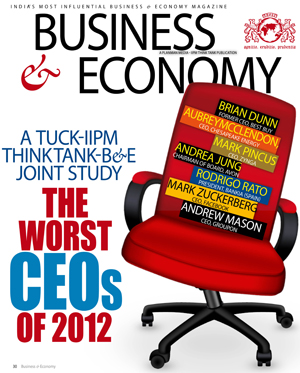
A Tuck-IIPM Think Tank-B&E joint study
Last year in April, Goldman Sachs CEO Lloyd Blankfein was caught in the eye of a storm when nuns of Saint Joseph of Boston, Sisters of Notre Dame de Namur, the Sisters of St Francis of Philadelphia and the Benedictine Sisters of Mt Angel (which are investors in the bank) protested in unison over the payment of $69.5 million to the five most senior executives of Goldman Sachs. This year, shareholder angst over immodest compensations for top management came to the fore most dramatically in the Glencore-Xstrata merger. In May, Xstrata faced shareholder protest over higher executive pay, with 40% not supporting the annual pay report. And when they did approve the $31 billion takeover by Glencore in November, they overwhelmingly disapproved of the proposed “golden handcuffs” retention plan for the company’s senior management, with over 78.88% voting for the option that did not include the same! Of course, Blankfein has been equally unlucky this year too, with one of Goldman Sachs’ ex-employees Greg Smith posting his resignation as an op-ed in the New York Times and publicly deriding the company’s policies and management for a number of reasons. The pay/performance debate is just one key highlight of the kind of scrutiny that CEOs, especially in the US, are under nowadays. But it is not without basis altogether. In 1978, CEOs used to earn around 29 times more than the average employee. Today, if you look at Payscale data on the Fortune 50, the CEO is now earning 231 times more on an average. The ratio ranges from 1737 times for UnitedHealth Group to 10 times for Berkshire Hathaway Inc. Graef Crystal, an expert on pay, attempted to find a correlation between CEO pay and shareholder returns for companies in the S&P 500, and failed to find any! CEOs like Antonio Perez of Eastman Kodak, Henry Meyer III of KeyCorp and Paul Evanson of Allegheny Energy in fact took home more even as shareholder returns came down. Perez, for instance, was among the highest paid, but he was fourth from the bottom in terms of delivering to shareholders.
Understanding the continuing debate on what constitutes good organisational leadership, Tuck School of Business, IIPM Think Tank and B&E present this joint study, which, interestingly, takes a long and hard look on the other side (i.e. the wrong kind of CEOs). Professor Sydney Finkelstein, Associate Dean for Executive Education; Steven Roth Professor of Management at the Tuck School of Business, presents his personally compiled list of the worst CEOs of 2012 and where they lost the plot. Prof. Arindam Chaudhuri, Hony. Director, IIPM Think Tank and Editor-in-Chief, Business & Economy, and Prof. A, Sandeep, Group Editorial Director, Daily Indian Media (co-authors of the bestseller ‘Cult: A CEO’s guide to calling the shots without being shot), follow it up with their perspective on 12 key traits that characterise bad CEOs and need to be considered carefully by organisations of today.