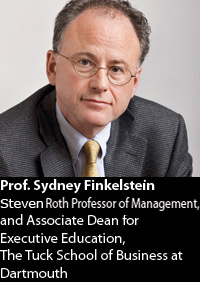
 CEOs today face far greater challenges than just perfecting the art of outperforming bottomline target estimates quarter after quarter. From keeping activist shareholders at bay, to satisfying consumers who demand innovation at the blink of an eye, today’s Chief Executives have their hands full. Not surprisingly, many of these highly-regarded strategists stumble. Prof. Sydney Finkelstein, Steven Roth Professor of Management, Tuck School of Business, writes on why such business leaders fail
2012 has been an eventful year as far as business is concerned. The global economy was stuck somewhere in between managing a full blow financial crisis on one hand and dealing with its after-effects on the other. However, this year did give CEOs an opportunity to reconsider changes that had been impacting their businesses and reinvent in response. And I would say that this is one area where business leaders have faced a great deal of trouble.
For many CEOs, adapting to change – especially dramatic and technological change – is disturbing. Companies like Motorola, Research in Motion and Kodak had to deal with big changes in the recent past mostly due to technological shifts in the economy and their respective industries. What they’d been doing effortlessly in the past stopped working. And unfortunately, they continued doing what made them successful in the first place. Business model innovation is a tricky proposition because even from a psychological point-of-view, it’s difficult to stop doing something for which one has been amply rewarded – and consistently so – in the past. However, the repercussions of not adapting are evident. Motorola was acquired by Google (not for a great line-up of products but more so for the patents), Kodak filed for bankruptcy and Research in Motion is struggling to sustain operations.
Nevertheless, there have been two chief executives in particular who, despite their short tenures, have demonstrated phenomenal leadership and a strong strategic outlook. Marissa Ann Mayer of Yahoo! and Tim Cook of Apple definitely stand out this year.
If you consider Meyer, she’s really given Yahoo!! a shot in the arm. She’s given the company a sense of purpose and if you ask employees and shareholders at Yahoo! today, they’ll tell you that they have much more confidence in the future direction of the company. In recent past, she has proved herself a leader at one of the most successful Internet businesses of our times – Google. And currently, that shows in her understanding of strategy. There is clear consensus now that Yahoo! is a media company – something which previous CEOs could not clearly establish. Further, Meyer has started unlocking some value that lay dormant in Yahoo!’s assets.
On the other hand we have Tim Cook, who has put up a commendable performance at Jobs’ exit. He launched the iPad Mini (despite Steve Jobs’ belief that the market wouldn’t like a small tablet) demonstrating that he is ready to adapt and change. He also had the courage and honesty to accept that Apple Maps was a mess. Some critics have been blaming him for the loss in the stock value of the company. But I don’t see how he’s responsible for any of that. Agreed that Apple didn’t launch a freakishly great product, but the iPhone 5 still sold record units. Apple’s market capitalisation is a case study in itself. To justify such high valuations, you literally need to reinvent the world. And I think Cook has done a fairly decent job till now. He deserves a little more time to demonstrate something even better.
 Similarly, there are some other great CEOs who have been performing phenomenally well despite a weak global economy and dwindling consumer confidence. I think Amazon’s chief Jeff Bezos is an outstanding CEO. He’s been consistent in his outlook and performance for a fairly long time now. Then there’s William R. Johnson, Chairman, President and CEO of Heinz who has put up a pretty impressive performance in recent past.
People ask me what makes a great CEO. One quality I think all these people possess in common is what I call ‘intellectual honesty’. Intellectually honest people face up to the reality of the economy-at-large and their respective industry (remember Tim Cook apologising for Apple Maps and subsequently reintroducing Google Maps on the iPhone?). They are hands-on managers who have a plan to manage both micro and macro-level changes. They are people who are conscious about the fact that they have to work on their organisation’s culture so that they can create exceptional teams of people who are focused on creating great products and services. Plus, they are adaptive and flexible.
There is no doubt that CEOs face a great deal of pressure these days. But I don’t see the financial crisis as an event that triggered this. If we look at the period between 2000 and 2005, there were two great events which led to a dramatic shift in how the world views business. The first one was the Internet bubble and the second was the emergence of ethically disturbing cases like Enron leading to the introduction of the Sarbanes-Oxley Act. That was perhaps a phase which forced corporations to make significant changes from a compliance perspective. But when I look at the post-financial crisis era, I don’t really see much change in terms of regulation. The financial crisis had more to do with the banking industry and specific deregulatory measures as against playing a role in determining how CEOs would run a business going forward. However, this financial meltdown has given business leaders a taste of what it’s like to manage a company in a time when the global economy is in a free fall. I would rather say that CEOs being under pressure has more to do with the rise of shareholder power, institutional investors and corporate raiders like Carl Icahn.
In these contemporary times, a lot of business leaders – especially the ones who made it to this year’s list of ‘Worst CEOs’ – have demonstrated an inability to understand the basics of corporate governance. They have also failed to separate their professional lives from their personal lives. Now, in a publicly listed or for-profit company, the CEO has a fiduciary responsibility to shareholders. As you might be aware, America has had a hugely successful start-up culture. But in order to ensure the continued growth of an enterprise after a certain point of time, the company has to be taken to market. In such cases, the founding CEO continues to own a substantial percentage of the company but that does not give him the ‘ego right’ to run the business as his own private venture. And I’ve been shocked by how many CEOs have gone to the edge of testing out what is legal. They didn’t really do anything illegal, but they came close.
What follows is an objective report of this year’s five worst CEOs and what they did to make it to the list. The case-wise brief analyses of mistakes that follow will give readers some good reasons why ‘Smart CEOs’ fail in these modern times.
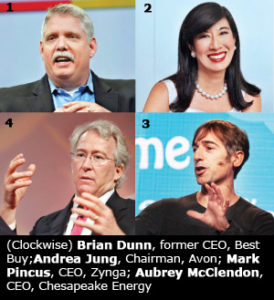
 1. Brian Dunn,
former CEO, Best Buy (resigned April 2012)
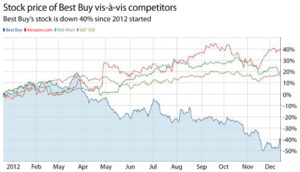
· Stepped down in April after five years of declining stock and losing market share to Amazon.com, Wal-Mart, and Apple. It happened to Circuit City, and now it’s happening to Best Buy. Showroom to buyers is not a defensible retail strategy anymore. · Led the company by deploying a strategy of up-selling and cross-selling instead of improving basic customer service and online offerings. · Allegations of an inappropriate relationship with a 29-year old subordinate later surfaced. · Stock down 50% (year-to-date), same stores sales down, EPS down, and cash down 85%. · Constantly used operation cash to repurchase shares. According to Minyanville (a US-based news website), Best Buy has spent $6.4 billion on share buybacks since 2008. This inflated the valuation of the retailer by $360 million. In essence, Dunn and his associates completely wasted $6.4 billion in cash that Best Buy could have used right now.
2. Aubrey McClendon,
CEO, Chesapeake Energy (Resigned as chairman)
· The CEO of America’s second-largest natural gas producer and champion of hydraulic fracturing has a long history of mingling personal and company finances. Often seen as an aggressive visionary, he was forced to sell all but 1% of his shares in 2008 and since then was allowed to run amuck by Chesapeake’s board. The board stripped Aubrey of his Chairman title, but he remains CEO. The stock is down 20% (year-to-date). · Documents reviewed by The Wall Street Journal show that several major Wall Street banks lent Aubrey money and then received lucrative work as public-offering underwriters or financial advisers to Chesapeake. · Aubrey personally borrowed $500 million from EIG Global Energy Partners, which also had been a large financier for Chesapeake. In securing personal loans from his company’s business associate, McClendon exposed himself to a potential conflict of interest. In effect, he was now bound to serve EIG’s interests in future corporate transactions, potentially at the expense of the best interests of Chesapeake shareholders. · Reuters exposed a $200 million oil and gas hedge fund which McClendon ran at the same time he was CEO of Chesapeake – an obvious conflict of interest. · Despite these disclosures, the actions being taken by the board are opposite of appropriate corporate governance and leadership: Company jets are still being availed for personal use, Chesapeake employees working for McClendon personally too, old friends of McClendon still continue on board. This reminds me of the Rigas family of Adelphia, and other CEOs who couldn’t keep personal and business sides of their lives separate.
 3. Andrea Jung,
Chairman, Avon Products (until Dec 2012; resigned as ceo in april 2012)
· Long string of poor performance – the company continuously missed analyst estimates and the management failed to fix operational problems. · There was no succession plan in place so the board had to hurry and replace Jung with Johnson & Johnson’s Vice-Chairman Sherilyn McCoy. · The company needs someone to handle day-to-day operations but there is no COO since 2006. · Rejected a $10.7 billion aquisition bid from Coty. Avon’s market value has declined from $21 billion in 2004 to $6.4 billion today. · The company has an extremely weak board that enjoyed working with a celebrity CEO. When she resigned as, they kept her as Chairman. And now, when she resigned as Chairman, they’re keeping her back as a senior advisor. Cushy. · The US Justice Department, Securities and Exchange Commission and Avon’s board are looking into possible violations of the Foreign Corrupt Practices Act, which bars bribery of foreign officials to get or keep business. Avon disclosed the probes in October 2011. The company has since spent $93 million investigating the bribery scandal and has by now incurred $300 million already in legal expenses. · At $14.50, the stock is down 18% y-o-y. Q3, 2012 earnings are down 81%. China sales are down 31% and dividend has been cut by 74%.
4. Mark Pincus,
CEO, Zynga
· Zynga’s stock is down 75% (year-to-date). The number of users are going up, but the number of paying customers are declining. · There has been an incredible exodus of top executive talent, always one of the biggest warning signs for impending disasters. · OMGPOP was another incompetent acquisition for almost $200 million (4x revenue). Zynga wrote down 50% of purchase price after 7 months. It is still unclear why it was necessary to buy this company. · The company completely depends on Facebook for revenues (~ 90%). This means that as Facebook changes, Zynga must adapt super-fast. · Pincus unloaded 16 million shares after the IPO lock-up period ended, not a crime to be sure, but a clear signal on what he thought of the company’s prospects.
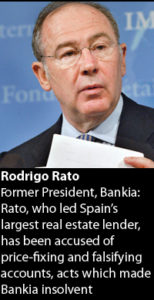
 5. Rodrigo Rato,
former President, Bankia (resigned may 2012)
· The former finance minister and MD of the IMF (2004-2007) is extremely well-connected at the top of Spanish and European political and business circles. He became CEO of Bankia in 2010, and resigned in May 2012. · He promoted the health of Bankia, and sold shares to hundreds of thousands of small investors not long before Bankia was bailed out by Spanish government. · Bankia announced profits of 309 million euros in 2011, but retracted to a 3 billion euro loss after Rato’s resignation. · Rato is now under investigation for fraud.
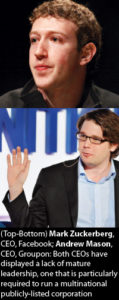
Mark Zuckerberg (Facebook) and Andrew Mason (Groupon) – Two CEOs who Almost Made it to the List · 2012 has not been a good year for both CEOs, with Groupon’s business model in particular under attack. · Facebook stock is down 30% · Groupon stock is down 80% · Groupon has a business model without barriers to entry, but at least Mason keeps experimenting with new products. · Both CEOs are not mature in a traditional sense – how they act (drinking beer during conference calls; wearing the famous hoodie in all sorts of places), and there’s no reason to believe they have the management skills to run a major public company. · Zuckerberg has created a dictatorship, where investors are betting on him without recourse. His massive ego at work is a danger sign for the company.