Cyprus’s recent financial bail-out (and bail-in) has brought the tiny nation under the global spotlight. But for countries like Russia, Israel and Turkey, Cyprus has always been a policy-priority. However, it was not the role of these countries that saved the day for Cyprus. The lifeboat to keep afloat its deadbeat banks and tanking economy came from the Eurozone, albeit after months of hard-knuckled negotiations and not without some prevarication as well. However, this bail-out has extracted a hefty price: the lifeline was thrown by the Eurozone but constituent members like Germany probably had to give away more than they bargained for!
Since the Ottoman conquest of Cyprus in 1571, the island nation has remained geographically important in the Mediterranean. It is a bridging nation between Africa, Europe and Asia. Being strategically located, connecting three continents. By virtue of its geographical location it can control the energy flow to the entire Persian Gulf and the Caspian basin. And having a full-fledged foreign airbase in Cyprus can offer the host nation the leverage to expand its ambit of influence over the entire region, ranging from the Persian Gulf to the Caucasus and the Middle East.
Cyprus also acts as a haven for the world’s rich oligarchs. The nation has gradually morphed into an alluring destination for rich Russians and Asians looking to park their money abroad. Given the fact that the tax rate in Cyprus is lower compared with the rich nations in its vicinity, it attracts corporates from across the region looking out for low tax rates and flexible banking laws.
Cyprus’s liberal banking sector acts as a low-tax haven for moneybags in the region. A low tax rate of 10% is like a freebie for Russians (who pay nothing less than 15%) and for French (who are taxed at 75%). This bonanza has been a particularly terrific bait for Russians who account for 30-40% of the entire Cypriot banking sector, which is valued to be more than $30 billion – far more the nation’s GDP of 18 billion euros! However, Cyprus has a few others for company as far as the region’s banking sector is concerned.
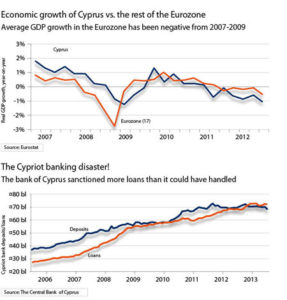 Neighbour Luxembourg is another tax-haven with banking assets that are 22 times its GDP. Still, Luxembourg’s banks are far healthier than those of Cyprus, which were overexposed to Greece. Cyprus is also far more amenable in its banking regulation and in granting citizenship to foreign nattionals. Over the years it has been awarding citizenship to Russian businessmen, including controversial names like Alexander Abramov. What makes Cyprus a particularly attractive destination for wealthy foreigners is the fact that it levies no tax on capital gains or trading profits from the disposal of shares and other titles. Also, no withholding taxes are levied on repatriation of profits in the form of interest, dividend and royalty payments abroad.
All this has made Cyprus a chief source of foreign direct investment for many nations, including Russia. But lax laws have also encouraged money laundering and associated activities like arms trade by Russia and other nations in the region. In recent years, Cyprus has become a funnel for arms flow into the conflict zones. As a nation connecting three continents, Cyprus is the only country that makes it possible for arms traders of the East to push their weapons into Africa or the Middle-East without much hassle. Last year, the Cyprus government allowed a ship full of arms and munitions (for the Assad regime in Syria) to dock at the Syrian port, thus enabling supplies to the infamous Syrian government for use against the locals.
The recent bail-out of Cyprus will force some of its banks to close and lead to an eventual dilution in the value of cash stacked by Russian billionaires in Cypriot banks. In an attempt to prevent the devaluation of its bank savings in Cyprus, Russia (before the final bail-out offer by the Eurozone) offered Cyprus a loan of 2.5 billion euros at an interest rate of 4.5% and at terms that were highly attractive. But by then Cyprus’s hands were tied as a financial Armageddon looked inevitable. To protect its citizens from a crippling ‘hair-cut’, Cyprus decided to accept EU’s offer even at the risk of souring its ties with Russia.
The Eurozone, which relies heavily on Russia for its energy needs picked up the gumption to scuttle a possible deal between Cyprus and Russia, thanks to the recent discovery of 120 trillion cubic feet of gas in the Levant Basin, a geological structure that straddles the territorial waters of Cyprus, Israel, the Palestinian Territories, Lebanon, and Syria. The gas find has the potential to be game-changing for the East Mediterranean region, which have been hitherto net energy importers. But now these countries face the prospect of long-term energy self-sufficiency, which has provided the confidence to stand up to the Russian influence in the region. The energy needs of the European Union can now be easily met by transferring gas via undersea pipeline directly to Europe.
However, for this to happen, the EU needs to keep Israel contented and happy. Israel has also been eying Cyprus since long and in past had also shown interest of having an airbase there. This gas discovery, in the backdrop of the recent bail-out, would allow Israel to wield its influence in the EU and exert pressure on Cyprus for allowing Israeli operations in the island nation. Israel would thus be able to not only control the energy supplies but would also get a strategically located airbase in the region, which would give it immense clout and geo-political leverage in the entire Middle-East and Africa.
But to think that Cyprus’s woes and worries are now a thing of the past would be a fallacy. The huge reserve of oil and gas in its backyard makes it a most coveted nation in the region. However, given its weak government and fragile economy, there are several minefields that this state can get trapped into. In order to avert those risks Cyprus will need to manage its resource assets deftly lest it ends up becoming a second-time victim in the hands of buccaneers out to make a “resource” killing.