 The Indian automobile industry is facing one of its toughest periods in over a decade. In the period between April 2012 and February 2013, the industry registered a negative growth of -4.64% in the passenger cars segment. Sales of small and medium automobile segments are slacking off, which is in sharp contrast to the scorching pace of growth witnessed till a couple of years ago. Between 2005-06 and 2010-11, passenger car sales blazed at 15.2% per annum. That fell to 4.7% in 2011-12, before languishing this past financial year.
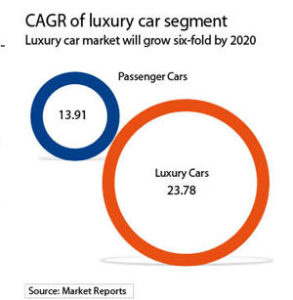
The only silver lining has been the luxury end of the car market, which has been an exception to this anaemic trend. While the overall passenger vehicle industry has grown at a CAGR of 19.04% in the past four years, and the luxury vehicle segment has grown at a CAGR of 32.02% during the same period. Currently, of total car sales of 2.5 million, the luxury segment contributes only 1.2%. But the segment has been growing steadily over the past couple of years and is expected to contribute 4% of the total car sales in the next eight years. Industry experts believe that demand for luxury cars will rise to at least 50,000 vehicles by 2015, from 25,000 units sold in 2012. India’s rising numbers of millionaires and well-heeled young professionals are driving sales of luxury and super luxury vehicles.
According to a study conducted by CLSA Asia-Pacific Markets, the number of millionaires in India are projected to grow twice their current size to 403,000 by 2015. Among them many would be from highly paid professional classes and these upwardly mobile young executives are more than willing to splurge on aspirational products like luxury cars. “As compared to the mass segment buyers who are most affected by the macroeconomic conditions, the rich and affluent class is not affected by factors such as rise in interest rates, increasing price of fuel and inflation. They are cash-rich and can readily buy the car of thier choice,” says Kumar Kandaswami, Senior Director, Deloitte India.
 So even though the economy continues to stutter, decades of growth has spawned a new upper class with global tastes and aspirations that is driving the luxury car market expanding at 40% annually, say industry analysts and research firms. According to a Confederation of Indian Industry-AT Kearney report, India’s luxury market was worth $5.8 billion in 2011 and is expected to treble by 2015. A recent survey done by Frost & Sullivan says that “The Indian luxury car market will grow by six-fold by 2020”. According to the survey, the luxury car market is expected to record 300,000 units per year in sales by the end of this decade. “If we talk about the next decade, i.e. from 2013-2023, India would be a market for luxury cars. Growth seems to be the fastest in this segment, says Abdul Majeed, National Automotive Leader at PricewaterhouseCoopers.
Mercedes-Benz, which came to India in 1994, was the largest seller of luxury cars in India till a couple of years ago when fellow German rival, BMW, beat the company to the numero uno position in 2009. That year, Mercedes recorded 3,202 units in sales whereas BMW sold a good 3,587 units, topping the sales chart. Audi, which was then just making its presence felt in the Indian market, registered 58% of whopping yoy growth in 2009, selling 1,987 units. Since 2009, the competition has gotten more intense and scalding hot. The German players have been at each other’s throat, straining their muscles to outperform in the competitive luxury car market, which has grown thicker with the entry of newer players like Volvo and Jaguar Land Rover.
On one hand we have the entry level luxury brands like BMW, Audi, Mercedes and Volvo; on the other hand there are the mid-level luxury brands like Jaguar and Land Rover (starting from about Rs.5 million) and then there are the ultra-luxe brands, some of the biggest names in the sports car and super luxury segment, like Bentley, Lamborghini, Rolls Royce, Ferrari, Aston Martin, Maserati and Bugatti. The arrival of these big guns in the Indian market over the past two years has further redefined and segmented the luxury car market: So we now have the entry-level, mid-level, super luxury, sports cars and SUVs. Another key trend in this luxury space is the sudden upsurge in the entry level cars starting as low as Rs.2.2 million.
 The trend was kicked off with BMW launching its X1 SUV model and lowering the entry level of its luxury cars to about Rs. 2.2 million (ex-showroom). The idea is to generate volumes and so players like BMW are launching new products in the affordable luxury segment, where the demand actually is. In the process, the traditional luxury segment has now morphed into the premium category with most luxury car makers moving towards affordable luxury. In order to vroom ahead in this new “affordable luxury” category, BMW has introduced its sub-brand Mini Cooper, which it introduced at last year’s auto show in Delhi. It is planning to launch three models of this sub-brand in India – Mini Cooper, Mini Cooper convertible and Countryman, priced aggressively between Rs.2.49 million to Rs.3.19 million. Rivals Audi and Mercedes have also taken steps to create excitement in the entry level luxury segment. Last year saw Audi introduce its Q3 model (priced at Rs.2.67 million) while Mercedes has launched its B-class priced competitively at Rs. 2.10 million, which competes with BMW X1 (priced at Rs.2.24 million).
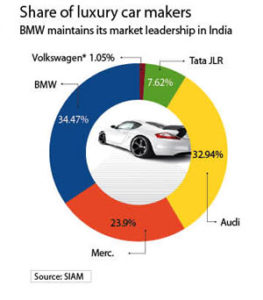
BMW is conscious of the fact that Audi has been fast closing on its lead in the luxury car market. Last year Audi India and BMW India came nail-bitingly close in terms of sales figures. While BMW sold 9,375 cars, Audi sold 9,003 cars and Mercedes Benz came third by selling 7,138 cars in India for 2012. BMW India sales grew by just 4 units, Audi India sales grew by 3,492 units, while that of Mercedes Benz India declined by 292 units. So, in terms of percentage, for 2012, BMW sales grew by 0.04%, Audi sales went up by 63%, while that of Mercedes Benz declined by 3.9% in India. In 2011, BMW sold 9,371 cars, Mercedes Benz sold 7,430 cars, and Audi sold 5,511 cars in India. Currently, BMW is at the top in the luxury car market with a 34.48% share, followed by the Volkswagen luxury sub-brand Audi with 33.95%, while Mercedes accounts for 23.90% market share.
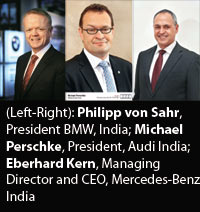
 As the churn in the luxury car market gets thicker, players are pulling out all the tricks to stay ahead in the competition by creating new segments and looking for new markets to generate demand. “As we move into the future, we are well positioned with a forward-looking strategy, progressive roadmap along with an exciting and emotional portfolio to tap the available market opportunities,” says Philipp Von Sahr, President, BMW Group, India. So, BMW is tapping the market for commercial use of luxury cars such as premium hotels and cab owners and has gone for selling the stripped versions of its traditional luxury cars to generate incremental demand.
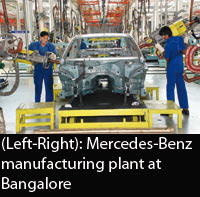
Likewise, Audi is contemplating to launch several initiatives on the product front this year. It plans to assemble the entry level Q3 SUV, which is giving good competition to the BMW X1, in India by the second quarter of this year. The price of Audi Q3, which starts from Rs.2.6 million, is expected to come down further once Audi starts assembling the Q3 in India. The car maker at present assembles sedan A4, A6 and SUV Q5, Q7 in India. Even, Mercedes has plans for expanding its product portfolio. “We would be launching one or two products, starting this year, with a B-class launch. And soon we would be launching an A-class product as well. Secondly, we are investing heavily on production at our factories. We want to make our CKD (complete knocked down) units because it take two to three years to get the CKD portfolio ready,” says Debashis Mitra, who was Director, Sales & Marketing, Mercedes India, before quitting just a few days ago.
Clearly, all the players are currently busy experimenting with new ways to gain purchase and advantage in the market. As economic growth increases the pool of potential customers for luxury cars, car makers who figure out how best to cater to the increasingly demanding tastes of their target consumers – by expanding their model range, bringing in relatively cheaper lower end luxury models, and investing in building their networks of showrooms and after-sales service centres, will stand to reap rich dividends.