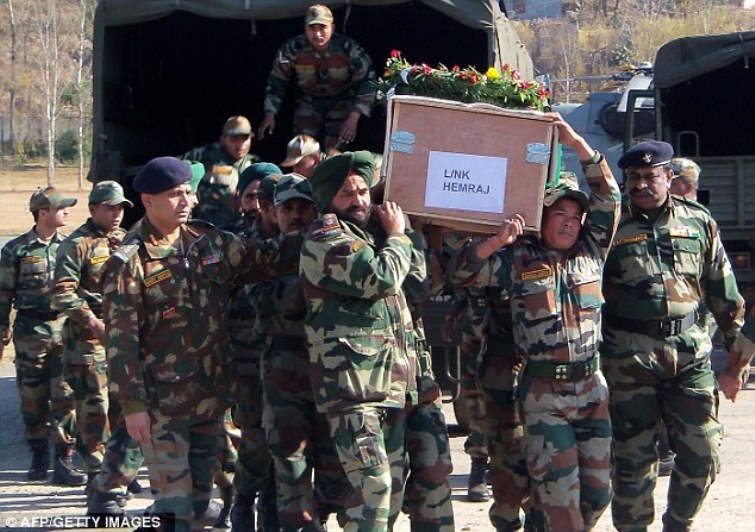
In retrospect, Pakistan Interior Minister Rehman Malik’s recent trip to New Delhi now seems like a distant little joke. All his ridiculous utterances paled into insignificance after the decapitation of two Indian soldiers on the Line of Control (LoC) by Pakistani Army regulars along with their terror cohorts, the globally banned Laishkar e Toiba (LeT), on January 8.
In one stroke, all the good work done by diplomats, Track Two specialists, peaceniks, cultural exchange wallahs, sporting icons and the mass of common people was undone. A process which had gathered momentum as never before with the most people-to-people contacts on a sustained basis since 1947, certainly got someone’s goat. Not too difficult to guess who it was though, as India pointed its finger at the Pakistani Army – after all who resides in the LoC?
The killings sent shock waves of anger as gory details emerged, prompted by a belligerent opposition demanding heads in return and shrill TV anchors equally vocal on asking questions on behalf of the ‘nation’.
The impact was immediate – and visible. Pakistani hockey players who were in India to play in the Indian Hockey League were packed off home, a liberal visa regime for Pakistani elders was stopped hours before it was to be launched at the Wagah border, a visiting women’s cricket team from Pakistan looked all set to return and the many weekend parties and dos meant to showcase this newly-found Indo-Pak bonhomie in Delhi, Mumbai, Hyderabad and other places came crashing down like a pack of cards.
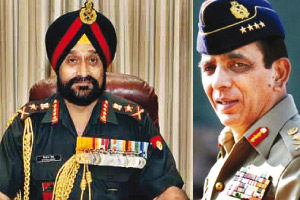 While Opposition ranted and railed, the Indian Army let it be known that a counter-hit would take place at “a day and time of their choosing.” Army Chief General Bikram Singh exhorted his army commanders to hit the enemy hard and not be ‘timid’ while placing their shots.
For some, the latest rocketing of tensions and its unpredictable outcome in the days to come is a worthy end to Prime Minister Manmohan Singh’s affair with Sharm-el-Sheikh, where India made undue ‘concessions’ to Pakistan in the desert expanse. Says BJP’s Arun Jaitley, “The major lapse at Sharm-el-Sheikh was to delink action on terrorism from the Composite Dialogue Process. This can be considered a huge set back for India and I hope that the current development will be an eye opener for the UPA government.”
The incident confirmed how tenuous the peace is between the two south Asian neighbours. For those in Rawalpindi – the Pakistani Army’s headquarters – who see peace between the two countries as anathema, it does not take much to undo years of hard work, back-channel diplomacy and intricate labour; a beheading like this is all that it takes to snuff out the peace pipe without breaking a sweat.
The Indian government has so far reacted soberly, even though Western diplomats based in Delhi attach much importance to the statement of Prime Minister Manmohan Singh who said that post the Mendhar killings, “it could not be business as usual” between the two countries. That, ironically, was signal enough for the others to follow suit with even the BJP saying the “PM has sensed the public mood.”
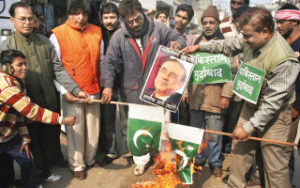 But even in this wave of chest-thumping jingoism, there are those who want to know whether a horrible killing as the one that took place on the LoC in Jammu and Kashmir’s Mendhar area, is provocation enough to scuttle years of peace making, just when things are beginning to look on course? Columnist and Congress leader Mani Shankar, an avowed peacenik, believes New Delhi must not get carried by shrill rhetoric at home and the best way forward is to keep the dialogue process on course. “The mindset in Pakistan is changing but India’s hawks still have not got it,” Aiyar wrote in an edit page piece in the Indian Express on Wednesday.
What has raised India’s hackles is Pakistan’s complete denial, not very different from its position on the November 2008 attack in Mumbai except that then there was Ajmal Kasab as a prize evidence. At a Brigadier-level meeting at the Chhakan da Bagh crossing at the LoC, the Pakistani side which came in declined to get into specifics: their team leader, a Brigadier, just read out from a prepared text which denied any Pakistani complicity in the beheading. Period.
The response from Islamabad too has been one of total denial. Some say it would be unrealistic to expect them to do otherwise, given their own surmounting problems, not the least being the defilement of Pakistani sovereignty by the Americans who came in to pick up and kill Osama bin Laden. With pressure obviously mounting on its western front, what with drone attacks continuing unabated, the idea to shift focus on its eastern front with India, appears quite tempting. Pakistanis know by experience that as far as the Americans are concerned, two nuclear powers, hostile to each other, sitting astride a 700-kilometre LoC, would be a bait that could make them ease pressures on Pakistan’s western border. Maybe, they are correct.
Despite the noise and heat of the moment, there are saner elements who believe that Pakistan is finally getting its act together and is in the process of seeing its first democratically-elected government complete a five-year term, a rarity in its six-decade-old existence where the army has traditionally called the shots in national politics and has acted as an overbearing mentor in Islamabad’s ties with New Delhi.
The mood in India is at the moment a little volatile. Politicians at one level cannot afford to ignore popular will and many hope that such a situation – despite the intense provocation – will not act as a catalyst to war mongering. Congress scion Rahul Gandhi, on a periodic trip to his constituency Amethi in Uttar Pradesh, was repeatedly asked when India would back more heads from Pakistan. Akhilesh Yadav, the UP chief minister and a man not given to talking on foreign affairs, vowed war against Pakistan as a panacea to all of India’s security ills. Naturally, elected leaders are shrewd enough to sense public hostility and it is going to take a very sane political head to put things on course. But whether all of this is going to take the relatively smooth on going peace process between the two countries back on track is something no one can predict at the moment. For the time being, most of them are concerned about keeping peace in south Asia as a first step towards returning to the path again.