
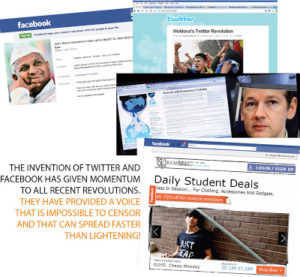
While it’s true that Twitter and Facebook are very important tools to spread information, the fact is, real change requires something more. It requires a true leader, who inspires a feeling of camaraderie, of brotherhood. It’s not just a voice, but a voice filled with passion. A true revolution is not about just the number of virtual “friends” who support you, but about those real people who are ready to die for you; it’s not about the number of “media tools” one has, but about the real ‘cause’ you stand for. As Malcolm Gladwell said, “Social media alone cannot provide what social change has always required.” Yes, it gives a voice to the powerless, but a voice needs a face, the face of a leader, who has the power to attract ‘real’ followers. The ‘Like’ button is a strong indicator of your potential, but for a revolution to reach its full potential, the ‘virtual’ voice needs to be backed by a ‘real’ one too. A great leader of tomorrow will be one who will have the maximum ‘Likes’ and “followers”, both in the virtual and the real world. Both grounds will be equally important .That will be the way to change tomorrow’s world.
VIRTUALLY POWERFUL
The ‘virtual world’ has a lot of potential and one person who exploited it best is Julian Assange. It’s not just the nuclear radiation leaks that have the power to destroy the world – rather more potent has been Wikileaks for that has caused more destruction; and that too in the right places. Assange found ways of channeling information from the ‘virtual’ spaces into the hands of the common man and woke him up from his slumber. When Assange started publishing the secret cables in Al-Akhbar, the Lebanese newspaper, did the common man realize how his leaders were cheating him. The revolution started from the average man and that’s how people could finally overthrow the government.
The ‘Virtual World’ has a lot of potential and a great leader can use it intelligently to change the world. An intelligent marketer can use it to get the cash registers jingling and change the very rules of business!
FACEBOOK SHOPS
Last year, two students of Wharton launched a site named ‘Kembrel’, which was a private shopping community for just college students. The site partnered with a few well-known lifestyle brands to offer deep discounts on goods for a limited window of time. The catch was, this was a private store which students could access entirely through Facebook – a place they anyway spent a lot of time on!
Facebook commerce is the new buzzword. Retailers are exploring Facebook as a revenue channel like never before. Bulgari, the high end fashion label, has developed jewellery lines, leather goods, and perfumes which are priced right for its Facebook audience, who may hesitate to enter its store in Fifth Avenue, New York; these very consumers can access the brand in the comfort of their Facebook world. This year, FCUK [French Connection] and Dove also opened shops on Facebook, enabling their followers to buy their products directly from the page. P&G had already tasted success when it launched its Max-Factor brand on Facebook last year. Again, last year, Tesco Clothing generated £2 mn in sales as a result of their UK Facebook page. Using vouchers, it tracked its activity on Facebook and found out that its campaign “Friday Frenzy” resulted in more sales in two hours, than it would usually get in a week.
Facebook is inarguably becoming a lucrative place for marketers. Oscar de la Renta launched his first fragrance in 10 years on Facebook. All the people who ‘Liked’ the brand’s page got a free sample. Indian designer Arjun Khanna saw his Facebook page grow so much in popularity that he opened his store in Goa. 3M came up with an innovative product to rejuvenate its Scotch Tape brand. It launched a Scotch Shoe, a tape dispenser that looked like a lady’s shoe. The launch happened only through Facebook, for that was the place where its consumers were.
According to Booz & Company, the value of goods sold through social media may rise six-fold by 2015 to reach $30 billion. In the future, many product sales/launches would happen on Facebook. It’s time for companies to seriously start working on getting more ‘Likes’ and simultaneously thinking of ways of converting the ‘Likes’ on their Facebook fan page into ‘Buys’.
The future seems to be all about ‘Likes’. The power will lie in the hands of the people who will use the ‘Like’ button to give their vote. The one with maximum ‘Likes’, be it an individual or a brand, is the one who will wield the maximum power; for that’s going to be the way to judge the potential of an idea or a brand.
As future leaders, let’s start thinking of ways of making the most of the ‘Like’ button.